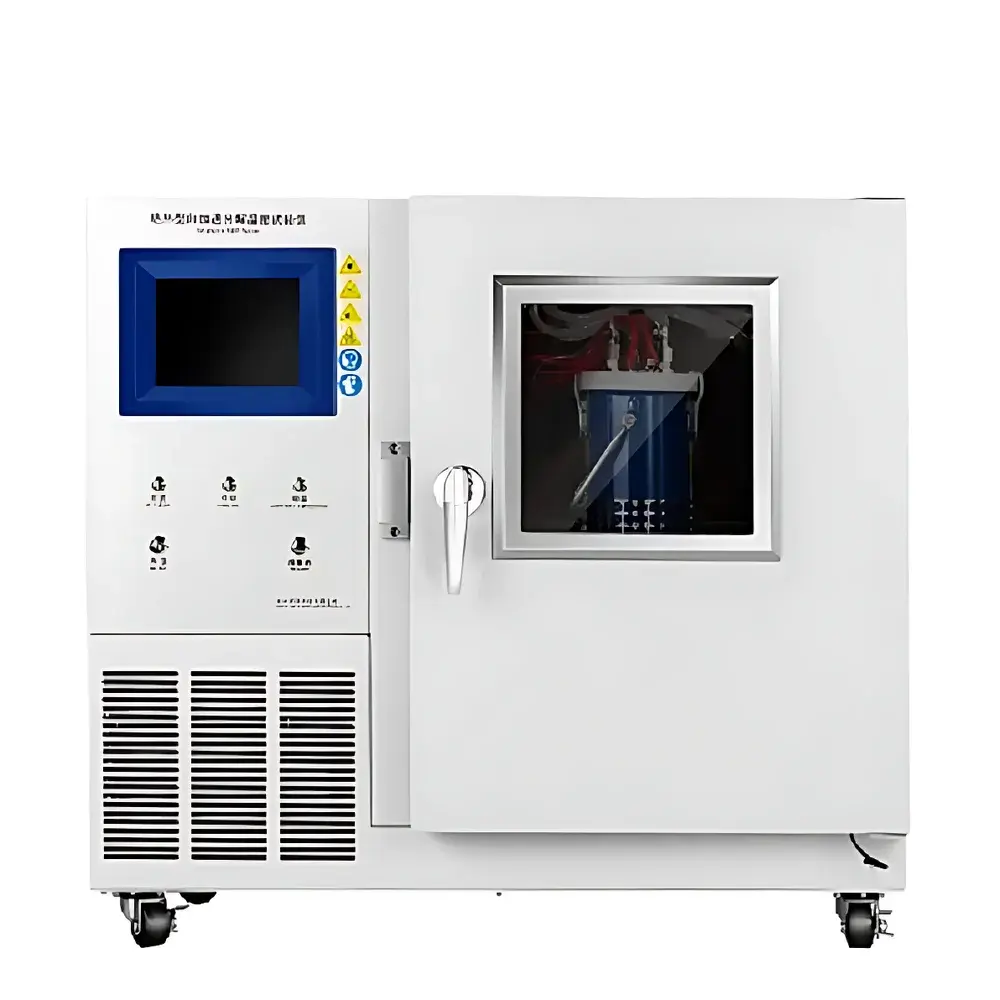
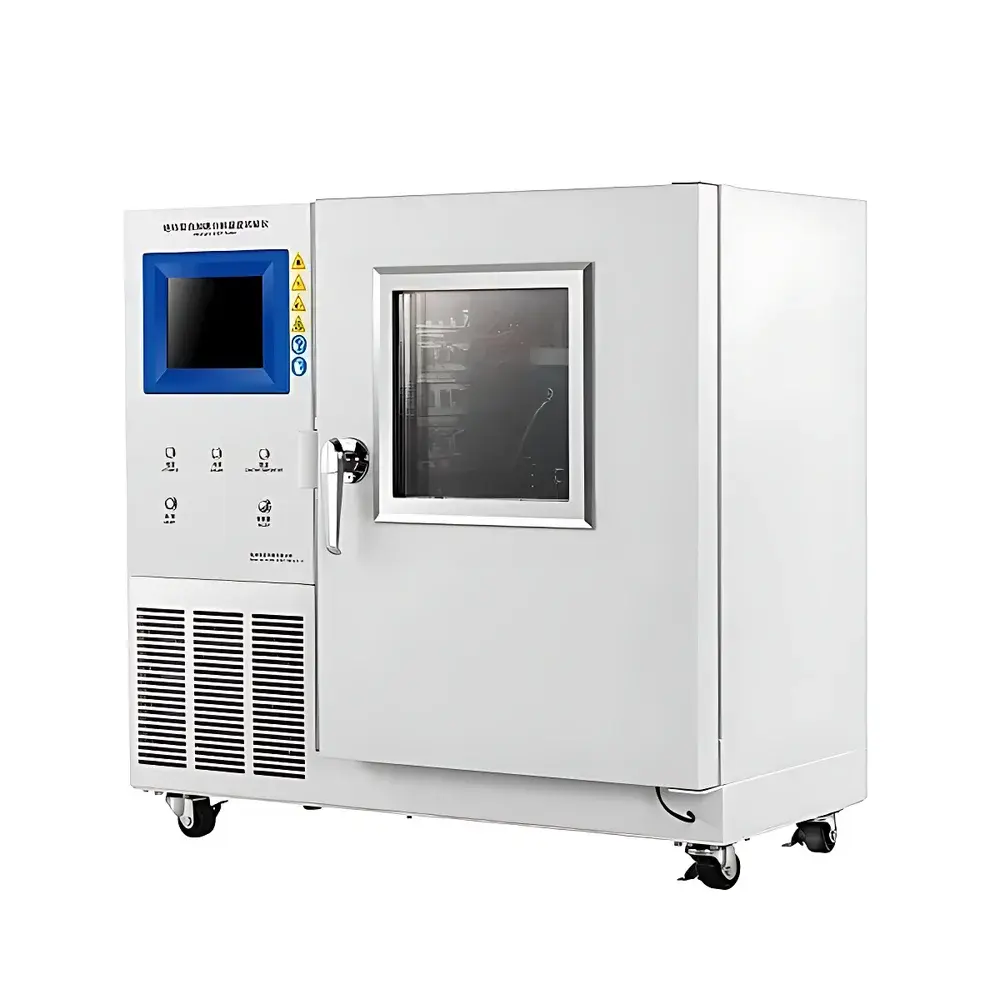

Young Instruments HWP27-10S Adiabatic Self-Accelerating Decomposition Temperature (SADT) Tester
| Brand | Young Instruments |
|---|---|
| Origin | Zhejiang, China |
| Manufacturer | Yes |
| Country of Origin | China |
| Model | HWP27-10S |
| Price | Upon Request |
| Operating Environment | (-5–45)°C, <95% RH |
| Chamber Temperature Range | -20°C to 220°C |
| Temperature Control Accuracy | ±1°C |
| Sample Temperature Measurement Range | -50°C to 500°C |
| Sample Temperature Resolution | 0.1°C |
| Sample Temperature Accuracy | ±(2.5 or 0.0075× |
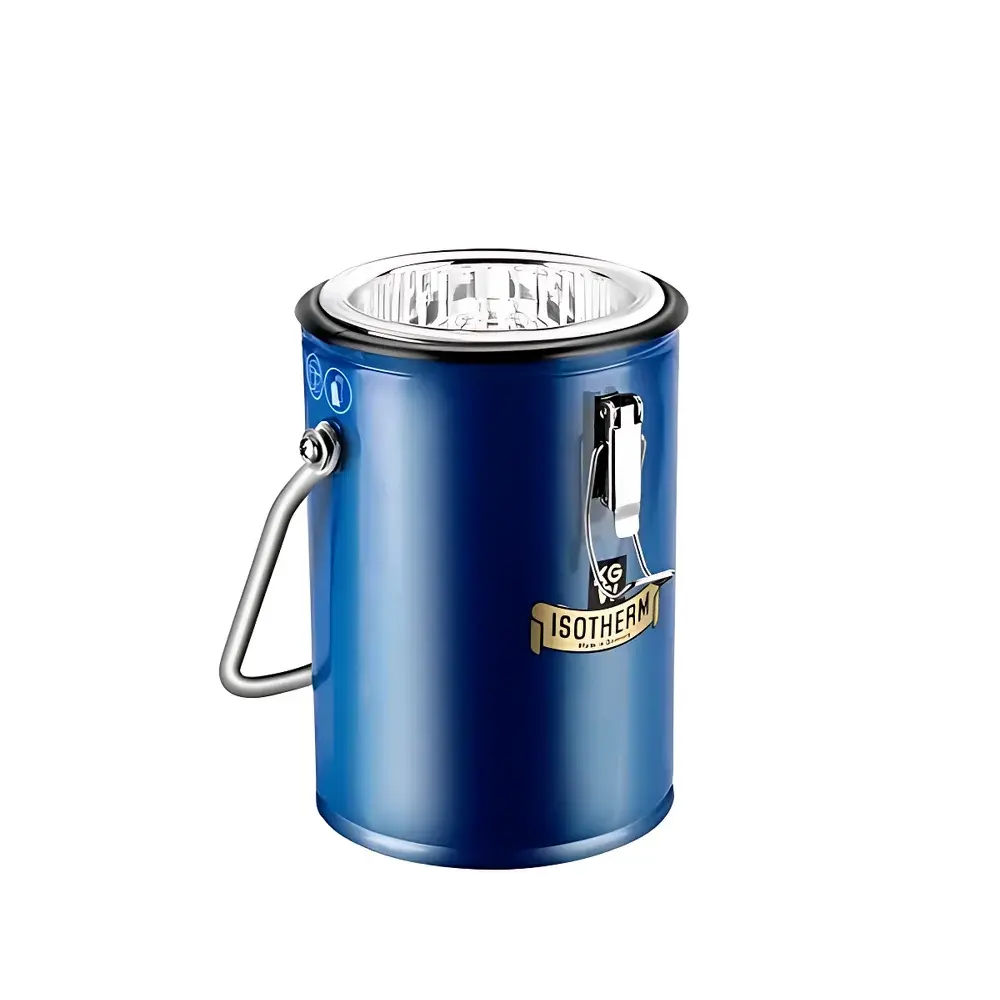
| Dewar Volume | 1 L |
| Constant Power Regulation Range | 0.1 W–2 W |
| Constant Power Accuracy | ≤0.015 W |
| Temperature Rise Rate Range | 0–2°C/min |
| Refrigerant Circulation Flow Rate | ≥3 L/min |
| Dewar Liner Material | Borosilicate Glass |
| Dimensions (L×W×H) | 930 mm × 545 mm × 875 mm |
Overview
The Young Instruments HWP27-10S Adiabatic Self-Accelerating Decomposition Temperature (SADT) Tester is a rigorously engineered instrument designed for the quantitative determination of the lowest temperature at which a substance undergoes self-accelerating decomposition under adiabatic storage conditions. It operates on the principle of adiabatic calorimetry—where the sample is thermally isolated within a high-efficiency Dewar vessel and subjected to precisely regulated thermal input, enabling real-time monitoring of exothermic behavior without heat loss to the environment. This method directly supports regulatory assessment of thermal stability for hazardous chemicals during transport and storage, particularly for organic peroxides, nitro compounds, azides, and other thermally sensitive formulations. The system conforms to the internationally recognized test protocol defined in Section 28.4.2, Test H.2 (“Adiabatic Storage Test”) of the United Nations Recommendations on the Transport of Dangerous Goods: Manual of Tests and Criteria, as well as GB 5085.5–2019 “Identification Standards for Hazardous Waste – Identification of Reactivity”. Its design prioritizes metrological integrity, mechanical safety, and operational traceability in compliance with ISO/IEC 17025 requirements for testing laboratories.
Key Features
- High-fidelity adiabatic environment achieved via vacuum-insulated 1 L borosilicate glass Dewar liner, minimizing radial and axial thermal leakage
- Precision constant-power heating control (0.1–2 W, accuracy ≤±0.015 W) enables reproducible thermal stimulus application aligned with UN H.2 methodology
- Embedded Windows CE platform with 8-inch resistive touch interface supports intuitive parameter configuration, real-time visualization of temperature vs. time profiles, and automatic curve generation
- Dual-stage thermal management: integrated air-circulated chamber (±1°C uniformity) combined with active refrigerant loop (≥3 L/min flow) ensures stable ambient control and rapid cooldown recovery
- Comprehensive safety architecture including dual redundant overtemperature cutoffs, pressure-actuated rear泄压 door (opens at >2.5 kgf internal thrust), and laminated anti-explosion observation window
- Real-time diagnostics with audible/visual alarms for sensor fault, power anomaly, cooling failure, or Dewar seal breach—each logged with timestamp and event code
- Automated test sequencing from initialization through endpoint detection, eliminating manual intervention and reducing operator-dependent variability
Sample Compatibility & Compliance
The HWP27-10S accommodates solid, liquid, and semi-solid samples in standard packaging configurations—including UN-certified drums, IBCs, and portable tanks—without requiring sample size reduction or dilution. Its 1 L Dewar volume allows representative testing of industrially relevant quantities while maintaining adiabatic fidelity. All thermal measurements adhere to the uncertainty budget specified in ISO 11358-1 for polymer thermal analysis and align with the data reporting conventions required by UN TDG Subsection 2.2.41.1 and the U.S. DOT 49 CFR §173.21. The instrument’s measurement traceability is maintained through NIST-traceable calibration certificates for both chamber and sample thermocouples (Type K, Class 1), and its software architecture supports audit-ready electronic records compliant with FDA 21 CFR Part 11 when deployed in GLP/GMP-regulated environments.
Software & Data Management
The embedded Windows CE application provides full lifecycle data handling: parameter setup (initial temperature, power setpoint, duration limits), live plotting of dT/dt vs. T, automatic SADT calculation using the ASTM E1981-20 inflection-point extrapolation algorithm, and export of raw CSV datasets with millisecond-level timestamps. All test sessions are stored locally with immutable metadata (operator ID, calibration status, environmental log), and optional network connectivity enables secure transfer to LIMS or enterprise QA systems via TLS 1.2–encrypted FTP/SFTP. Audit trails record every user action—including parameter edits, manual overrides, and report generation—with SHA-256 hashing to prevent tampering. Exported reports include UN-compliant headers, uncertainty statements per GUM (JCGM 100:2008), and graphical overlays of reference curves for comparative analysis.
Applications
- Determination of SADT for classification and transport authorization under UN Class 5.2 (Organic Peroxides) and Class 4.1 (Self-reactive substances)
- Thermal hazard screening of battery electrolytes, energetic materials, and pharmaceutical intermediates during process safety reviews (e.g., CCPS, NFPA 495)
- Validation of thermal stabilization strategies—e.g., inhibitor efficacy, packaging insulation performance, or cold-chain logistics protocols
- Supporting SDS Section 9 (Physical and Chemical Properties) and Section 10 (Stability and Reactivity) documentation per GHS Annex 5
- Research into decomposition kinetics, including Arrhenius parameter derivation and activation energy estimation via multi-temperature adiabatic runs
FAQ
What standards does the HWP27-10S comply with for SADT testing?
It fully implements UN Manual of Tests and Criteria, Part II, Section 28.4.2 (Test H.2) and GB 5085.5–2019, with hardware and software validated against the metrological requirements of ISO/IEC 17025.
Can the instrument test samples in their original shipping containers?
Yes—within dimensional constraints of the Dewar opening (Φ85 mm), samples may be introduced in UN-certified drums, jerricans, or IBC liners; custom adapters are available upon request.
How is adiabaticity verified during operation?
Adiabatic deviation is continuously calculated in real time using the measured thermal resistance between sample and Dewar wall, with automatic alerting if heat loss exceeds 5% of total exotherm magnitude.
Is remote monitoring supported?
Standard Ethernet interface enables secure remote viewing of live plots and status logs; full remote control requires optional VPN-configured access with role-based authentication.
What maintenance intervals are recommended?
Annual recalibration of all temperature sensors and power transducers is advised; refrigerant loop filter replacement every 12 months; Dewar vacuum integrity check every 24 months.