
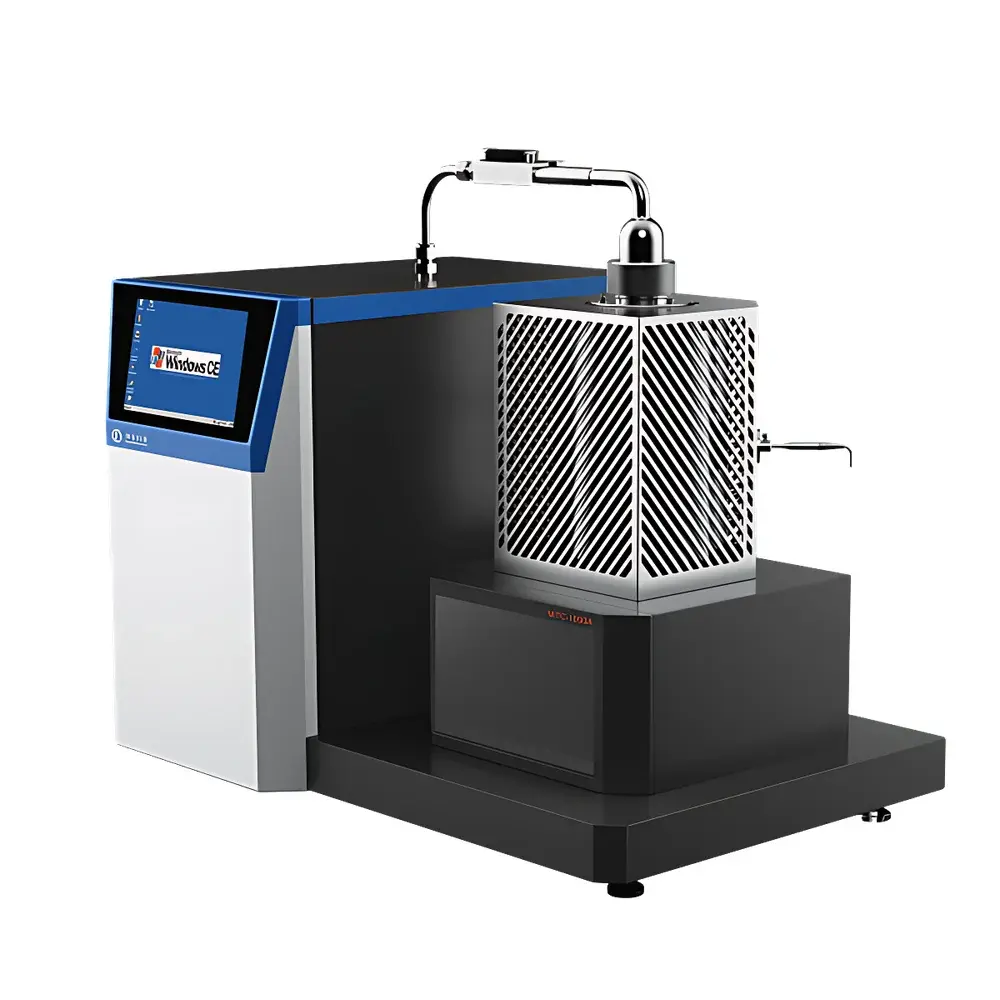
Young Instruments MITC-1000A Dust Cloud Minimum Ignition Temperature Tester
| Brand | Young Instruments |
|---|---|
| Origin | Zhejiang, China |
| Manufacturer Type | Direct Manufacturer |
| Country of Origin | China |
| Model | MITC-1000A |
| Pricing | Available Upon Request |
| Temperature Range | Ambient to 1000 °C |
| Heating Rate | ≤20 min (ambient to 500 °C) |
| Temperature Stability | ±5.0 °C |
| Temperature Accuracy | ±3.0 °C |
| Temperature Precision | ±0.1 °C |
| Powder Dispersion Pressure | 0–100 kPa (±5% accuracy) |
| Gas Reservoir Volume | 500 mL |
| Ambient Temp. Sensing | −10 °C to +60 °C |
| Ambient Humidity Sensing | 5–95% RH |
| Power Supply | 220 VAC / 50 Hz |
| Power Consumption | 2600 W |
| Dimensions | 670 mm × 400 mm × 590 mm |
| Display | 7-inch color TFT touchscreen |
| Interface | Dual USB 2.0 ports |
| Compliance Standards | ASTM E1491-06, EN 50281-2-1, GB/T 16429, IEC 61241-2, ISO/IEC 80079-20-2 |
Overview
The Young Instruments MITC-1000A Dust Cloud Minimum Ignition Temperature (MIT) Tester is a precision-engineered apparatus designed to determine the lowest temperature at which a suspended cloud of combustible dust ignites when exposed to a heated surface under controlled laboratory conditions. Based on the principle of thermal ignition in a defined turbulent cloud environment, the instrument generates a reproducible dust dispersion within a vertically oriented quartz tube housed inside a high-stability furnace. The test follows the fundamental methodology outlined in internationally recognized electrothermal ignition protocols—where a pre-weighed dust sample is pneumatically injected into the hot zone, and ignition is detected via optical flame sensing or thermocouple-based thermal runaway confirmation. This measurement is critical for classifying dust explosion hazards, establishing safe operating temperatures for process equipment (e.g., dryers, mills, silos), and supporting hazard analysis required under ATEX, IECEx, and NFPA 652 frameworks.
Key Features
- Pre-loaded compliance templates for ASTM E1491-06, EN 50281-2-1, GB/T 16429, IEC 61241-2, and ISO/IEC 80079-20-2—enabling direct standard-mode execution or fully customizable parameter sets
- Fuzzy PID temperature control algorithm ensures rapid thermal equilibration and sustained furnace stability within ±5.0 °C across the full 0–1000 °C operating range
- Dedicated thermocouple calibration port allows traceable verification and offset correction using external reference standards (e.g., calibrated PRTs or fixed-point cells)
- High-performance Borger-Grunwald-type furnace with fused quartz reaction tube, optimized for uniform axial temperature distribution and resistance to thermal shock and particulate deposition
- Vacuum-formed ceramic fiber insulation chamber provides low thermal mass, minimal heat loss, and effective operator-side surface temperature containment (<45 °C at ambient conditions)
- Industrial-grade Type K thermocouples from certified international suppliers ensure long-term drift resistance and metrological consistency over >10,000 test cycles
- Integrated environmental monitoring module records ambient temperature (−10 °C to +60 °C) and relative humidity (5–95% RH) automatically with each test session for audit-ready metadata linkage
- Remote operation capability via isolated Ethernet or optional wireless interface eliminates personnel exposure during high-risk ignition trials
- Role-based user management system supports up to four hierarchical account levels (Administrator, Supervisor, Technician, Guest) with configurable access rights to calibration logs, method editing, and report export functions
- Dual USB 2.0 host ports enable direct connection of flash drives or external printers without requiring intermediate PCs—data files are saved in CSV and PDF formats compliant with GLP documentation requirements
- Ergonomic 7-inch capacitive touchscreen with anti-glare coating displays real-time furnace profile, pressure waveform, dispersion timing, and flame detection status in synchronized graphical overlay
Sample Compatibility & Compliance
The MITC-1000A accommodates a broad spectrum of organic and inorganic powders relevant to chemical manufacturing, food processing, pharmaceutical synthesis, metallurgy, and biomass handling. Validated applications include aluminum, zinc, magnesium, and titanium metal powders; polymer granules and ground thermoplastics (e.g., polyethylene, nylon, PVC); carbohydrate-based dusts (wheat flour, sugar, starch); lignocellulosic materials (wood sawdust, tea leaf powder, tobacco cuttings); coal and coke fines; pharmaceutical intermediates; and composite pigment formulations. All test procedures adhere strictly to the sample preparation, dispersion energy, and observation duration stipulated in referenced standards. Instrument validation includes factory-installed NIST-traceable thermocouple calibration certificates and as-delivered furnace temperature mapping reports per ASTM E220.
Software & Data Management
The embedded firmware implements deterministic real-time scheduling for synchronized actuation of pneumatic valves, furnace ramping, and optical detection sampling at 100 Hz. Test data—including time-stamped temperature profiles, pressure transients, ambient conditions, and ignition event markers—are stored locally in encrypted binary format and exported in human-readable CSV/PDF bundles. Audit trails record all user actions (login/logout, method modification, calibration events) with timestamps and account identifiers, satisfying FDA 21 CFR Part 11 electronic record requirements when deployed in regulated GMP environments. Optional software extension supports automated report generation aligned with DSEAR (UK), TRBS 2152 (Germany), or OSHA Combustible Dust National Emphasis Program documentation templates.
Applications
- Hazard classification of bulk solids under UN GHS Category 1 or 2 for transport and storage safety data sheets (SDS)
- Design basis input for explosion protection systems—including explosion venting area calculation per EN 14491 and suppression system response timing
- Process safety management (PSM) support for PHA/HAZOP studies in OSHA 1910.119-covered facilities
- Verification of inerting effectiveness by comparing MIT values under nitrogen vs. air atmospheres
- Quality control screening of raw material batches for thermal sensitivity deviations indicative of particle size distribution shifts or moisture content changes
- Research into ignition mechanisms of nanoscale or surface-modified powders where conventional thermal models require empirical validation
FAQ
What dust sample mass is required for a valid MIT test?
Typical sample mass ranges from 0.5 g to 5 g depending on dust reactivity and standard-specific requirements—ASTM E1491 recommends 2 g for most industrial dusts.
Is the quartz tube replaceable, and what is its service life?
Yes—the fused quartz tube is a field-replaceable consumable with an expected lifetime of ≥500 tests under proper cleaning and thermal cycling protocols.
Can the MITC-1000A be integrated into a central LIMS or MES platform?
Via optional RS-485 or Modbus TCP gateway module, enabling bidirectional communication for test initiation, parameter push, and structured result ingestion.
Does the system support testing under reduced oxygen or inert atmospheres?
The base configuration operates in ambient air; optional gas purging kits (N₂, Ar, CO₂) with mass flow controllers are available for modified atmosphere testing.
How frequently must the temperature sensors be recalibrated?
Annual recalibration is recommended per ISO/IEC 17025 guidelines; however, the built-in calibration port enables in-house verification before critical test series using portable reference standards.







