
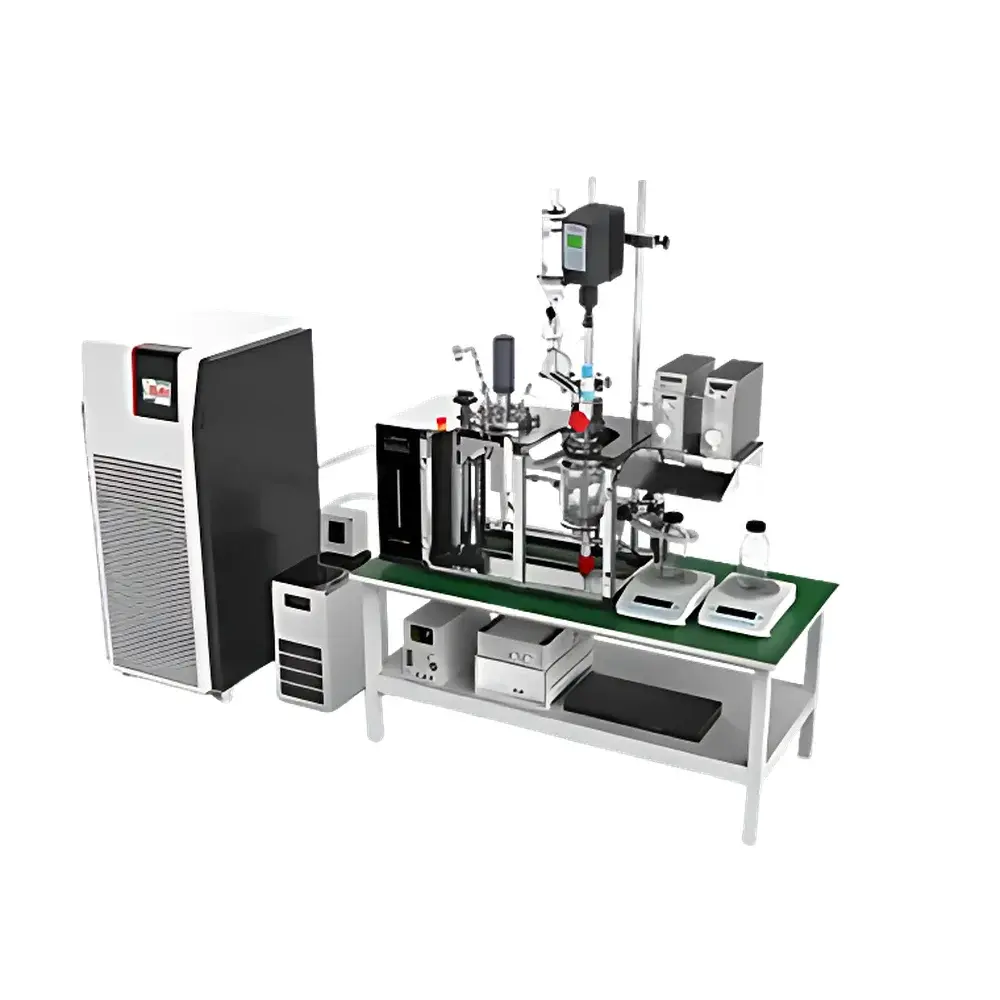
Young Instruments RC HP-1000D Dual-Reactor Automated Reaction Calorimeter
| Brand | Young Instruments |
|---|---|
| Origin | Zhejiang, China |
| Manufacturer Type | Direct Manufacturer |
| Country of Origin | China |
| Model | RC HP-1000D |
| Pricing | Upon Request |
| Calorimetry Methods | Heat-Flow, Power-Compensation (optional), Reflux (optional) |
| Reactor Temperature Range | −25 °C to 200 °C |
| Oil-Bath Temperature Range | −45 °C to 250 °C |
| Temperature Resolution | 1.0 mK |
| Temperature Control Precision | ±0.1 K |
| Oil Circulation Rate | 35–76 L/min |
| Heating Power | Up to 120 W |
| Max Stirring Speed | 2000 rpm (optional 3000 rpm) |
| Max Torque | 75 N·cm (optional 300 N·cm) |
| Reactor Volumes | 1000 mL standard (customizable) |
| Pressure Ratings | Ambient / 0.6–1.2 MPa (glass, medium-pressure) / 10 MPa (metal, high-pressure) |
| Reactor Materials | Borosilicate glass, 316L stainless steel, Hastelloy® |
| Stirrer Materials | PTFE, 316L, Hastelloy® |
| Feed Channels | 1 liquid + 1 solid + 1 gas (expandable to 4) |
| Balance Capacity | 3100 g, readability 0.01 g |
| Pump Types | Electromagnetic diaphragm (≤2 L/h), precision plunger (≤2.4 L/h) |
| Electrical Supply | 3×400 V / 50 Hz (±10%) / 20 A |
| Total Power Consumption | 7000 VA |
| Footprint (Test Area) | 1200 × 600 × 1850 mm |
| Oil Bath Dimensions | 600 × 700 × 1300 mm |
| Oil Bath Mass | 210 kg |
| System Mass | 350 kg |
Overview
The Young Instruments RC HP-1000D Dual-Reactor Automated Reaction Calorimeter is an engineered platform for quantitative thermal analysis of chemical reactions under laboratory-scale conditions that closely emulate industrial batch and semi-batch processes. Based on the principle of heat-flow calorimetry—supplemented optionally by power-compensation and reflux calorimetry—the system measures real-time heat release/absorption, enabling rigorous determination of reaction enthalpy (ΔHr), heat flow profiles, conversion kinetics, specific heat capacity (Cp), adiabatic temperature rise (ΔTad), and maximum theoretical temperature (MTT) in runaway scenarios. Designed for process safety evaluation and reaction engineering, the RC HP-1000D supports both atmospheric and pressurized operation across corrosive, viscous, or heterogeneous chemistries. Its dual-reactor architecture—sharing a single high-stability oil bath, central control unit, and reflux condensation system—enables rapid comparative studies without reconfiguration or silicone oil drainage, significantly reducing experimental downtime and cross-contamination risk.
Key Features
- Triple calorimetric methodology support: primary heat-flow mode with optional power-compensation and reflux modes for method validation and extended dynamic range
- Multi-mode thermal control: isothermal, isoperibolic, linear temperature ramp (scan), and user-defined temperature profiles
- Modular reactor configuration: selectable combinations including ambient-pressure glass, medium-pressure glass (0.6–1.2 MPa), and high-pressure metal reactors (up to 10 MPa) with 316L SS or Hastelloy® construction
- Integrated fluid handling: independent liquid, solid, and gas feed channels—with mass-based, volumetric, or pressure-driven dosing—scalable to four parallel streams
- High-fidelity thermal actuation: dual-zone heating/cooling with fast-response Peltier and resistive elements; oil circulation up to 76 L/min ensures uniform jacket temperature distribution and sub-0.1 K stability
- Real-time safety interlocks: programmable thresholds for temperature, pressure, exothermic rate (dQ/dt), and stirrer torque; automatic emergency cooling initiation and hardware-triggered shutdown compliant with IEC 61511 SIL-1 logic
- Comprehensive in-situ monitoring: simultaneous acquisition of reactor temperature, jacket temperature, feed mass, stirring speed, headspace pressure, gas flow rates, pH (via optional probe), and reflux condenser inlet/outlet temperatures
Sample Compatibility & Compliance
The RC HP-1000D accommodates diverse sample classes—including aqueous, organic, halogenated, and highly corrosive systems—through chemically resistant wetted materials (borosilicate glass, PTFE-sealed joints, 316L SS, and Hastelloy® C-276). Reactor configurations meet ASTM E1981 and ISO 11358 standards for reaction calorimetry, while pressure-rated vessels conform to PED 2014/68/EU and ASME BPVC Section VIII Div. 1. The system supports GLP-compliant data integrity through time-stamped audit trails, electronic signatures, and 21 CFR Part 11–ready software architecture (with optional validation packages). All thermal and mechanical calibrations are traceable to NIST-certified references, and operational logs include full metadata (operator ID, calibration status, environmental conditions).
Software & Data Management
The native Windows-based control software provides a unified interface for experiment design, execution, and post-processing. A built-in hardware database enables plug-and-play integration of third-party sensors (e.g., FTIR probes, Raman cells, or conductivity meters). Users define complex sequences via drag-and-drop workflow editors—including conditional branching, feedback loops, and event-triggered actions—with live parameter adjustment during active runs. Raw data streams (≥100 Hz sampling) are stored in HDF5 format with embedded metadata, supporting direct import into MATLAB, Python (via h5py), or commercial process modeling tools (Aspen Batch, gPROMS). Reporting modules generate ASTM E2550–aligned calorimetric reports—including heat flow curves, cumulative enthalpy plots, kinetic model fitting (e.g., nth-order, autocatalytic), and thermal hazard classification (TC, MTSR, TD24)—all exportable as PDF, CSV, or XML.
Applications
- Process safety assessment per CCPS Guidelines: determination of adiabatic onset temperature (Tonset), time-to-maximum-rate (TMRad), and criticality classification (Class 1–5)
- Reaction mechanism elucidation through calorimetric deconvolution of parallel/consecutive pathways
- Scale-up support: correlation of lab-scale heat transfer coefficients (UA) with pilot-plant geometry using dimensionless number analysis (e.g., Reynolds, Nusselt)
- Crystallization process optimization: monitoring dissolution enthalpy, supersaturation profiles, and nucleation kinetics
- API synthesis route selection: comparative exotherm profiling of alternative catalytic cycles or workup steps
- Third-party hazard evaluation for regulatory submissions (FDA, EMA, REACH)
FAQ
What calorimetric methods does the RC HP-1000D support, and how do they differ in application scope?
The system operates primarily in heat-flow mode for routine screening and kinetic modeling. Power-compensation mode is recommended for low-thermal-mass reactions or when high-resolution heat flux quantification is required (e.g., catalyst activation studies). Reflux calorimetry is applied to volatile systems where latent heat contributions dominate—such as solvent-mediated crystallizations or distillative workups.
Can the instrument perform simultaneous experiments in both reactors?
No—reactors operate sequentially via automated valve switching. This design ensures identical thermal boundary conditions and eliminates calibration drift between units, enhancing reproducibility for comparative studies.
Is the software compatible with LIMS or enterprise data systems?
Yes. The software provides OPC UA and RESTful API interfaces for bidirectional integration with laboratory information management systems (LIMS), MES platforms, and cloud-based analytics infrastructure.
What maintenance protocols are required for long-term accuracy?
Annual verification includes thermal calibration (using certified Pt100 reference probes), flowmeter validation, balance linearity check, and pressure transducer zero/span adjustment—all documented in accordance with ISO/IEC 17025 internal audit requirements.
Does the system support automated cleaning-in-place (CIP) procedures?
While not equipped with dedicated CIP manifolds, the modular reactor design allows rapid disassembly and compatibility with standard solvent flush protocols; optional heated jacket rinse cycles can be scripted via the software’s custom action library.



