
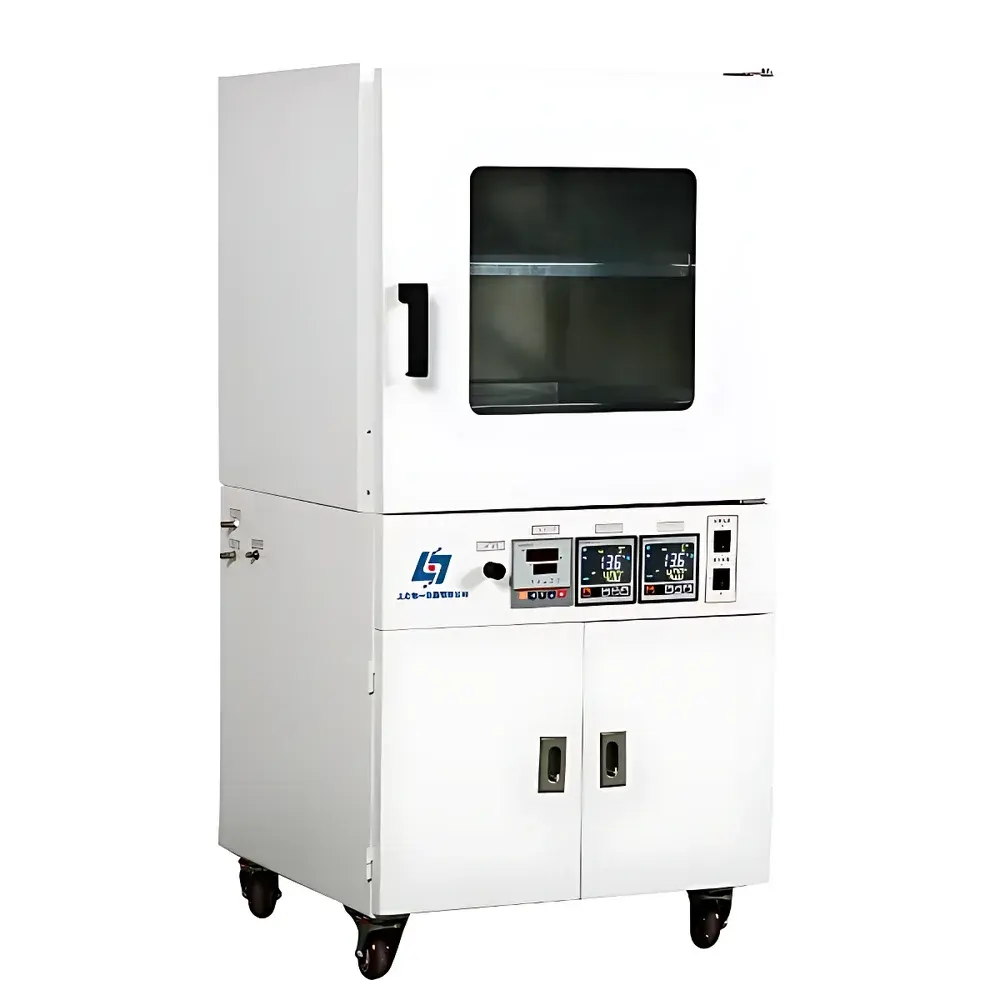
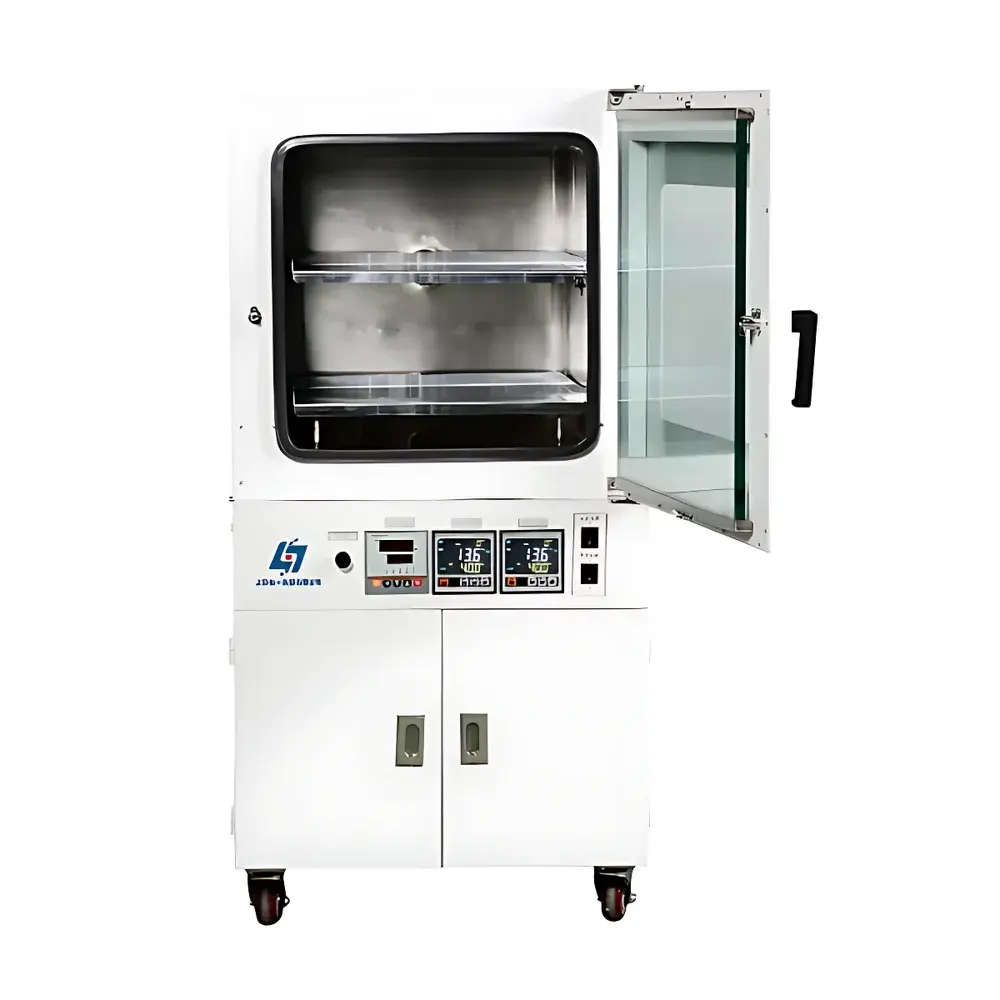
Yoyi DZF-6020SC Automatic Nitrogen-Purged Vacuum Drying Oven with Pressure Regulation
| Brand | Yoyi |
|---|---|
| Origin | Shanghai, China |
| Manufacturer Type | Direct Manufacturer |
| Instrument Type | Vacuum Drying Oven |
| Model | DZF-6020SC |
| Temperature Range | RT+10°C to 250°C |
| Temperature Uniformity | ±1°C |
| Temperature Resolution | 0.1°C |
| Vacuum Degree | ≤133 Pa |
| Chamber Dimensions (W×D×H) | 300×300×275 mm |
| External Dimensions (W×D×H) | 590×470×1370 mm |
| Inner Chamber Material | Stainless Steel |
| Vacuum Display | LED Digital Gauge |
| Nitrogen Inlet | Φ10 mm Quick-Connect Fitting |
| Pressure Control | Electromagnetic Valve, 5-Stage Programmable Constant-Pressure Mode (0–9999 min per stage) |
| Heating Power | 450 W |
| Timer Range | 1–9999 min |
| Insulation | Ceramic Fiber Blanket Between Chamber and Outer Shell |
| Door Seal | Molded Silicone Rubber Gasket |
| Shelf | 1 × Aluminum Tray (High-Temperature Oxidation-Resistant, Rapid Thermal Conduction) |
Overview
The Yoyi DZF-6020SC is an engineered vacuum drying oven designed for precise thermal processing under controlled inert atmospheres. It operates on the principle of simultaneous vacuum evacuation and nitrogen purging—enabling moisture removal from heat-sensitive, oxidation-prone, or chemically unstable samples without thermal degradation. Unlike conventional hot-air ovens, this system eliminates oxygen presence during drying, thereby preventing oxidation, polymerization, or decomposition reactions in pharmaceutical intermediates, battery electrode materials, catalyst precursors, and biological extracts. Its integrated microprocessor-based control architecture supports programmable vacuum ramping, staged nitrogen injection, and pressure-hold cycles—making it suitable for GLP-compliant R&D workflows where atmospheric integrity and process repeatability are critical.
Key Features
- Programmable 5-stage nitrogen pressure regulation: Each stage allows independent setpoint definition for vacuum level and dwell time (0–9999 minutes), enabling complex drying protocols such as stepwise solvent removal or annealing under inert gas blanket.
- Dual-mode operation: Fully autonomous switching between vacuum-only, nitrogen-purge-only, and combined vacuum/nitrogen modes via electromagnetic valve sequencing.
- High-fidelity temperature management: PID-controlled heating system with 0.1°C resolution and ±1°C uniformity across the 300×300×275 mm stainless steel chamber; validated per ASTM E2203 for laboratory oven performance verification.
- Robust thermal insulation: Dual-layer construction with ceramic fiber blanket (thermal conductivity <0.05 W/m·K at 200°C) minimizes energy loss and ensures stable chamber wall temperatures during extended high-temperature runs.
- Visual monitoring & safety interlock: Tempered double-glazed observation window with integrated O₂ barrier seal; door-open detection halts nitrogen flow and initiates vacuum release to prevent uncontrolled air ingress.
- Power-loss recovery: Non-volatile memory retains all active parameters—including temperature setpoints, vacuum profiles, and nitrogen timing sequences—ensuring uninterrupted execution after unexpected power interruption.
Sample Compatibility & Compliance
The DZF-6020SC accommodates powders, thin films, granules, lyophilized formulations, and coated substrates up to 5 kg total load. Its stainless steel interior resists corrosion from residual solvents (e.g., DMF, THF, ethanol), while the aluminum tray provides uniform thermal distribution without surface oxidation up to 250°C. The system meets mechanical safety requirements per IEC 61010-1 and electromagnetic compatibility standards EN 61326-1. For regulated environments, optional audit trail logging (via RS485 interface) supports 21 CFR Part 11 compliance when paired with validated LIMS integration. It is routinely deployed in ISO 17025-accredited labs for stability testing of APIs per ICH Q1A(R3), and in battery material R&D per IEEE 1625 guidelines.
Software & Data Management
While the DZF-6020SC operates via standalone front-panel controls, its embedded RS485 port enables serial communication with external SCADA systems or custom LabVIEW/Python scripts for remote parameter adjustment and real-time data acquisition. Vacuum pressure, chamber temperature, and elapsed cycle time are output as ASCII-readable values at 1-second intervals. Optional firmware upgrade adds CSV export capability for post-run analysis in Excel or MATLAB. All operational logs—including alarm events, door status transitions, and nitrogen valve actuation timestamps—are timestamped and stored in non-volatile EEPROM for traceability during internal QA audits.
Applications
- Pharmaceutical: Residual solvent removal from sterile-filtered injectables; desiccation of hygroscopic excipients without Maillard reaction onset.
- Materials Science: Pre-sintering treatment of Li-ion cathode precursors (e.g., NMC, LFP); moisture elimination from MOF frameworks prior to BET surface area measurement.
- Electronics: Degassing of conformal coatings and encapsulants; pre-bake of PCB assemblies before underfill dispensing.
- Academic Research: Controlled dehydration of plant tissues for SEM sample preparation; low-oxygen annealing of perovskite thin films.
- Environmental Testing: Accelerated aging of adsorbent media (e.g., activated carbon, zeolites) under inert atmosphere to isolate thermal effects from oxidative decay.
FAQ
What vacuum pump is compatible with the DZF-6020SC?
The unit ships with a dedicated 2L/s two-stage rotary vane pump rated for ultimate vacuum ≤5 Pa. For enhanced performance with solvent-laden vapors, optional oil-free diaphragm pumps (e.g., KNF NMP 830) can be integrated via standard KF-16 flange.
Can the nitrogen purge function operate independently of vacuum mode?
Yes—the control logic permits standalone nitrogen flow at atmospheric or elevated pressure (up to 0.1 MPa gauge), with adjustable flow rate via built-in needle valve and electromagnetic on/off control.
Is calibration documentation available for metrological traceability?
Factory calibration certificates (temperature uniformity, vacuum sensor linearity) are provided with each unit, traceable to CNAS-accredited reference standards. On-site IQ/OQ validation packages are available upon request.
How is overtemperature protection implemented?
Independent mechanical overtemperature cutoff (270°C fixed limit) acts as hardware fail-safe, physically interrupting power to heating elements regardless of controller status.
Does the chamber support negative pressure cycling?
No—this model maintains static or stepped vacuum levels only. Dynamic vacuum pulsing requires external PLC interfacing via digital I/O expansion module (sold separately).



