
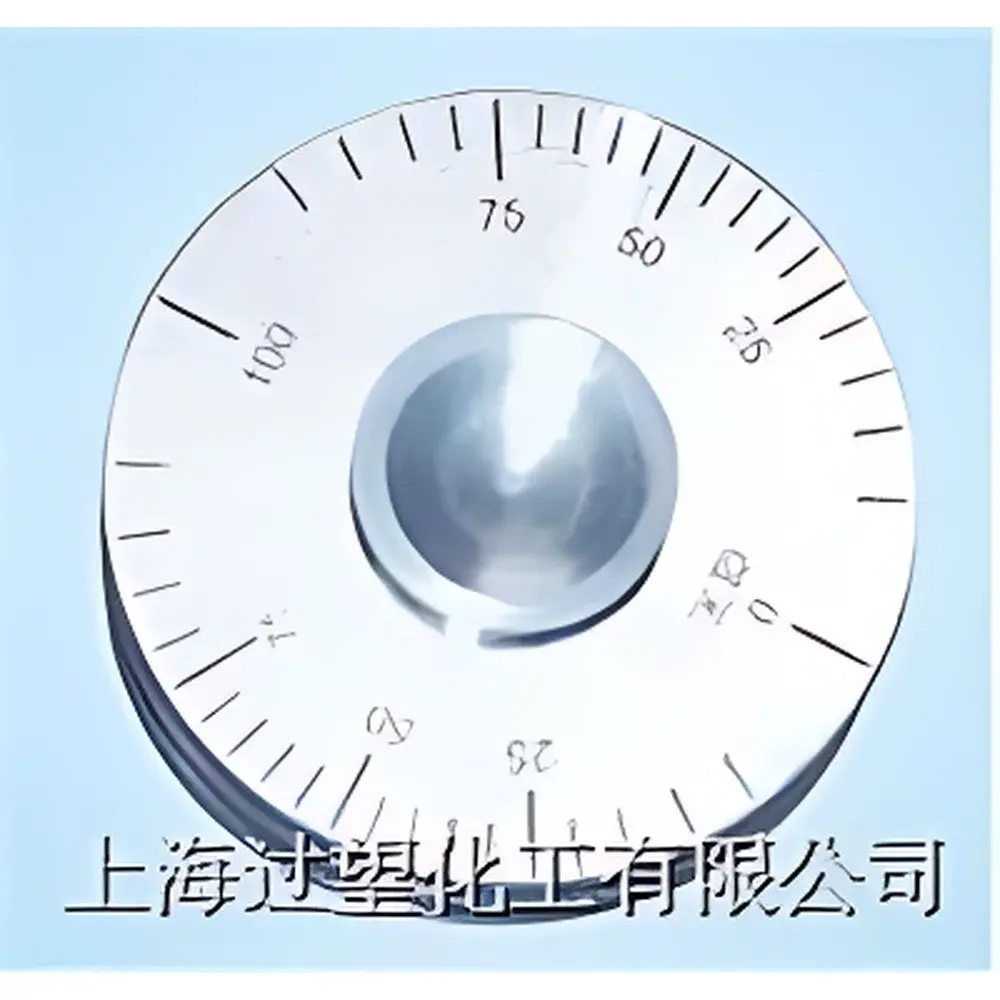
YQH Series Roller-Type Wet Film Thickness Gauge
| Origin | Shanghai, China |
|---|---|
| Manufacturer Type | Distributor |
| Product Origin | Domestic (China) |
| Model | YQH-100 / YQH-200 / YQH-1000 |
| Measuring Range | 0–100 µm / 0–200 µm / 0–1000 µm |
| Weight | 0.2 kg |
| Dimensions | Ø50 mm × 27 mm |
Overview
The YQH Series Roller-Type Wet Film Thickness Gauge is a precision mechanical instrument engineered for non-destructive, real-time measurement of wet film thickness during coating application processes. Based on the principle of controlled roller indentation and calibrated step-edge registration, the gauge operates by rolling across a freshly applied wet coating—leaving a series of parallel impressions whose depth corresponds directly to the film thickness. Unlike comb-type or notch gauges, the roller design ensures consistent contact geometry and minimizes surface disturbance, enabling reliable measurements on both planar and gently curved substrates (e.g., pipes, cylindrical tanks, and contoured automotive panels). This method complies with ASTM D1212 – Standard Test Methods for Measurement of Wet Film Thickness of Organic Coatings, and supports quality control workflows aligned with ISO 23603 (Coating inspection — Wet film thickness measurement) and ISO 19840 (Protection of steel structures — Assessment of coating system performance). The device requires no power supply, calibration software, or consumables—making it suitable for field use, production line audits, and third-party inspection services where portability and operational simplicity are critical.
Key Features
- Three standardized models (YQH-100, YQH-200, YQH-1000) covering wet film thickness ranges from 0–100 µm up to 0–1000 µm, each with engraved, corrosion-resistant stainless steel rollers and high-contrast depth markings.
- Compact, ergonomic cylindrical form factor (Ø50 mm × 27 mm) optimized for single-hand operation and easy storage in toolkits or QC carts.
- Roller geometry designed to maintain uniform pressure distribution and minimize lateral slippage, ensuring repeatable readings across varying substrate curvatures (radius ≥ 50 mm).
- Calibrated step increments traceable to national metrology standards; zero-reference point verified via optical flat and interferometric surface analysis during manufacturing.
- No batteries, electronics, or firmware required—fully compliant with intrinsically safe environments (ATEX Zone 2 / IECEx Class II) where electromagnetic interference or spark hazards prohibit powered instruments.
Sample Compatibility & Compliance
The YQH gauge is validated for use with solvent-borne, water-borne, high-solids, and UV-curable coatings—including epoxies, polyurethanes, alkyds, acrylics, and zinc-rich primers. It accommodates non-porous and semi-porous substrates such as cold-rolled steel, aluminum, stainless steel, fiberglass-reinforced polymer (FRP), and pre-treated concrete. Surface roughness (Ra) up to 25 µm does not significantly affect reading accuracy when proper rolling technique is applied (per ISO 2808 Annex B). All models meet requirements for routine inspection under ISO 9001:2015 clause 7.1.5 (Monitoring and measuring resources) and support documented evidence generation for internal audits, customer-facing reports, and regulatory submissions under ISO/IEC 17025-accredited laboratories.
Software & Data Management
As a purely mechanical analog instrument, the YQH gauge does not integrate with digital data acquisition systems or proprietary software platforms. However, its readings are fully compatible with standard QC documentation protocols: values may be manually entered into LIMS (Laboratory Information Management Systems), ERP modules (e.g., SAP QM), or electronic batch records compliant with FDA 21 CFR Part 11 (when paired with secure, audit-trail-enabled entry procedures). For traceability, each unit carries a unique serial number laser-engraved on the roller housing, and calibration verification records—including date, technician ID, and reference standard used—can be maintained per GLP/GMP record retention policies.
Applications
- Pre-drying verification of wet film build in industrial painting lines (e.g., coil coating, automotive OEM, and heavy equipment finishing).
- Field inspection of protective coatings on offshore platforms, pipelines, and structural steel prior to cure and holiday detection.
- Process validation during R&D formulation trials where rapid iteration between wet film target and dry film outcome is essential.
- Training and competency assessment for coating applicators under SSPC-PA 2 or NACE RP0188 guidelines.
- Third-party inspection agencies performing ASTM D1212-conformant thickness surveys for contract compliance reporting.
FAQ
How often should the YQH gauge be recalibrated?
Recalibration is recommended annually or after 5000 operational cycles—whichever occurs first—as defined in ISO/IEC 17025 Clause 6.5.2. Verification against certified step-height standards (e.g., NIST-traceable gauge blocks) should be performed before each shift in high-precision applications.
Can the YQH gauge measure over textured or blasted surfaces?
It is intended for use on smooth-to-moderately profiled surfaces (Sa ≤ 2.5 per ISO 8503-1). For blast profiles exceeding Sa 3.0, alternative methods such as ultrasonic dry film measurement (per ISO 2808:2016 Annex C) are advised.
Is the roller material resistant to aggressive solvents?
Yes—the roller is manufactured from hardened 440C stainless steel with passivated surface finish, providing resistance to common organic solvents including xylene, methyl ethyl ketone (MEK), and acetone per ASTM D5402.



