
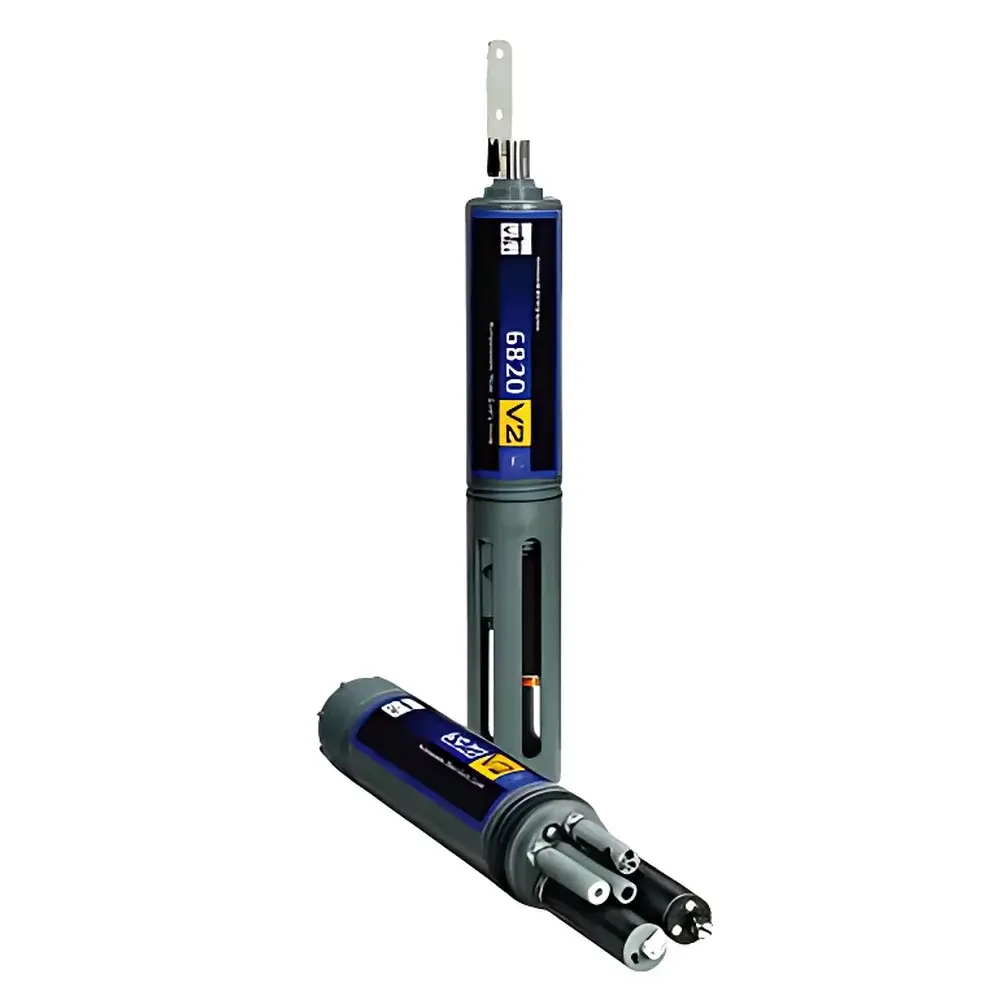
YSI 6820/6920 V2-2 Multiparameter Water Quality Monitoring System
| Brand | YSI |
|---|---|
| Origin | USA |
| Model | 6820/6920 V2-2 |
| Depth Rating | 15 m (ISE probes), 61 m (standard optical probes), 200 m (optional deep-water probes) |
| Data Storage Capacity | 150,000 readings |
| Sampling Interval | User-programmable |
| Battery Life | Up to 30 days at 15-min intervals |
| Power Supply | 12 V DC |
| Communication Interface | SDI-12, RS-232 |
| Compatible Display/Logger | YSI 650MDS |
| Software Platform | EcoWatch for Windows |
| Compliance | ASTM D1129, ASTM D3764, Standard Methods 2540–2550, US EPA Method 180.1 (conductivity), ISO 7888 (conductivity), ISO 10260 (turbidity), ISO 10261 (chlorophyll-a fluorescence) |
Overview
The YSI 6820/6920 V2-2 Multiparameter Water Quality Monitoring System is an engineered field-deployable platform designed for long-term, unattended in-situ monitoring of freshwater ecosystems. Built upon YSI’s proven 6-series architecture, this system employs a modular sensor architecture that supports simultaneous measurement of up to 16 physicochemical and biological parameters—including temperature, dissolved oxygen (DO), pH, oxidation-reduction potential (ORP), conductivity, specific conductance (temperature-compensated to 25 °C), resistivity, total dissolved solids (TDS), salinity, depth/water level, turbidity, chlorophyll-a fluorescence, Rhodamine WT fluorescence, nitrate, chloride, and ammonium. Measurements are derived from electrochemical (e.g., ion-selective electrodes), optical (e.g., fluorescence-based chlorophyll and BGA sensors), and galvanic/polarographic (DO) sensing principles—each calibrated and validated per internationally recognized standard methods. The system is explicitly intended for freshwater applications and is not rated for seawater or highly corrosive brines.
Key Features
- Modular probe base with dual optical ports enabling concurrent deployment of turbidity, chlorophyll-a, Rhodamine WT, ROX optical DO, and blue-green algae (BGA) sensors
- ROX Optical Dissolved Oxygen Sensor: Utilizes lifetime-stable luminescent phase-shift detection; immune to flow rate variations, H2S interference, and oxygen depletion artifacts; requires no membrane replacement or electrolyte refills
- Self-cleaning optical sensors: Integrated motorized brush mechanism for turbidity, chlorophyll-a, and Rhodamine WT probes minimizes biofouling-induced drift during extended deployments
- Fast-pulse, non-stirred DO sensor: Eliminates mechanical stirring requirements while maintaining high temporal resolution and low power consumption
- User-configurable sampling intervals (seconds to hours); internal memory stores up to 150,000 data points
- Field-replaceable sensor cartridges: Enables rapid recalibration, maintenance, or parameter reconfiguration without returning the entire instrument to the lab
- SDI-12 and RS-232 interfaces support seamless integration with third-party data loggers (e.g., Campbell Scientific CR1000), telemetry systems, or YSI’s 6200 Data Collection Platform
Sample Compatibility & Compliance
The 6820/6920 V2-2 is validated for use in natural and engineered freshwater systems—including rivers, lakes, reservoirs, wetlands, and groundwater wells. Its ISE-based ammonium, nitrate, and chloride probes operate reliably to 15 m depth; standard optical probes (turbidity, chlorophyll-a, Rhodamine WT) are rated to 61 m; optional deep-water variants extend operational depth to 200 m. All conductivity-derived parameters (specific conductance, TDS, resistivity, salinity) conform to Standard Methods for the Examination of Water and Wastewater (23rd ed.) equations and are traceable to NIST-certified KCl standards. Chlorophyll-a measurements are reported as relative fluorescence units (RFU), with optical accuracy ±5% of reading (per ISO 10261 Annex B), acknowledging the absence of aqueous chlorophyll-a reference standards. The system supports GLP-compliant data integrity through time-stamped, non-erasable logging and optional audit-trail-enabled EcoWatch software configurations compliant with FDA 21 CFR Part 11 requirements when deployed with appropriate IT infrastructure.
Software & Data Management
EcoWatch software (Windows-based) serves as the primary interface for instrument configuration, real-time data visualization, post-deployment analysis, statistical summarization, and export to CSV, Excel, or GIS-compatible formats. It supports automated calibration curve generation using multi-point standard solutions, batch processing of large datasets, and spectral deconvolution for BGA quantification. Data files include embedded metadata (sensor serial numbers, calibration dates, firmware versions, GPS coordinates if external receiver is connected), ensuring full traceability. When integrated with YSI’s 6200 Data Collection Platform or custom SCADA systems via SDI-12, the 6820/6920 V2-2 enables remote alarm thresholds, scheduled telemetry bursts, and cloud-based dashboard visualization—fully compatible with MQTT and Modbus TCP protocols via gateway adapters.
Applications
- Long-term limnological monitoring programs tracking eutrophication indicators (chlorophyll-a, nitrate, ammonium, turbidity)
- Drinking water source protection: Early detection of algal blooms (via BGA and chlorophyll-a), contaminant intrusion (Rhodamine WT tracer studies), and redox shifts in aquifers
- Wastewater effluent compliance monitoring per NPDES permit conditions (DO, pH, ORP, conductivity)
- Groundwater quality assessment using flow-through chambers and submersible pump integration
- Ecological research requiring high-temporal-resolution profiling across vertical water columns (e.g., thermocline, chemocline, and photic zone dynamics)
- Regulatory reporting under USEPA, State Water Board, and EU WFD frameworks where standardized, auditable field data are required
FAQ
Is the YSI 6820/6920 V2-2 suitable for marine or estuarine environments?
No. This system is validated exclusively for freshwater applications. Conductivity algorithms, ISE selectivity, and sensor materials are not optimized for high-chloride or variable-salinity matrices.
What is the calibration frequency recommendation for optical sensors?
Chlorophyll-a and turbidity sensors should be verified weekly in the field using stable secondary standards (e.g., formazin or AMCO AEPA-1 suspensions); full recalibration is recommended every 30–45 days depending on fouling risk.
Can the ROX optical DO sensor be used in sulfide-rich sediments?
Yes. Unlike electrochemical DO sensors, the ROX sensor exhibits no signal suppression or poisoning in H2S concentrations up to 10 mg/L and remains functional at dissolved oxygen levels below 0.1 mg/L.
Does the system meet FDA 21 CFR Part 11 requirements out-of-the-box?
The hardware and EcoWatch software support Part 11 compliance when deployed with role-based user accounts, electronic signatures, and audit-trail logging enabled—however, full validation must be performed by the end-user per organizational SOPs.
How is depth compensation handled for pressure-based water level measurements?
The integrated pressure transducer outputs absolute pressure; barometric compensation is applied either manually (via local weather station input) or automatically (when paired with YSI’s 6150 Barometric Pressure Sensor).
Related Products







