
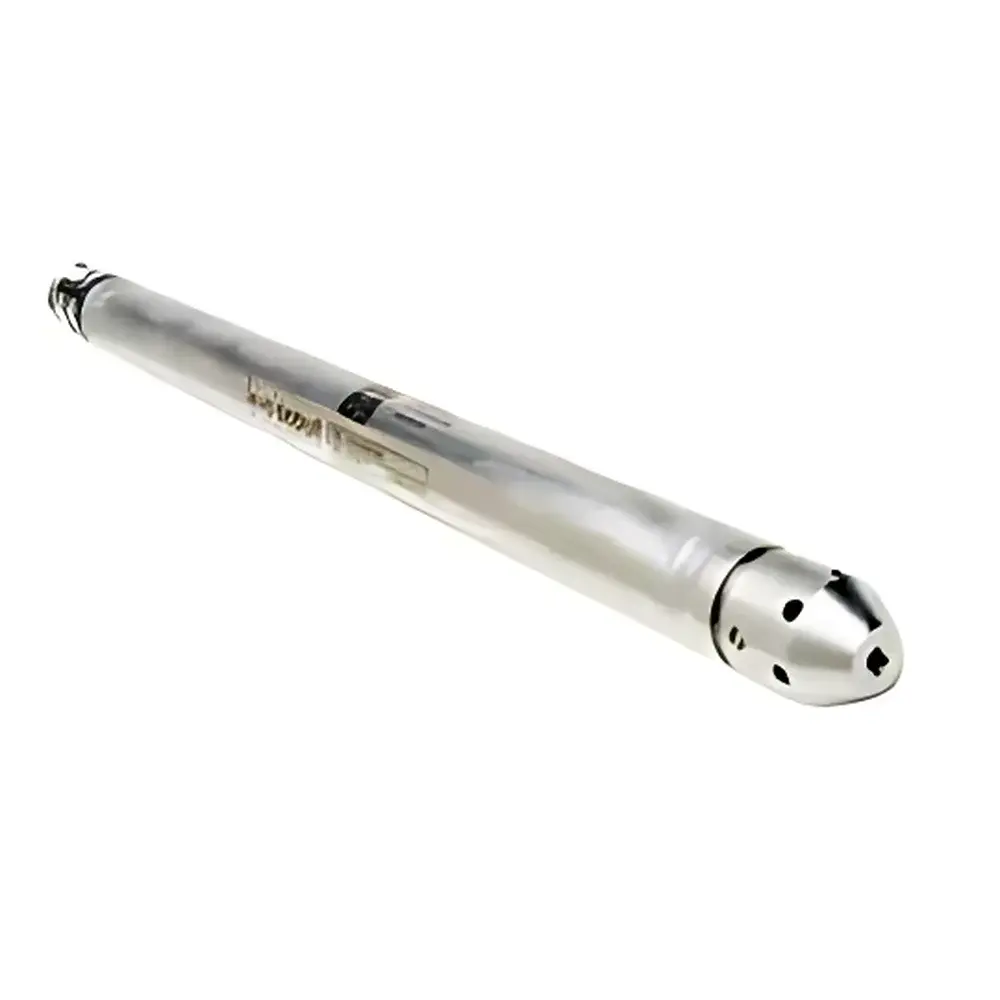
YSI Level Scout Water Level Logger
| Brand | YSI |
|---|---|
| Origin | USA |
| Housing Rating | NEMA 6P / IP68 |
| Construction Materials | 316 Stainless Steel or Titanium Alloy |
| Memory Capacity | 2 MB or 4 MB |
| Data Storage Capacity | Up to 600,000 records (water level, temperature, timestamp) |
| Water Level Range | up to 210 m |
| Accuracy | ±0.05% of full scale (for water levels > 3 m) |
| Pressure Reference Options | Ventilated (gauge) or Non-ventilated (absolute) with optional integrated barometer |
| Battery Life | Up to 3 years (field-replaceable) |
| Sampling Modes | Linear, Linear-Averaged, Event-Triggered, Logarithmic |
| Operating Temperature Range | –20 °C to +50 °C |
| External Diameter | 1.9 cm |
| Firmware Upgrade | Field-upgradable via USB or serial interface |
| Software | YSI DataScout (Windows-based, supports ASTM D4044, ISO 14001-aligned data handling, FDA 21 CFR Part 11-compliant audit trail in licensed version) |
Overview
The YSI Level Scout Water Level Logger is a high-precision, submersible environmental monitoring instrument engineered for long-term, unattended measurement of water level and temperature in groundwater, surface water, and industrial process applications. It operates on the principle of piezoresistive pressure transduction—converting hydrostatic pressure exerted by a water column into an electrical signal calibrated to depth—while simultaneously recording temperature using a factory-traceable thermistor. Its dual-sensor architecture enables compensation for thermal drift and fluid density variation, ensuring metrological integrity across seasonal temperature fluctuations. Designed for deployment in wells, rivers, lakes, drainage channels, and soil vapor extraction (SVE) systems, the Level Scout delivers stable, low-drift performance under continuous immersion and extreme environmental exposure. Its compact 1.9 cm diameter form factor allows installation in narrow-diameter monitoring wells (≥2 inches), while its NEMA 6P/IP68-rated housing guarantees reliable operation at depths up to 210 meters.
Key Features
- High-accuracy piezoresistive pressure sensor with total error band of ±0.05% FS (for depths > 3 m), traceable to NIST standards
- Dual-sensor configuration: integrated water-level pressure transducer and high-stability thermistor (±0.1 °C accuracy)
- Configurable sampling strategies: linear interval logging, linear-averaged mode (reducing noise in turbulent environments), event-triggered acquisition (e.g., threshold-based pumping onset detection), and logarithmic sampling for capturing rapid transient dynamics during step tests or recovery phases
- Field-serviceable design: user-replaceable lithium-thionyl chloride battery (3-year typical life), tool-free cable connector, and firmware-upgradable microcontroller via USB or RS-232 interface
- Material options: corrosion-resistant 316 stainless steel or titanium alloy housing, suitable for saline, acidic, or sulfide-rich aquifers
- Ventilated (vented gauge) and non-ventilated (absolute reference) configurations; non-ventilated models include an internal barometric sensor for real-time atmospheric pressure compensation
Sample Compatibility & Compliance
The Level Scout is validated for use in heterogeneous hydrogeological media—including sand, gravel, fractured bedrock, and clay-rich aquifers—and compatible with standard PVC, stainless steel, and HDPE well casings. Its pressure sensor diaphragm resists fouling from suspended solids and biofilm accumulation, supporting multi-year deployments without recalibration. The device complies with ASTM D4044 (Standard Test Method for Determining Hydraulic Conductivity of Soils), ISO 14001 environmental management system requirements for data integrity, and EPA Method 9020B for groundwater monitoring instrumentation. When used with YSI DataScout software’s licensed edition, it supports GLP/GMP-aligned audit trails, electronic signatures, and 21 CFR Part 11 compliance for regulated environmental reporting.
Software & Data Management
YSI DataScout is a Windows-based desktop application enabling full configuration, visualization, and export of Level Scout datasets. Users can define custom sampling schedules, apply barometric compensation algorithms (for non-ventilated units), generate time-series plots with dual Y-axes (depth vs. temperature), and export CSV, Excel, or XML files compatible with MODFLOW, GMS, and other hydrologic modeling platforms. The software includes built-in tools for identifying pump test boundaries, calculating drawdown curves, and flagging anomalous readings via user-defined thresholds. Firmware updates and calibration certificates are accessible through YSI’s secure customer portal, with version-controlled release notes and validation documentation provided for each update.
Applications
- Long-term groundwater level monitoring for resource assessment, drought response, and regulatory compliance (e.g., USGS NWIS, EU WFD reporting)
- Well hydraulics testing: constant-rate pumping tests, slug tests, step-drawdown analysis, and recovery curve modeling
- Surface water stage monitoring in rivers, streams, reservoirs, and tidal estuaries
- Soil vapor extraction (SVE) system performance verification, including vacuum decay and plume migration tracking
- Open-channel flow estimation using stage-discharge relationships (e.g., Palmer-Bowlus flumes, Palmer-Bowlus weirs)
- Landfill leachate collection system monitoring and dam seepage analysis
FAQ
What is the difference between ventilated and non-ventilated Level Scout models?
Ventilated models measure gauge pressure relative to ambient atmospheric pressure via a moisture-permeable vent tube; non-ventilated models measure absolute pressure and require barometric correction—either manually or using the integrated barometer.
Can the Level Scout be deployed in seawater?
Yes—titanium-alloy-housed units are recommended for prolonged marine or brackish water exposure due to superior resistance to chloride-induced stress corrosion cracking.
How is barometric compensation applied in post-processing?
DataScout automatically synchronizes barometric readings (from the internal sensor or external station) with water level timestamps and applies hydrostatic head correction using the standard gravity-adjusted density of water at measured temperature.
Is field recalibration possible?
No—calibration is performed at the factory using dead-weight testers and temperature-controlled baths; however, zero checks and field verification protocols are supported via DataScout’s “dry-run” diagnostic mode.
Does the device support wireless telemetry?
The Level Scout itself is a standalone logger; wireless transmission requires integration with third-party telemetry gateways (e.g., cellular RTUs, LoRaWAN nodes) via its RS-232 or SDI-12 output interface.
Related Products







