
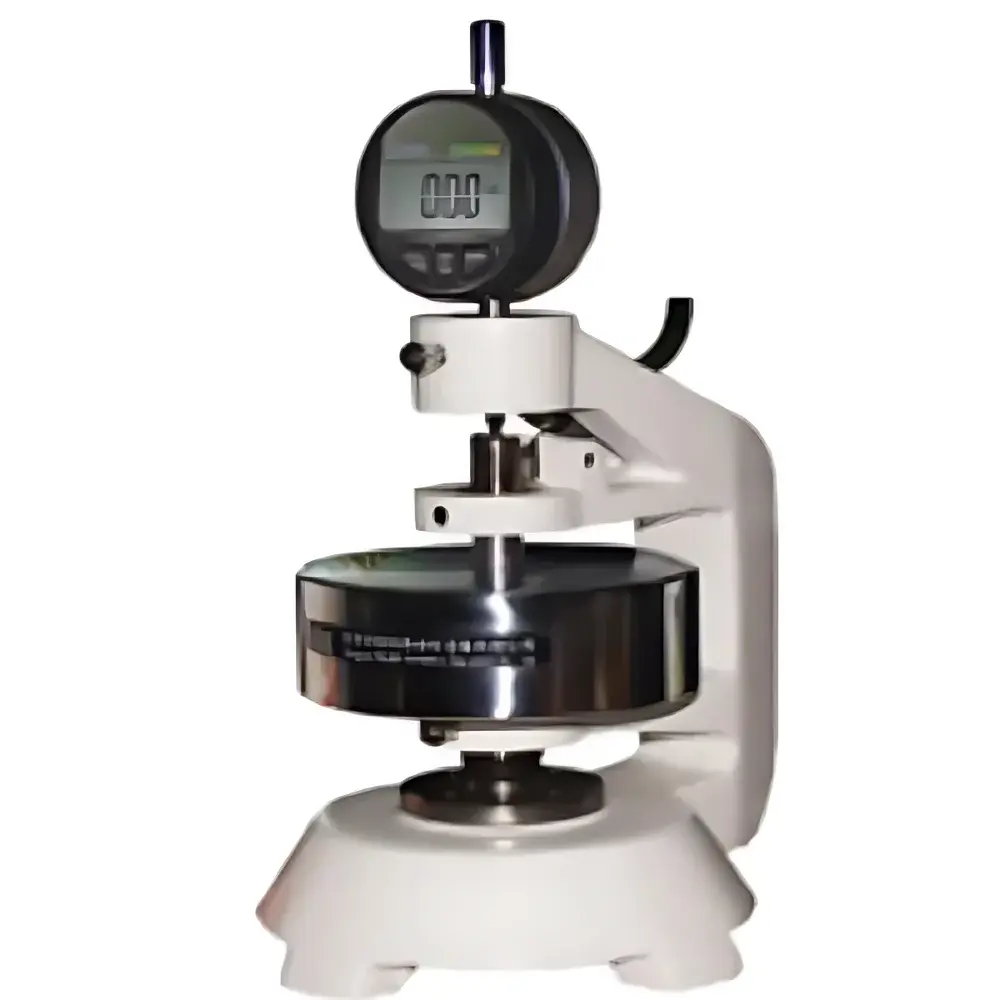
Yuelian PW-TCK-01 Digital Handheld Paper Thickness Gauge
| Brand | Yuelian / PW |
|---|---|
| Origin | Guangdong, China |
| Model | PW-TCK-01 |
| Measurement Range | 0–4 mm |
| Resolution | 0.001 mm |
| Indication Error | ±0.05% of full scale |
| Contact Area | 200 ± 5 mm² |
| Anvil Diameter | 16 ± 0.15 mm |
| Applied Pressure | 100 ± 10 kPa (per GB/T 451.3) |
| Parallelism | ≤0.002 mm |
| Weight | ~5 kg |
| Compliance | GB/T 451.3–1989, QB/T 1055–2004, ISO 534:2011 |
Overview
The Yuelian PW-TCK-01 Digital Handheld Paper Thickness Gauge is a precision mechanical thickness measurement instrument engineered for routine quality control and laboratory evaluation of planar sheet materials. It operates on the principle of controlled-contact mechanical displacement measurement: a calibrated anvil applies standardized pressure to the specimen surface while a high-resolution linear encoder detects the vertical displacement between two parallel contact surfaces — the fixed base plate and the movable measuring head. This method ensures direct, traceable, and repeatable thickness determination in accordance with internationally recognized standards for paper, board, films, and laminated sheet materials. Unlike optical or ultrasonic methods, this gauge delivers absolute dimensional data without reliance on material optical properties or acoustic impedance, making it especially suitable for heterogeneous composites, coated substrates, and low-density foams where non-contact techniques may yield ambiguous results.
Key Features
- High-resolution digital display with 1 µm (0.001 mm) resolution and ≤0.05% full-scale indication error — validated against certified gauge blocks per ISO/IEC 17025-accredited calibration protocols.
- Standardized test configuration compliant with GB/T 451.3–1989, QB/T 1055–2004, and ISO 534:2011 — including a precisely machined 16.0 ± 0.15 mm diameter anvil and a 200 ± 5 mm² contact area to ensure uniform pressure distribution.
- Controlled loading system delivering 100 ± 10 kPa nominal contact pressure — achieved via integrated spring mechanism and verified with NIST-traceable pressure transducers during factory certification.
- Robust aluminum alloy chassis with electrostatically applied anti-corrosive epoxy coating — resistant to ambient humidity, mild solvents, and repeated handling in industrial QC environments.
- Ergonomic handheld design weighing approximately 5 kg — optimized for both benchtop stability and portability across production lines, supplier audits, and multi-site laboratories.
- Zero-point repeatability maintained within ≤0.002 mm parallelism tolerance across the entire measurement range — critical for detecting subtle caliper variations in coated papers and thin barrier films.
Sample Compatibility & Compliance
The PW-TCK-01 is validated for use with flat, compressible, and semi-rigid sheet specimens up to 4 mm thick, including uncoated and coated printing papers, corrugated board liners, polymeric films (e.g., PET, BOPP, PE), mica sheets, fiber-reinforced composites, and laminated packaging substrates. Its mechanical loading profile meets the requirements of ISO 534:2011 for “paper and board” and extends to ASTM D645 for “thin plastic sheeting” when used with appropriate operator training and environmental conditioning (23 °C ± 1 °C, 50% RH ± 2%). All measurements are traceable to national metrology institutes through documented calibration certificates issued at time of delivery. The device supports GLP-compliant recordkeeping when paired with external logging software and satisfies basic documentation requirements for ISO 9001:2015 clause 7.1.5 (monitoring and measuring resources).
Software & Data Management
While the PW-TCK-01 operates as a standalone analog-digital hybrid instrument without embedded firmware or Bluetooth connectivity, its RS-232 output interface (optional accessory) enables integration with third-party data acquisition systems. When connected to a PC running validated laboratory software (e.g., LabVIEW-based custom modules or LIMS-compatible applications), raw thickness values can be timestamped, assigned sample IDs, and exported in CSV or XML format. Audit trails—including operator ID, environmental readings (if externally sourced), and calibration status flags—can be maintained to satisfy FDA 21 CFR Part 11 requirements for electronic records, provided the host system implements appropriate access controls and electronic signatures. Factory calibration reports include uncertainty budgets calculated per GUM (JCGM 100:2008) and are supplied with each unit.
Applications
- Quality assurance of paper caliper consistency across reel-to-reel production runs in pulp and paper mills.
- Verification of coating thickness uniformity on gravure- or flexo-printed substrates prior to lamination.
- Incoming inspection of polymer films used in pharmaceutical blister packaging, ensuring compliance with USP dimensional specifications.
- Research-level characterization of nanocellulose composite thickness gradients under controlled hygrothermal cycling.
- Supplier qualification testing for automotive interior trim laminates, where interlayer thickness directly affects acoustic damping performance.
- Forensic document analysis — non-destructive verification of substrate thickness anomalies indicative of counterfeiting or tampering.
FAQ
What standards does the PW-TCK-01 comply with?
It conforms to GB/T 451.3–1989, QB/T 1055–2004, and ISO 534:2011 for paper and board thickness measurement, and its mechanical design supports adaptation to ASTM D645 and TAPPI T411 for related sheet materials.
Is periodic recalibration required?
Yes — annual recalibration is recommended under ISO/IEC 17025 guidelines, particularly after mechanical shock, exposure to extreme temperature gradients, or >5,000 measurement cycles. Calibration certificates include measurement uncertainty at three points across the 0–4 mm range.
Can the instrument measure wet or damp paper samples?
No — moisture content significantly alters compressibility and violates the dry-condition assumptions embedded in ISO 534. Specimens must be conditioned per ISO 187 (23 °C, 50% RH, ≥24 h) prior to measurement.
Does the gauge support statistical process control (SPC) functions?
Not natively — however, real-time data streaming via RS-232 allows integration into SPC platforms such as Minitab Workspace or InfinityQS Enact, enabling X-bar/R chart generation and Cp/Cpk calculation when combined with appropriate sampling plans.
How is traceability to SI units ensured?
Each unit undergoes final verification using NIST-traceable gauge blocks and certified pressure standards; calibration documentation includes full uncertainty analysis referencing BIPM CIPM MRA signatory laboratory credentials.



