
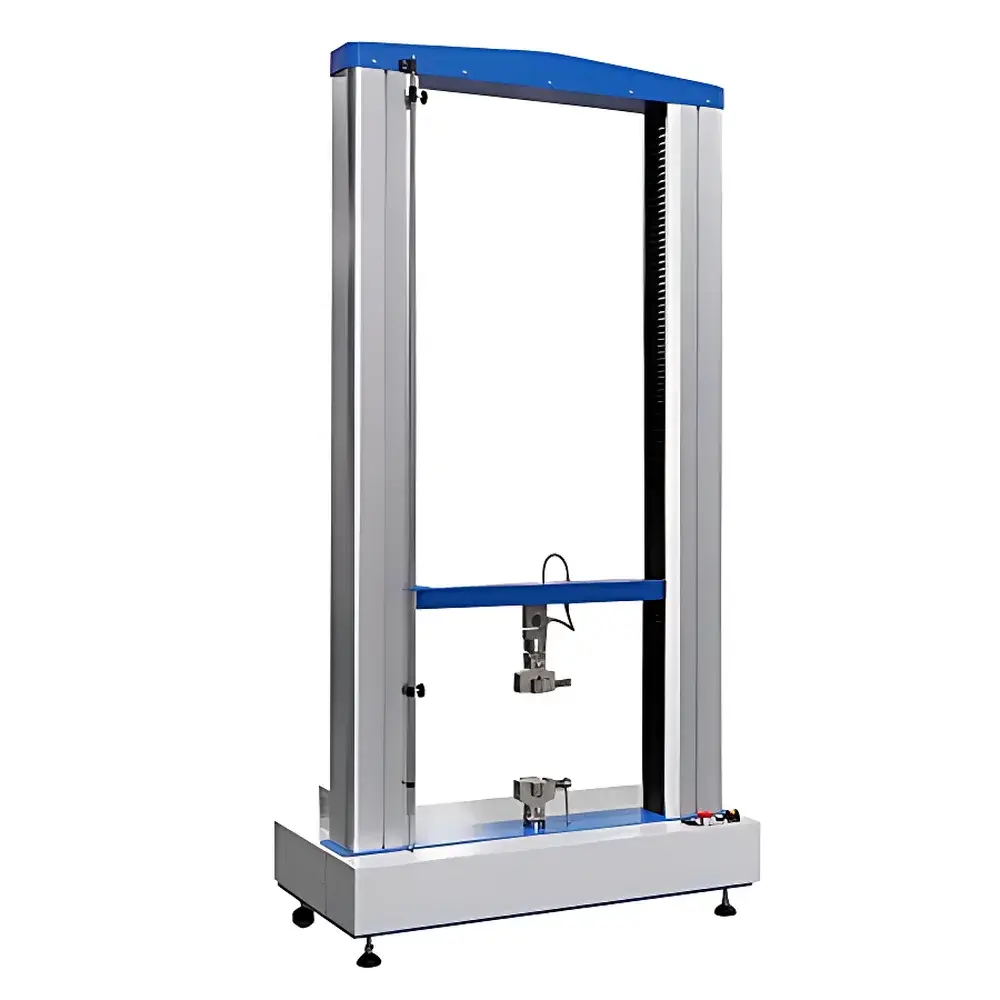
Yuelian PW-UD20 Universal Testing Machine for Compression Stress-Strain and Compression Ratio Testing
| Brand | Yuelian |
|---|---|
| Model | PW-UD20 |
| Type | Electromechanical Universal Testing Machine |
| Max Load Capacity | 5 kN (optional range: 10 N to 5 kN) |
| Force Resolution | 1/500,000 full scale |
| Force Accuracy | ±0.03% FS |
| System Accuracy Class | ISO 7500-1 / ASTM E4 Class 0.5 |
| Travel Range | 800 mm (customizable) |
| Crosshead Speed | 0.01–500 mm/min (customizable) |
| Test Space (W×D) | 420 mm (customizable) |
| Dimensions (W×D×H) | 780 × 530 × 1420 mm |
| Weight | 85 kg |
| Power Supply | 220 V, 50–60 Hz |
| Motor Drive | Servo Motor |
| Communication Interface | Optically Isolated USB |
Overview
The Yuelian PW-UD20 is a precision-engineered electromechanical universal testing machine designed for static mechanical characterization of solid materials under uniaxial compressive loading. It operates on the principle of controlled displacement or force-controlled actuation via a high-resolution servo motor drive system, enabling accurate determination of stress–strain behavior, compression ratio, yield point, compressive strength, modulus of elasticity, and deformation recovery characteristics. The system complies with core international standards including ISO 6892-1 (tensile), ISO 14126 (compressive properties of fiber-reinforced plastics), ASTM D695 (compressive properties of rigid plastics), ASTM C39 (concrete cylinders), and ISO 7500-1 (static calibration of force-measuring systems). Its modular architecture supports interchangeable load cells, fixtures, and environmental accessories—making it suitable for R&D laboratories, quality control departments, and third-party certification facilities requiring traceable, repeatable mechanical testing.
Key Features
- High-fidelity dual-closed-loop control: Simultaneous real-time regulation of crosshead position and load output for precise stress–strain curve acquisition.
- Optically isolated USB interface: Eliminates ground-loop interference and enables hot-plug compatibility with Windows-based host PCs—critical for long-term system stability in industrial lab environments.
- Multi-level software permission management: Role-based access control (operator, supervisor, manufacturer) ensures data integrity and audit readiness per GLP/GMP and FDA 21 CFR Part 11 requirements.
- Auto-return function: Upon specimen failure or limit trigger, the crosshead returns at maximum speed to initial position—reducing cycle time and operator intervention.
- 16-bit analog-to-digital conversion with 1/500,000 internal resolution across force and displacement channels, supporting sub-micron displacement detection and sub-newton force sensitivity.
- Thermally stable load cell mounting and low-drift signal conditioning circuitry ensure <0.03% FS force accuracy over extended test durations.
- Modular fixture compatibility: Standard compression platens included; optional fixtures available for bending (3-point/4-point), shear, peel, tear, and tensile testing per ISO 527, ASTM D882, and ISO 8510.
Sample Compatibility & Compliance
The PW-UD20 accommodates specimens ranging from thin polymer films (<0.1 mm thick) to structural concrete cylinders (up to Ø150 mm × 300 mm). Its 420 mm lateral test space and 800 mm vertical stroke allow evaluation of both standard and non-standard geometries—including foams, elastomers, ceramics, composites, biomedical scaffolds, and food products. All hardware and firmware conform to CE electromagnetic compatibility (EMC) directives and RoHS material restrictions. Software-generated reports include embedded metadata (timestamp, operator ID, calibration certificate ID, environmental conditions) to support ISO/IEC 17025 accreditation. Raw test data files are stored in vendor-neutral binary format with ASCII export capability for third-party statistical analysis.
Software & Data Management
The integrated Windows-native testing software provides full compliance with analytical traceability requirements. It supports SI, metric (kgf-cm), and imperial (lbf-in) unit systems—with six preconfigured engineering unit sets (e.g., N–mm–MPa, lbf–in–kpsi) and automatic field-name translation across 12 UI languages. Data handling includes: raw waveform capture at ≥1 kHz sampling rate; multi-curve overlay with independent scaling and color assignment; derivative-based modulus calculation (secant/tangent); automatic identification of yield points per ASTM E111; and customizable report templates exportable to PDF, Word (.docx), and Excel (.xlsx). Database schema follows relational design principles, enabling SQL-based querying and integration with LIMS platforms via ODBC drivers.
Applications
- Compression testing of polymeric foams per ISO 1856 and ASTM D3574.
- Determination of compression set and recovery kinetics in elastomeric seals and gaskets.
- Characterization of pharmaceutical tablet mechanical integrity (crushing strength, friability correlation).
- Mechanical validation of additive-manufactured lattice structures under quasi-static loading.
- Quality assurance of packaging materials—including corrugated board (ISO 3037), honeycomb panels, and cushioning inserts.
- Educational use in materials science curricula for stress–strain diagram construction and Hooke’s law verification.
FAQ
What standards does the PW-UD20 comply with for compression testing?
It meets ISO 7500-1 (force measurement accuracy), ISO 14126 (FRP compression), ASTM D695 (rigid plastics), and ASTM C39 (concrete)—with optional calibration certificates traceable to NIST or national metrology institutes.
Can the system perform cyclic compression tests?
Yes—the software supports programmable multi-step load/displacement profiles, including hold periods, ramp reversals, and staircase sequences for fatigue-relevant quasi-static cycling.
Is third-party calibration support available?
Yuelian provides factory calibration documentation and coordinates with ISO/IEC 17025-accredited service providers for on-site or depot recalibration.
How is data security ensured during long-term deployment?
Role-based login, encrypted local database storage, electronic signature logging, and configurable audit trail retention align with FDA 21 CFR Part 11 and EU Annex 11 expectations.
What maintenance intervals are recommended?
Biannual inspection of load cell mounting integrity, lubrication of lead screws, and verification of encoder linearity—documented in the included maintenance logbook and supported by remote diagnostic tools.



