
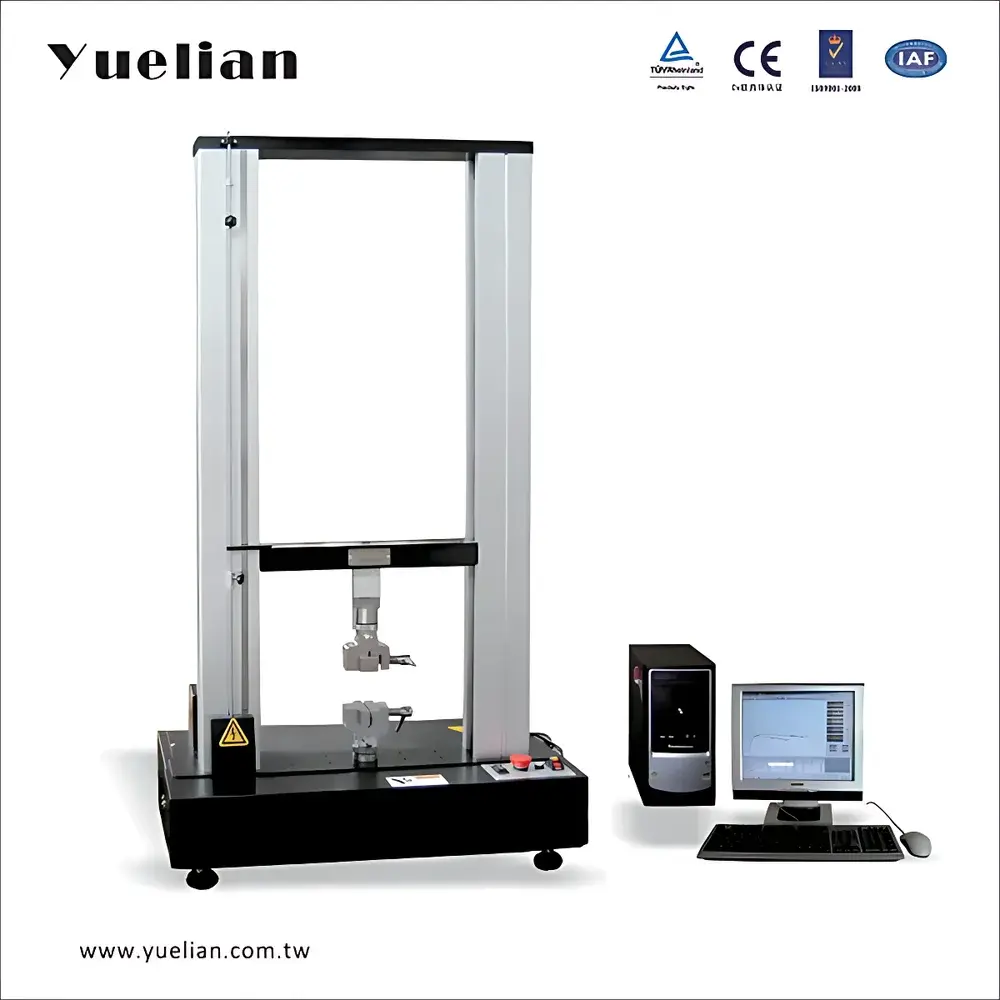
Yuelian YL-1210 Universal Electronic Testing Machine
| Brand | Yuelian |
|---|---|
| Origin | Guangdong, China |
| Model | YL-1210 |
| Instrument Type | Electronic Universal Testing Machine |
| Load Capacity Options | 10 N, 20 N, 50 N, 100 N, 200 N, 500 N, 1 kN, 2 kN, 5 kN (dual-range configuration available) |
| Force Resolution | 1/500,000 |
| Force Accuracy | ±0.3% of full scale |
| Crosshead Travel | 800 mm |
| Test Width | 420 mm |
| Speed Range | 0.01–1000 mm/min (computer-controlled) |
| Position Resolution | 1/500,000 |
| Drive System | Servo motor with precision ball screw and timing belt transmission |
| Power Supply | 220 V, 50/60 Hz, 10 A |
| Power Consumption | 400 W |
| Dimensions (W×D×H) | 80 × 52 × 155 cm |
| Weight | ~220 kg |
| Standard Accessories | One set of grips, proprietary PC-based test software, USB interface cable |
| Optional | User-supplied desktop computer |
| Compliant Standards | GB/T 2792, ASTM D3330, GB/T 15598–1995, HG/T 2-163, GB/T 7753–1987, GB/T 7754–1987, GB/T 7124–1986, GB/T 7124–2008 |
Overview
The Yuelian YL-1210 Universal Electronic Testing Machine is a microprocessor-controlled, servo-driven mechanical testing system engineered for high-reproducibility tensile, compression, flexural, shear, peel, tear, and adhesion characterization of polymeric, metallic, fibrous, and composite materials. Based on the fundamental principles of axial force-displacement measurement under controlled strain or load rates, the YL-1210 implements closed-loop feedback control via high-resolution encoder signals from the ball screw assembly and precision load cell output. Its modular architecture supports standardized mechanical testing protocols across R&D laboratories, QC/QA departments, and contract testing facilities—particularly where compliance with international material specification frameworks (e.g., ISO 527, ASTM D638, ISO 178, ASTM D790) is required. Designed for stability and repeatability in ambient laboratory environments, the system delivers traceable mechanical property data including ultimate tensile strength, yield stress, elongation at break, Young’s modulus, bending stiffness, and interfacial bond strength.
Key Features
- Servo-motor actuation with precision ground ball screw and synchronous timing belt transmission ensures smooth, low-backlash motion and long-term mechanical stability.
- High-resolution force measurement: 1/500,000 internal resolution with ±0.3% full-scale accuracy across nine selectable load ranges (10 N to 5 kN), enabling dual-capacity configurations for multi-material workflows.
- Programmable crosshead speed from 0.01 to 1000 mm/min—adjustable in real time via intuitive PC interface; includes dedicated rapid-positioning buttons for fixture alignment.
- 800 mm vertical travel and 420 mm test width accommodate extended specimens (e.g., geotextiles, laminated composites, extruded profiles) without reconfiguration.
- Integrated safety logic: automatic halt on specimen rupture, overload detection, user-defined upper/lower displacement limits, emergency stop button, and auto-return-to-initial-position function.
- Robust steel frame construction with vibration-damped base minimizes environmental interference during low-force measurements (e.g., thin films, elastomeric adhesives).
Sample Compatibility & Compliance
The YL-1210 accommodates diverse specimen geometries—from sub-millimeter polymer filaments and pressure-sensitive adhesive tapes to 10-mm-thick structural composites—via interchangeable grip systems (tensile wedge, pneumatic, hydraulic, peel, shear, and custom fixtures). It supports standardized test methods referenced in major regulatory and industrial specifications, including GB/T 2792 (peel strength of pressure-sensitive tapes), ASTM D3330 (adhesive tape peel adhesion), GB/T 7124 (adhesive shear strength), and ISO 8510-2 (peel testing of flexible substrates). Data acquisition and reporting meet GLP-aligned documentation requirements, with audit-trail-capable software logs (user actions, parameter changes, calibration events) compatible with FDA 21 CFR Part 11 readiness when deployed with validated IT infrastructure.
Software & Data Management
The proprietary Windows-based control and analysis suite provides real-time graphical display of force–displacement, stress–strain, and time-based curves. It calculates and exports over 20 mechanical parameters—including maximum load, yield point (0.2% offset method), modulus of elasticity, secant modulus, energy to break, and average peel force—with customizable pass/fail thresholds. Raw data is stored in native binary format and exportable to CSV, Excel, or PDF. The software embeds MS Access database architecture for structured test record management, supporting batch ID tagging, operator authentication, instrument calibration history linkage, and report generation per ISO/IEC 17025 Annex A.5 requirements. Multi-sensor input channels allow simultaneous acquisition from extensometers, environmental chambers, or video extensometry modules (optional).
Applications
- Quality assurance of injection-molded plastic components (PP, ABS, PC, POM) per ISO 527-2 tensile testing protocols.
- Adhesive performance validation in automotive trim bonding, medical device packaging lamination, and flexible electronics substrate attachment.
- Mechanical screening of biodegradable polymers (PLA, PHA) during formulation development and degradation studies.
- Compression testing of foam cushions, gaskets, and elastomeric seals per ASTM D3574.
- Peel and tack evaluation of PSA tapes, labels, and wound-care dressings under variable peel angles and rates.
- Educational use in university materials science labs for hands-on instruction in solid mechanics fundamentals and standard test method execution.
FAQ
Does the YL-1210 support extensometer integration?
Yes—the system features analog and digital input channels compatible with contact and non-contact extensometers for strain-controlled testing and modulus determination.
Is calibration certification included with delivery?
A factory-issued calibration certificate traceable to national standards (CNAS-accredited reference labs) is provided; annual recalibration services are available under service agreement.
Can test methods be password-protected or locked for production line use?
Yes—operator privilege levels can restrict access to method editing, parameter modification, or report deletion, ensuring SOP adherence in regulated manufacturing environments.
What operating system versions are supported?
The software is validated on Windows 10 (64-bit) and Windows 11 (64-bit); legacy Windows 7 support is discontinued as of Q2 2024.
Is thermal chamber compatibility available?
Optional environmental chamber interfaces (−70 °C to +250 °C) are supported via third-party vendors; integration requires signal conditioning and firmware update verification.



