
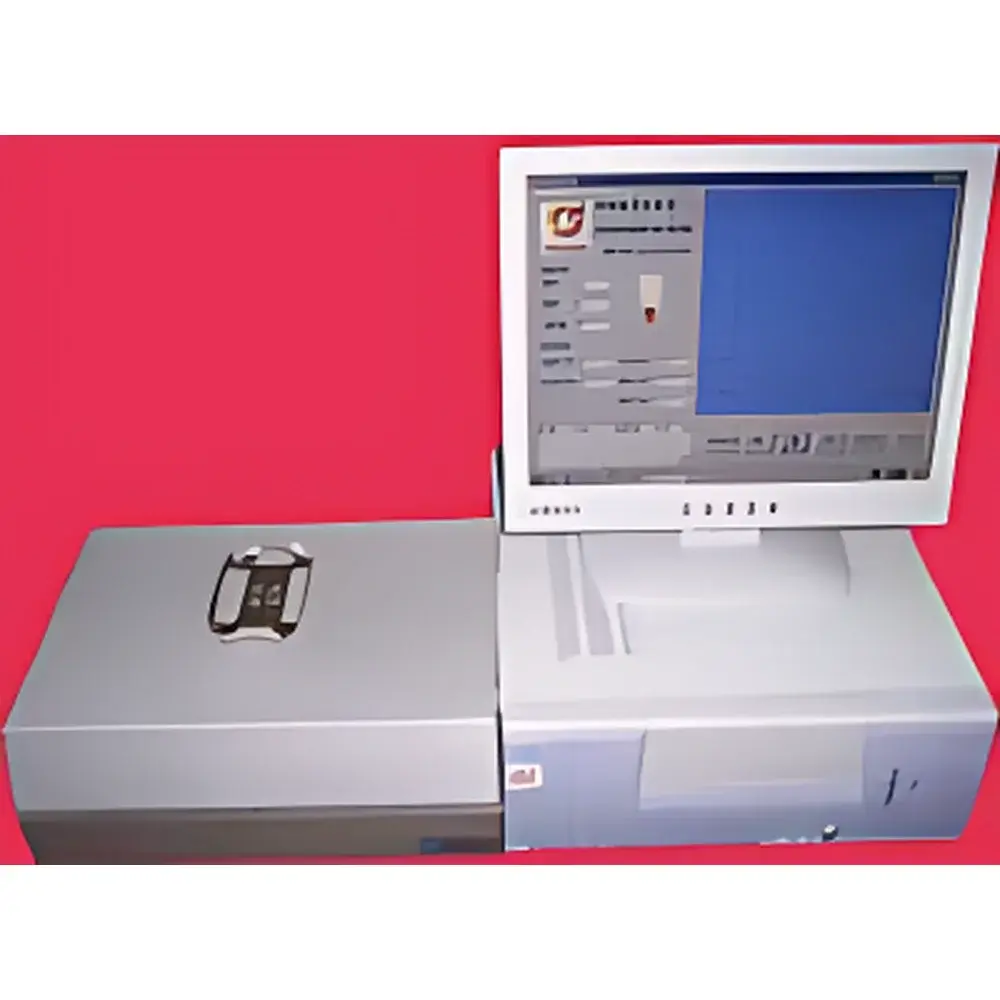
Yueweitang RS-2A Non-Destructive Package Integrity Tester for Aseptic Cartons
| Brand | Yueweitang |
|---|---|
| Model | RS-2A |
| Origin | Beijing, China |
| Type | Industrial Non-Destructive Integrity Tester for Aseptic Beverage Packaging |
| Detection Principle | Inertial Kinetic Energy Measurement |
| Max Throughput | 700–800 packages/hour |
| Accuracy (Standard Deviation) | ≤0.0030 |
| Resolution | 0.0001 |
| Recognition Rate | >99% for Coagulated, Gas-Swollen, and Severely Acidified Packages |
| Sample Compatibility | Tetra Brick®, Tetra Pillow® cartons (standard), with interchangeable trays for multiple package formats |
| Compliance | Designed for GLP-aligned food quality control environments |
Overview
The Yueweitang RS-2A Non-Destructive Package Integrity Tester is an industrial-grade instrumentation system engineered specifically for rapid, contactless assessment of microbiological spoilage in aseptically packaged liquid foods—primarily dairy, juice, and plant-based beverages sealed in Tetra Brick® and Tetra Pillow® cartons. Unlike destructive sampling methods requiring package opening and microbial culturing (which incur delays of 48–72 hours), the RS-2A employs a proprietary inertial kinetic energy measurement principle. This technique quantifies minute variations in internal mass distribution and fluid dynamics induced by gas evolution (CO₂ from lactic acid bacteria) or protein coagulation—both hallmarks of spoilage—by subjecting each package to controlled oscillatory motion and analyzing its deceleration profile under calibrated inertial load. The system operates without mechanical contact with package contents, eliminating cross-contamination risk and preserving product integrity throughout testing. It is not a sensor-based gas detector or optical scanner; rather, it functions as a dynamic mechanical integrity analyzer, delivering objective, physics-based pass/fail classification aligned with established sensory and microbiological failure thresholds.
Key Features
- Non-destructive, zero-prep operation: Packages are loaded directly onto standardized trays—no opening, no labeling removal, no temperature equilibration required.
- Inertial kinetic measurement architecture: Patented mechanical transduction system with no consumables or wear-prone components (e.g., no load cells, piezoelectric sensors, or optical emitters).
- High-throughput validation: Sustained detection rate of 700–800 cartons per hour under continuous operation, compatible with inline QC station integration.
- Modular tray system: Interchangeable fixtures for Tetra Brick® (1L, 500mL, 250mL), Tetra Pillow® (200mL–1L), and custom configurations—enabling rapid reconfiguration across production lines.
- Digital acquisition and classification: Embedded microcontroller performs real-time signal processing, applies empirically validated discriminant algorithms, and outputs binary integrity status (Pass / Reject) with confidence indexing.
- Stability and reproducibility: Standard deviation ≤0.0030 and resolution of 0.0001 ensure consistent discrimination between borderline spoilage events and normal fill variation across shifts and operators.
Sample Compatibility & Compliance
The RS-2A is validated for use with commercially sterilized, multi-layer composite cartons manufactured using polyethylene-aluminum-polyethylene (PE/Al/PE) laminates and sealed via hydrogen peroxide or UV sterilization—specifically Tetra Pak®-compatible formats including Tetra Brick® Aseptic, Tetra Pillow®, and equivalent OEM packaging. It does not support rigid PET bottles, glass containers, or foil-laminated pouches outside its defined mechanical envelope. While not certified to ISO/IEC 17025 or ASTM F2096 (bubble emission test), the instrument is routinely deployed within food manufacturing QA frameworks compliant with Codex Alimentarius General Principles of Food Hygiene and national GMP regulations. Its output supports root-cause analysis in HACCP plans and fulfills internal documentation requirements for non-conformance tracking under ISO 22000:2018 Clause 8.7.1.
Software & Data Management
The RS-2A integrates a dedicated Windows-based host application that provides full traceability: each test record includes timestamp, operator ID (optional login), package type, tray position, raw kinetic waveform, classified result, and confidence score. Data export is available in CSV and XML formats for ingestion into LIMS or ERP systems (e.g., SAP QM, MasterControl). Audit trails capture all user actions—including parameter modifications and calibration resets—with immutable timestamps. Though not FDA 21 CFR Part 11-compliant out-of-the-box (no electronic signature module), the software architecture supports configuration for 21 CFR Part 11 readiness when deployed with validated domain authentication and external digital signature infrastructure.
Applications
- Routine end-of-line QC screening for shelf-stable UHT milk, soy milk, and fruit nectars prior to palletizing.
- Investigation of suspected spoilage incidents in finished goods inventory or customer complaint batches.
- Process validation during changeovers involving new packaging suppliers or sterilization parameters.
- Supporting accelerated shelf-life studies by enabling repeated non-destructive monitoring of stability samples over time.
- Reducing laboratory workload by filtering >95% of sound packages before selective microbiological confirmation testing.
FAQ
What physical property does the RS-2A actually measure?
It measures the damping coefficient and oscillatory decay profile of a package subjected to controlled inertial excitation—correlating deviations from baseline kinematics to internal phase changes caused by microbial gas production or protein network formation.
Can the RS-2A detect early-stage spoilage before visible swelling occurs?
Yes—its sensitivity to subtle shifts in internal mass inertia enables detection of CO₂ accumulation at levels below macroscopic distension, typically 12–24 hours earlier than visual inspection.
Is calibration required between shifts or daily?
No scheduled recalibration is needed; the system uses self-referencing mechanical reference states and factory-trimmed inertial constants. A daily performance verification using certified reference packages is recommended.
Does it require connection to a central network or IT infrastructure?
No—it operates as a standalone unit with local data storage. Network connectivity is optional and used only for scheduled data upload or remote diagnostics.
How is operator training structured?
Training consists of a 4-hour hands-on session covering tray loading, result interpretation, basic troubleshooting, and data export—no prior metrology or fluid mechanics background required.
Related Products






