
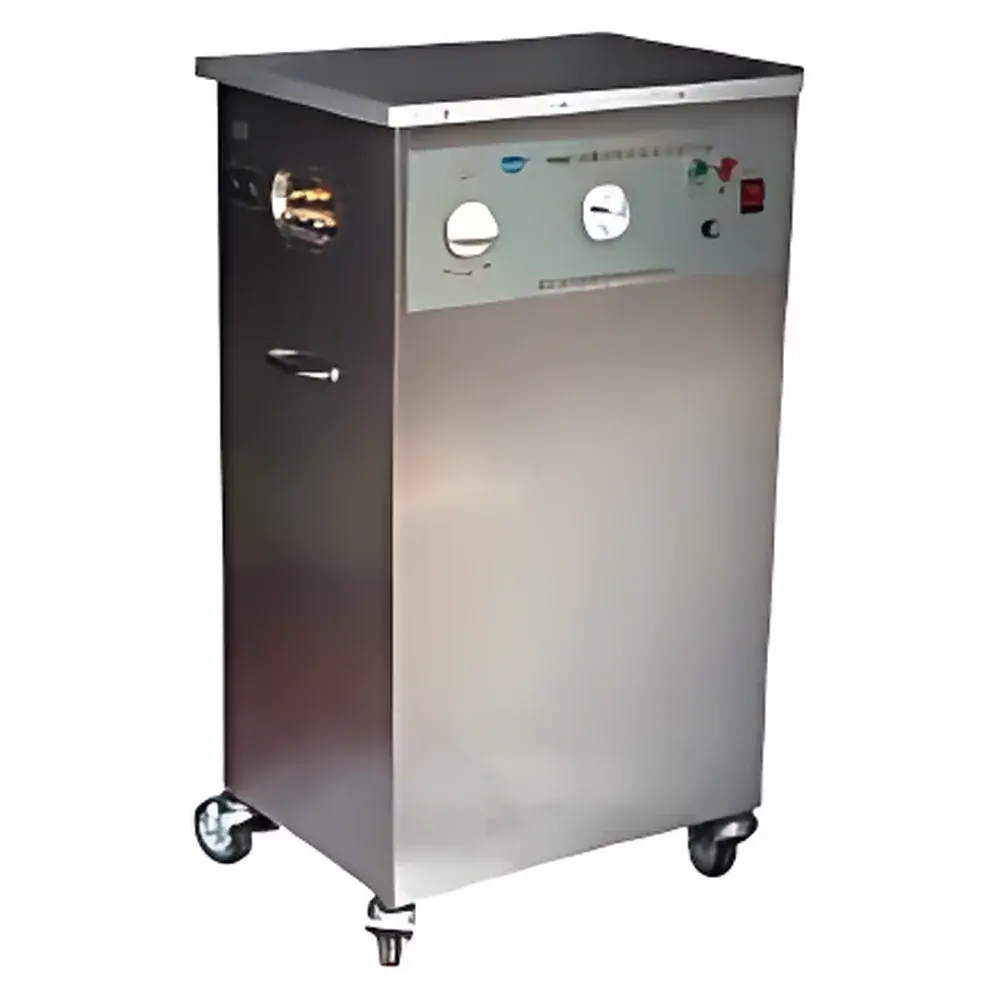
YUHUA SHZ-C Stainless Steel Five-Port Circulating Water Vacuum Pump
| Brand | YUHUA |
|---|---|
| Origin | Henan, China |
| Model | SHZ-C |
| Construction | Fully stainless steel pump body, impeller, and water distributor |
| Number of Vacuum Ports | 5 (independently controllable or parallel operation) |
| Operating Principle | Water-ring vacuum generation via circulating water cooling and sealing |
| Power Supply | Standard AC mains (220 V / 50 Hz typical for domestic lab use) |
| Cooling Method | Internal + external recirculating water system |
| Lubrication | Oil-free operation |
| Compliance | Designed for general laboratory vacuum applications per GB/T 29878–2013 (Chinese national standard for laboratory vacuum pumps) |
Overview
The YUHUA SHZ-C Stainless Steel Five-Port Circulating Water Vacuum Pump is an oil-free, water-sealed vacuum source engineered for continuous-duty operation in chemistry, pharmaceutical, and materials science laboratories. It operates on the water-ring principle: rotating stainless steel impellers displace water within a cylindrical casing to form a dynamic seal, generating vacuum through volumetric displacement. Unlike dry scroll or diaphragm pumps, this design leverages recirculated water as both coolant and sealing medium—eliminating hydrocarbon contamination risks while maintaining stable suction pressure across multiple simultaneous processes. The integrated dual-loop water circulation system (internal chamber + external reservoir) ensures thermal stability during extended operation and minimizes tap water consumption—a critical consideration for labs subject to water-use regulations or operating in regions with limited municipal supply.
Key Features
- Five independently configurable vacuum ports: Each port features a dedicated valve for isolated control, enabling concurrent operation of up to five separate vacuum-dependent apparatuses—such as rotary evaporators, vacuum filtration manifolds, distillation traps, or degassing chambers—without cross-contamination or pressure coupling.
- Corrosion-resistant stainless steel construction: Pump body, impeller, and water distributor are fabricated from AISI 304 stainless steel, providing long-term resistance to acidic vapors (e.g., HCl, HNO₃), organic solvents (acetone, ethyl acetate), and aqueous salt solutions commonly encountered in synthetic and analytical workflows.
- No-oil, low-maintenance architecture: Eliminates need for oil replenishment, vapor trapping, or periodic oil analysis—reducing operational overhead and ensuring consistent vacuum integrity across GLP-compliant documentation cycles.
- Acoustically optimized mechanical design: Precision-balanced impeller and vibration-dampened mounting reduce operational noise to ≤62 dB(A) at 1 m distance, meeting ISO 3744 acoustic emission requirements for shared laboratory environments.
- Energy-efficient thermal management: Dual-path water circulation (internal jacket + external reservoir loop) maintains optimal operating temperature (typically 15–25 °C) without reliance on continuous tap water flow—reducing power draw by up to 40% compared to single-pass systems.
Sample Compatibility & Compliance
The SHZ-C is compatible with standard ground-glass jointed glassware (ISO 2798, DIN 12255) and common vacuum-rated tubing (silicone, Viton®, or reinforced PVC). It supports vacuum levels down to approximately 0.095 MPa (absolute), sufficient for rotary evaporation of solvents with boiling points below 120 °C at atmospheric pressure. While not certified for explosive or highly toxic gas handling per ATEX or IECEx directives, its oil-free, spark-free motor and non-ferrous wetted parts make it suitable for Class I, Division 2 hazardous locations when installed per NEC Article 500 guidelines. The unit conforms to GB/T 29878–2013 for laboratory vacuum pump performance, safety, and labeling; documentation includes CE-marked electrical components compliant with IEC 61000-6-3 (EMC) and IEC 60335-1 (safety).
Software & Data Management
As a standalone mechanical vacuum source, the SHZ-C does not incorporate embedded microcontrollers, digital interfaces, or data logging capabilities. Its operation is manually controlled via front-panel valves and main power switch. For integration into automated workflows, third-party pressure transducers (e.g., Validyne DP15 or MKS Baratron series) may be installed downstream to monitor absolute vacuum levels, with analog outputs routed to PLCs or LIMS-compatible DAQ systems. Audit trails for maintenance intervals (e.g., water reservoir cleaning, gasket inspection) should be recorded manually per institutional GLP/GMP procedures.
Applications
- Routine solvent removal via rotary evaporation under reduced pressure
- Vacuum-assisted gravity and Büchner filtration of crystalline or particulate products
- De-airing of resin mixtures, polymer precursors, or ceramic slurries prior to casting
- Low-pressure drying of heat-sensitive biological samples (lyophilization pre-chamber evacuation)
- Gas-phase reaction setup requiring inert atmosphere purging and vacuum backfilling cycles
- Supporting vacuum-jacketed condensers in fractional distillation assemblies
FAQ
What is the maximum achievable vacuum level?
Typical ultimate vacuum is 0.095 MPa (absolute) under ambient conditions with clean, cool circulating water (≤25 °C). Actual performance depends on water temperature, ambient humidity, and system leak integrity.
Can this pump be used with aggressive solvents like chloroform or THF?
Yes—the stainless steel wetted path resists corrosion from most common organic solvents; however, prolonged exposure to halogenated solvents may require more frequent water changes to prevent hydrolysis byproducts from accumulating in the reservoir.
Is tap water required for operation?
No. The dual-loop design enables closed-circuit operation using deionized or distilled water; tap water may be used only if local hardness is low (<100 ppm CaCO₃) to avoid scale buildup.
How often should the circulating water be replaced?
Under continuous 8-hour operation, replace water every 2–3 days; for intermittent use, weekly replacement is sufficient. Visual inspection for turbidity or biofilm formation should guide maintenance frequency.
Does the pump include vacuum gauges or pressure regulation?
No—vacuum monitoring and regulation must be implemented externally using calibrated analog or digital gauges compatible with the intended pressure range (0–100 kPa absolute).



