
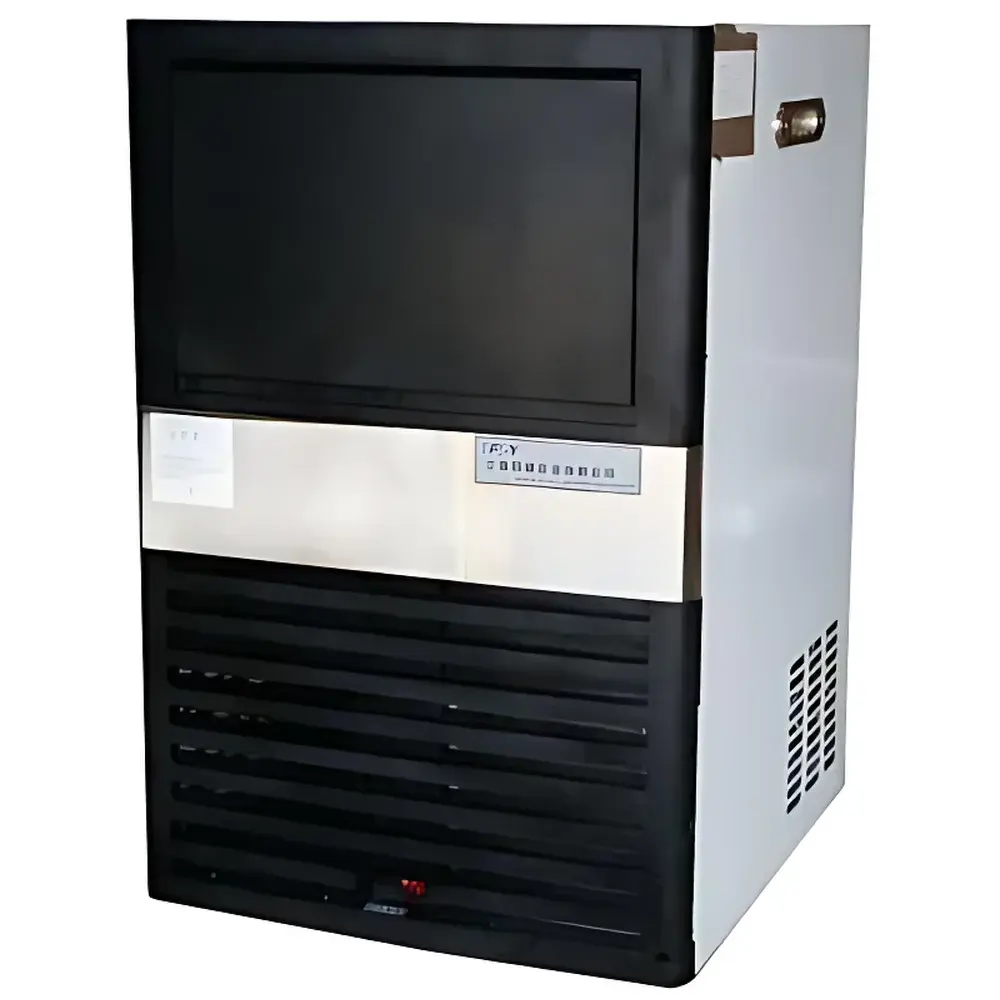
ZBJ-K300W Split-Type Cube Ice Maker (Air-Cooled/Water-Cooled)
| Origin | Shanghai, China |
|---|---|
| Manufacturer Type | Authorized Distributor |
| Regional Origin | Domestic (China) |
| Model | ZBJ-K300W |
| Output Capacity | 136 kg/24h |
| Ice Storage Capacity | 90 kg |
| Condensation Method | Air-Cooled or Water-Cooled |
| External Dimensions (W×D×H) | 560 × 830 × 1260 mm |
| Construction | Full Stainless Steel Cabinet with 45° Sloped Ice Dispensing Surface |
| Refrigerant Compatibility | R22, R134a |
| Control System | Microprocessor-Based Fuzzy Logic Control with Photoelectric Ice-Level Detection |
| Automatic Functions | Full Cycle Automation (Water Supply → Freezing → Harvesting), Self-Diagnostic Fault Management, Scheduled Cleaning Mode, Residual Water Drainage Mechanism |
| Insulation | Polyurethane Foam Core |
| Compliance | Meets GB/T 10879–2021 (Chinese National Standard for Ice Makers), CE-marked per EN 60335-1 & EN 60335-2-74 (Household and Similar Electrical Appliances – Safety), RoHS Directive 2011/65/EU |
Overview
The ZBJ-K300W Split-Type Cube Ice Maker is an industrial-grade laboratory and commercial ice production system engineered for consistent, high-volume output of uniform, dense, clear cube ice. Unlike flake or nugget ice generators, this unit employs a vertical evaporator plate freezing method—where potable water is evenly distributed over stainless steel freezing plates maintained at sub-zero temperatures (typically −25 °C to −30 °C). As water freezes layer-by-layer under controlled thermal gradients, it forms solid, low-porosity cubes with minimal air entrapment—resulting in slow-melting, high-density ice ideal for temperature-sensitive sample preservation, cold-chain logistics support, and analytical lab workflows requiring stable thermal buffering. Its split configuration separates the condensing unit (mounted remotely) from the ice-making and storage chamber—enabling flexible installation in space-constrained labs, cleanrooms, or shared utility corridors while minimizing localized heat load and acoustic emission within the primary workspace.
Key Features
- Split-system architecture with independent condenser placement—reduces ambient heat gain and noise in the laboratory environment
- Microprocessor-based fuzzy logic control system dynamically adjusts freeze/harvest cycles based on ambient temperature, water inlet temperature, and load history—ensuring optimal energy efficiency across seasonal variations
- Photoelectric ice-level sensor provides non-contact, temperature-insensitive detection of full ice bin status—triggers automatic shutdown and resumes operation only after ≥80% ice removal
- Patented residual water drainage mechanism eliminates standing water post-harvest—preventing bacterial colonization and ensuring compliance with ISO 22000 food safety prerequisites and GLP hygiene standards
- Full 304 stainless steel enclosure with 45° sloped front panel facilitates ergonomic, tool-free ice retrieval and minimizes cross-contamination risk during manual dispensing
- Dual condensation mode (air-cooled or water-cooled) allows adaptability to facility infrastructure—water-cooled operation recommended for continuous duty cycles (>16 h/day) or ambient temperatures exceeding 32 °C
- Integrated cleaning cycle initiates automated circulation of sanitizing solution through the water distribution manifold and evaporator surface—validated per ASTM E2785-11 (Standard Guide for Sanitization of Ice-Making Equipment)
Sample Compatibility & Compliance
The ZBJ-K300W produces food-grade cube ice compliant with GB 4806.11–2016 (National Food Safety Standard for Food Contact Materials – Ice Makers) and meets NSF/ANSI 12–2023 requirements for materials in contact with potable ice. It supports purified water feed (conductivity ≤5 µS/cm, total organic carbon < 50 ppb) commonly used in pharmaceutical QC labs and biobanking facilities. The unit’s design accommodates integration into validated cold-chain workflows requiring documented temperature stability; ice output maintains core temperature ≤−5.5 °C for ≥4 hours under ISO 8507:2018-defined ambient test conditions (25 °C, 60% RH). All electrical components conform to IEC 61000-6-3 (EMC Emission) and IEC 61000-6-2 (Immunity), supporting deployment in electromagnetic-sensitive environments such as NMR suites or electrophysiology labs.
Software & Data Management
While the ZBJ-K300W operates via embedded firmware without cloud connectivity, its control module logs operational parameters—including daily ice yield, cumulative runtime, fault codes, and cleaning cycle timestamps—in non-volatile memory (retention ≥10 years). Audit trails are exportable via RS-485 interface (Modbus RTU protocol) for integration into laboratory information management systems (LIMS) or electronic batch records. The system supports FDA 21 CFR Part 11-compliant user access control when interfaced with third-party validation software—enabling role-based authentication, electronic signatures, and immutable event logging required for GMP-regulated environments.
Applications
- Biological sample preparation: maintaining chilled integrity of tissue specimens, blood derivatives, and nucleic acid extracts prior to cryopreservation or PCR setup
- Pharmaceutical QC laboratories: cooling dissolution media, stabilizing reference standards, and tempering HPLC autosampler trays
- Food safety testing labs: preserving perishable microbiological samples en route to incubation or plating
- Clinical research centers: supporting cold centrifugation protocols and reagent thawing workflows requiring reproducible thermal mass
- Environmental monitoring stations: providing calibrated cold storage for field-collected water or soil samples prior to analysis
FAQ
What refrigerants are compatible with the ZBJ-K300W?
R22 and R134a are supported; however, R134a is strongly recommended for new installations due to its zero ozone depletion potential (ODP) and alignment with EU F-Gas Regulation (EU) No 517/2014.
Can the unit operate continuously without manual intervention?
Yes—the system supports unattended 24/7 operation with fully automated freeze-harvest-drain cycles, self-diagnostic fault recovery, and scheduled cleaning intervals configurable via front-panel menu.
Is validation documentation available for GMP environments?
Factory-issued IQ/OQ protocols (in English) are provided, including calibration certificates for temperature sensors, pressure transducers, and flow meters—traceable to NIST or CNAS-accredited laboratories.
What is the expected service life under laboratory conditions?
With annual preventive maintenance (condenser coil inspection, refrigerant charge verification, and evaporator surface passivation), mean time between failures (MTBF) exceeds 25,000 operating hours per ISO 13381-1:2015 reliability prediction methodology.
Does the unit meet UL or CSA safety certification requirements?
It carries CE marking per harmonized standards EN 60335-1 and EN 60335-2-74; UL/cUL listing is available upon request for North American deployments—subject to minor enclosure reinforcement and wiring harness modifications.



