
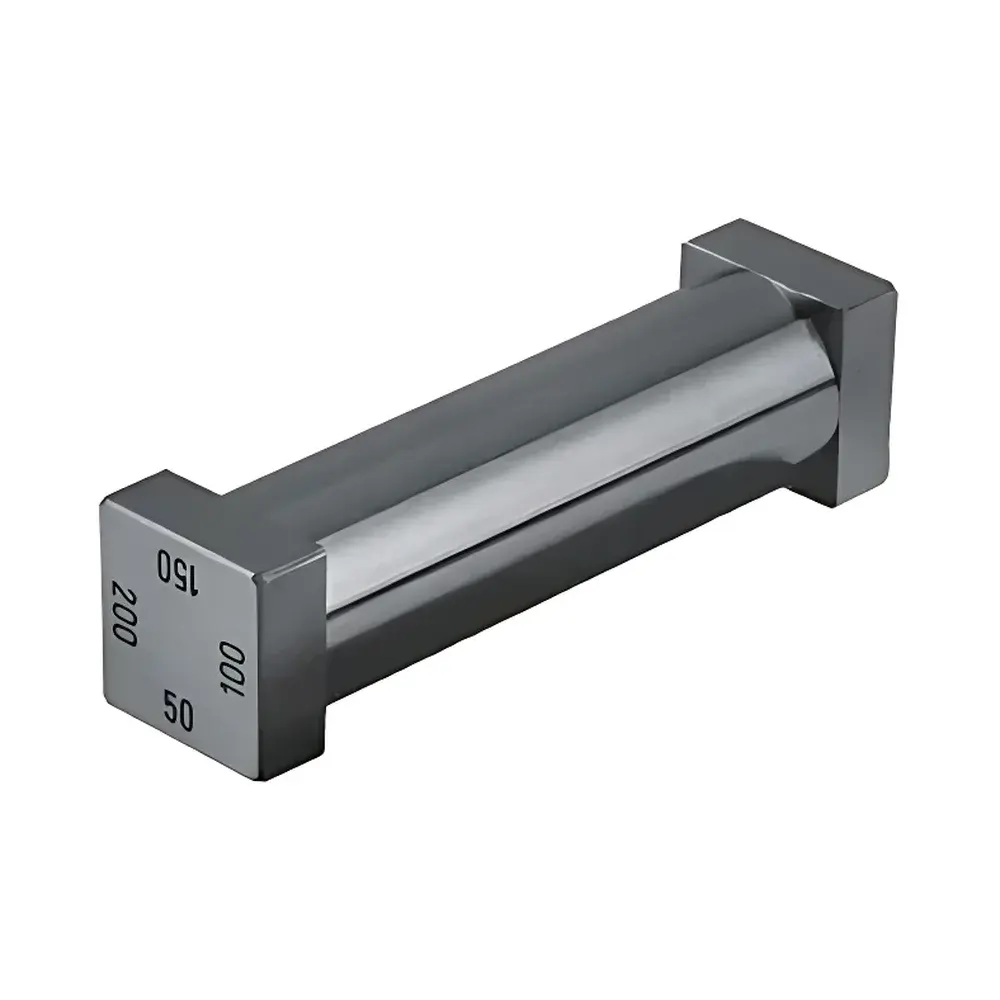
ZBQ-4 Four-Sided Wet Film Applicator
| Origin | Shanghai, China |
|---|---|
| Manufacturer Type | Authorized Distributor |
| Origin Category | Domestic (China) |
| Model | ZBQ-4 Four-Sided |
| Price | Upon Request |
| Material | Stainless Steel (Corrosion-Resistant) |
| Effective Coating Width | 80 mm |
| Total Length | 100 mm |
| Available Wet Film Thicknesses | 5–1000 µm across seven interchangeable blade sets (5/10/15/20/25/50/75/100 |
Overview
The ZBQ-4 Four-Sided Wet Film Applicator is a precision-engineered laboratory tool designed for reproducible, controlled deposition of liquid coatings—such as paints, adhesives, inks, sealants, and functional dispersions—onto flat, rigid substrates. It operates on the principle of gap-controlled draw-down: as the applicator is drawn uniformly across the surface at a consistent speed and angle, the liquid film thickness is determined solely by the calibrated height of the machined notches on each side. This mechanical method eliminates operator-dependent variability and provides traceable, repeatable wet film thickness (WFT) values without requiring real-time instrumentation or calibration against reference standards. The device is widely deployed in R&D laboratories, quality control environments, and formulation development workflows where rapid, standardized film preparation is essential prior to drying, curing, or subsequent characterization (e.g., gloss, adhesion, hardness, FTIR mapping, or cross-section SEM analysis).
Key Features
- Four-sided stainless steel body with eight distinct notch arrays—two per side—enabling immediate selection of 32 discrete wet film thicknesses ranging from 5 µm to 1000 µm;
- Corrosion-resistant 304 stainless steel construction ensures long-term dimensional stability and compatibility with aqueous, acidic, alkaline, and mildly solvent-based formulations;
- 80 mm effective coating width and 100 mm total length optimized for standard test panels (e.g., ISO 1514, ASTM D1729, GB/T 9271);
- High-precision wire-EDM machined notches with ±1 µm tolerance on nominal depth, verified via tactile profilometry during manufacturing;
- No moving parts or electronic components—fully manual operation ensures zero maintenance, intrinsic safety in volatile environments, and compliance with explosion-proof lab protocols;
- Integrated ergonomic handle design minimizes lateral torque during draw-down, reducing streaking and edge bead formation.
Sample Compatibility & Compliance
The ZBQ-4 is compatible with Newtonian and moderately shear-thinning liquids having Brookfield viscosities up to 50,000 mPa·s (at 25°C, spindle #3, 12 rpm). It has been validated for use with waterborne acrylics, epoxy resins, polyurethane dispersions, ceramic slurries, conductive pastes, and pharmaceutical film-coating suspensions. All wet film thickness values conform to ISO 23603:2021 (Paints and varnishes — Wet film thickness gauges — Calibration and verification), and measurement procedures align with ASTM D823-22 (Standard Practices for Producing Films of Uniform Thickness of Paint, Varnish, and Related Products on Test Panels). The stainless steel body meets FDA 21 CFR 178.3570 requirements for indirect food-contact equipment surfaces.
Software & Data Management
As a purely mechanical, non-instrumented device, the ZBQ-4 does not incorporate embedded electronics, firmware, or connectivity interfaces. Consequently, it requires no software installation, firmware updates, or cybersecurity validation. However, its use is fully integrable into GLP- and GMP-compliant documentation systems: operators record selected notch depth, substrate type, ambient temperature/humidity, draw-down speed (recommended: 10–15 cm/s), and post-application dwell time in paper-based or LIMS-linked electronic batch records. Audit trails for applicator calibration history—including periodic verification using certified step gauges (traceable to NIM, China)—are maintained separately per instrument ID in accordance with ISO/IEC 17025:2017 clause 6.4.10.
Applications
- Rapid screening of coating formulation rheology and leveling behavior;
- Preparation of uniform films for accelerated weathering tests (QUV, Q-SUN) and corrosion resistance evaluation (salt spray per ISO 9227);
- Calibration reference generation for non-contact optical WFT sensors (e.g., laser triangulation, chromatic confocal);
- Substrate priming consistency checks in automotive OEM paint labs;
- Thin-film electrode fabrication for battery R&D (slurry casting onto Cu/Al foil);
- Controlled deposition of hydrogel precursors in biomedical material studies.
FAQ
What standards govern the use of wet film applicators in QC testing?
ISO 23603, ASTM D823, and GB/T 1727 specify procedural requirements for applicator selection, draw-down technique, and environmental conditioning prior to measurement.
Can the ZBQ-4 be used with high-viscosity paste formulations?
Yes—provided the material exhibits sufficient flow under shear during draw-down; viscosity limits are functionally defined by notch geometry and operator technique, not instrument rating.
How often should the notch depths be verified?
Annually or after 500+ uses—whichever occurs first—using traceable step gauges or optical profilometry per ISO 5725-2.
Is cleaning required between different chemistries?
Yes. Residue removal with appropriate solvents (e.g., IPA for waterborne systems, acetone for solvent-borne) followed by lint-free wipe is mandatory to prevent cross-contamination and notch clogging.
Does this applicator support automated integration?
No—it is a manual tool by design; however, it is routinely mounted on motorized linear stages in custom-built semi-automated film-casting rigs for high-throughput screening.
Related Products



