
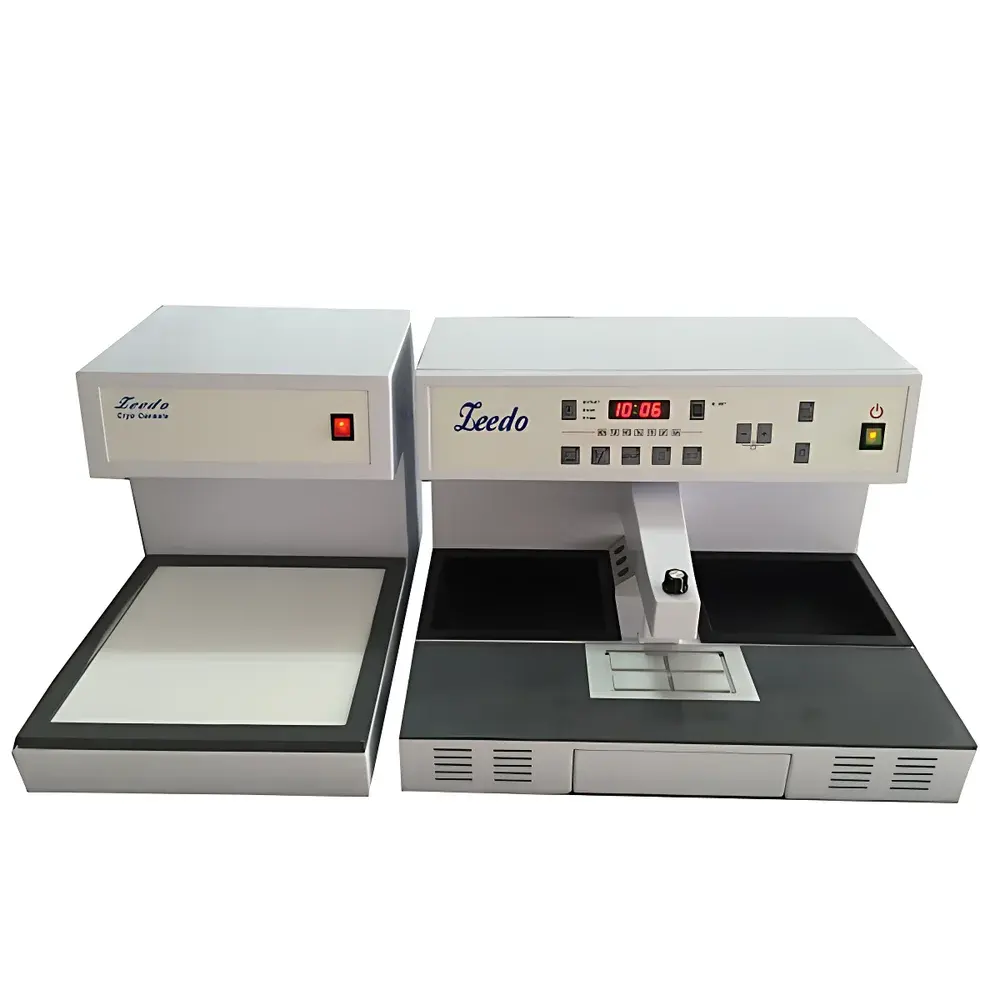
ZEEDO ES-300 Tissue Embedding Station
| Brand | ZEEDO |
|---|---|
| Origin | Zhejiang, China |
| Manufacturer Type | Authorized Distributor |
| Country of Origin | China |
| Model | ES-300 |
| Price | USD 2,300 (FOB) |
| Wax Bath Capacity | 3.2 L |
| Temperature Range (Wax Systems) | Ambient to 99°C |
| Cryostage Temperature Range | Ambient to –20°C |
| Dimensions (Embedder) | 560 × 540 × 375 mm |
| Dimensions (Cryostage) | 345 × 600 × 375 mm |
| Weight | 40 kg |
| Power Supply | 220 V, 50 Hz |
| Rated Power | 800 W |
| Independent Temperature Zones | 5 (Wax Bath, Wax Dispenser Nozzle, Work Surface, Storage Chamber, Specimen Mold Holder) |
| Safety Features | Dual Overheat Protection, Two-Stage Wax Filtration, Gravity-Based Wax Return System with Solenoid Valve Control |
| Operation Modes | Fully Automatic (7-day programmable scheduler), Manual (Hall-effect sensor switch + foot pedal), Illuminated Embedding Positioning |
| Design | Modular — Embedder and Cryostage Operate Independently |
Overview
The ZEEDO ES-300 Tissue Embedding Station is a precision-engineered, modular paraffin embedding system designed for high-throughput histopathology laboratories, academic medical centers, and biomedical research facilities. It operates on the principle of controlled thermal phase transition: molten paraffin wax (typically 56–62°C) is dispensed onto pre-chilled tissue specimens mounted in molds, followed by rapid solidification under precisely regulated cooling conditions. The ES-300 integrates five independently adjustable temperature zones—wax bath, dispensing nozzle, embedding work surface, specimen storage chamber, and mold holder—to ensure optimal wax viscosity, minimal thermal shock to delicate tissues, and consistent block integrity. Its cryostage achieves stable temperatures down to –20°C, enabling immediate post-embedding chilling without cross-contamination or condensation buildup. Unlike single-zone embedding units, the ES-300’s distributed thermal architecture minimizes inter-zone drift and supports simultaneous processing of heterogeneous tissue types—including neural, adipose, and fibrous specimens—within a single workflow cycle.
Key Features
- Fully programmable 7-day embedded scheduler with daily time-slot configuration—supports unattended overnight and weekend operation in GLP-compliant environments.
- Dual-stage wax filtration system prevents nozzle clogging and ensures uniform wax flow; combined with gravity-driven return and solenoid-valve regulation, it delivers repeatable dispensing volume accuracy within ±1.5% CV over 250 consecutive cycles.
- Modular physical design allows independent placement and calibration of the embedding station and cryostage—facilitating flexible lab layout optimization and ISO 15189-aligned spatial segregation of warm and cold workflows.
- Integrated LED-based top illumination module (5,000 K CCT, 1,200 lux at 10 cm) enables precise visualization of sub-millimeter tissue orientation during mold loading—critical for diagnostic-level sectioning alignment in tumor margin assessment and neuroanatomical studies.
- Hall-effect proximity switches and optional foot pedal provide ergonomic, contactless manual control—reducing repetitive strain injury risk during extended embedding sessions typical in high-volume pathology labs.
- Comprehensive thermal safety architecture includes redundant bimetallic overheat cutoffs in the wax bath and real-time thermistor monitoring across all five zones—fully compliant with IEC 61010-1:2010 for laboratory electrical equipment safety.
Sample Compatibility & Compliance
The ES-300 accommodates standard histological molds (e.g., 25 × 25 mm, 35 × 25 mm, and custom aluminum/steel variants), as well as disposable plastic cassettes compatible with automated tissue processors. It accepts dehydrated and cleared tissues processed via ethanol/xylene or alternative reagents (e.g., limonene, isopropanol), and maintains compatibility with low-melting-point paraffins (52–54°C) and high-melting-point formulations (60–64°C). All temperature control systems are traceable to NIST-certified references and support audit-ready logging per FDA 21 CFR Part 11 requirements when paired with validated third-party data acquisition software. The unit conforms to ISO 13485:2016 (medical device quality management) and meets essential requirements under the EU In Vitro Diagnostic Regulation (IVDR) Annex I for non-active diagnostic equipment.
Software & Data Management
While the ES-300 operates via an embedded microcontroller interface (no proprietary OS), its digital scheduler and thermal logs export timestamped CSV files via USB port for integration into LIMS platforms (e.g., Sunquest, Cerner CoPath). Optional firmware upgrade enables RS-485 Modbus RTU communication for centralized monitoring in multi-instrument histology suites. All temperature setpoints, actual readings, and alarm events—including overtemperature excursions and filter maintenance alerts—are stored for ≥30 days with automatic overwrite protection. Audit trail functionality satisfies GLP documentation standards, including user ID tagging, electronic signature capability (via external authentication gateway), and immutable log encryption.
Applications
- Routine surgical pathology: embedding of biopsy specimens (e.g., breast lumpectomies, prostate cores, GI biopsies) with reproducible orientation for serial sectioning.
- Preclinical toxicology studies: high-volume embedding of rodent organ sections across dose cohorts, ensuring inter-group thermal consistency critical for morphometric analysis.
- Plant tissue histology: stabilization of lignified or mucilaginous samples using elevated wax bath temperatures (up to 99°C) without structural collapse.
- Forensic anthropology: embedding of calcified or mineralized bone fragments with minimized microcracking through gradient-cooling protocols.
- Diagnostic IHC validation: preparation of matched normal/tumor blocks under identical thermal profiles to eliminate antigen retrieval variability.
FAQ
What is the maximum number of tissue specimens that can be embedded per cycle?
The ES-300 supports up to 250 standard-sized molds (25 × 25 mm) per full wax bath fill, assuming continuous operation and ambient room temperature ≤25°C.
Does the cryostage require external refrigerant or compressor cooling?
No—the integrated Peltier-based thermoelectric cooling system operates autonomously with passive heat dissipation; no glycol loops or external chillers are required.
Can the ES-300 be validated for ISO 17025 accreditation?
Yes—its five-zone temperature stability (±0.3°C over 8 hours), traceable calibration paths, and electronic audit trail meet ISO/IEC 17025:2017 clause 7.8.2 for equipment verification.
Is the wax filtration system user-serviceable?
Yes—both filter cartridges are accessible via front-panel latches and require replacement every 6 months under typical usage (≈1,200 embedding cycles); replacement kits include calibration certificates.
How does the gravity-based wax return system improve long-term reliability?
By eliminating rotary pumps and associated seals, the passive return design reduces mechanical wear, prevents wax carbonization in heated manifolds, and extends mean time between failures (MTBF) to >15,000 operating hours.



