
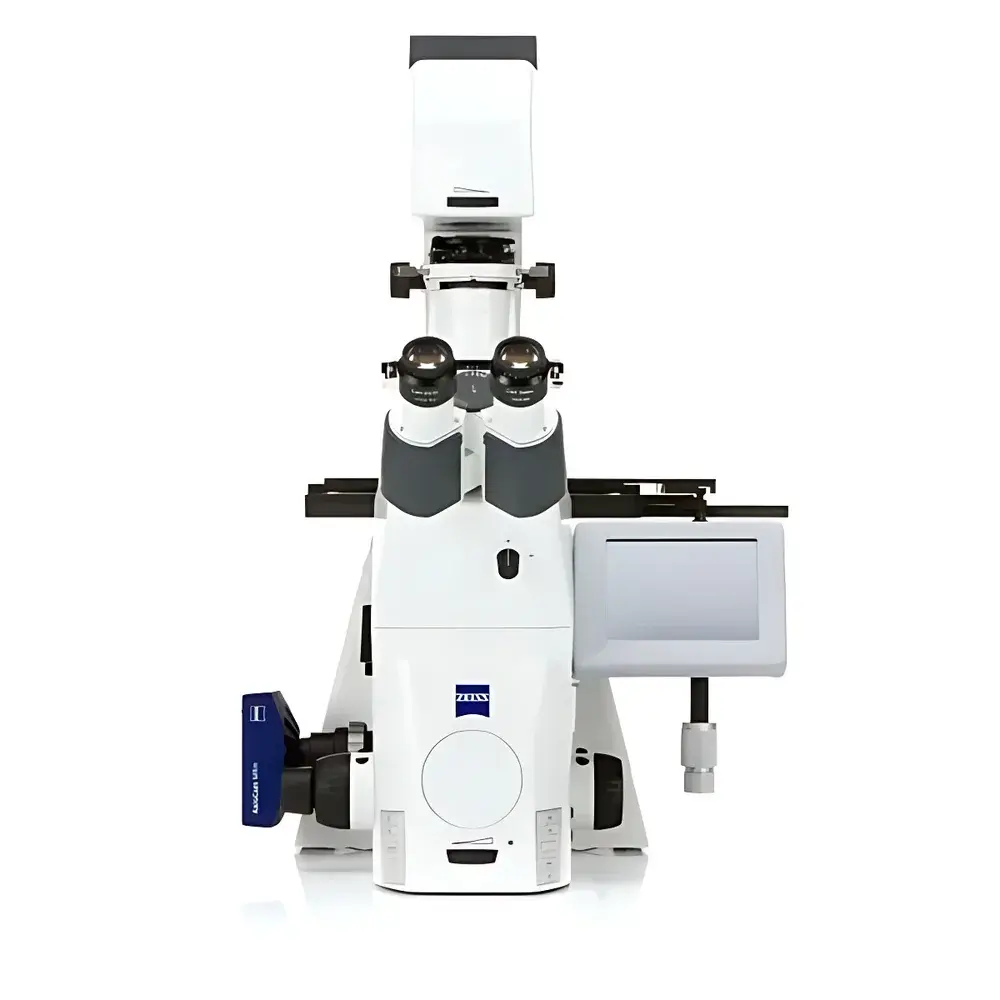
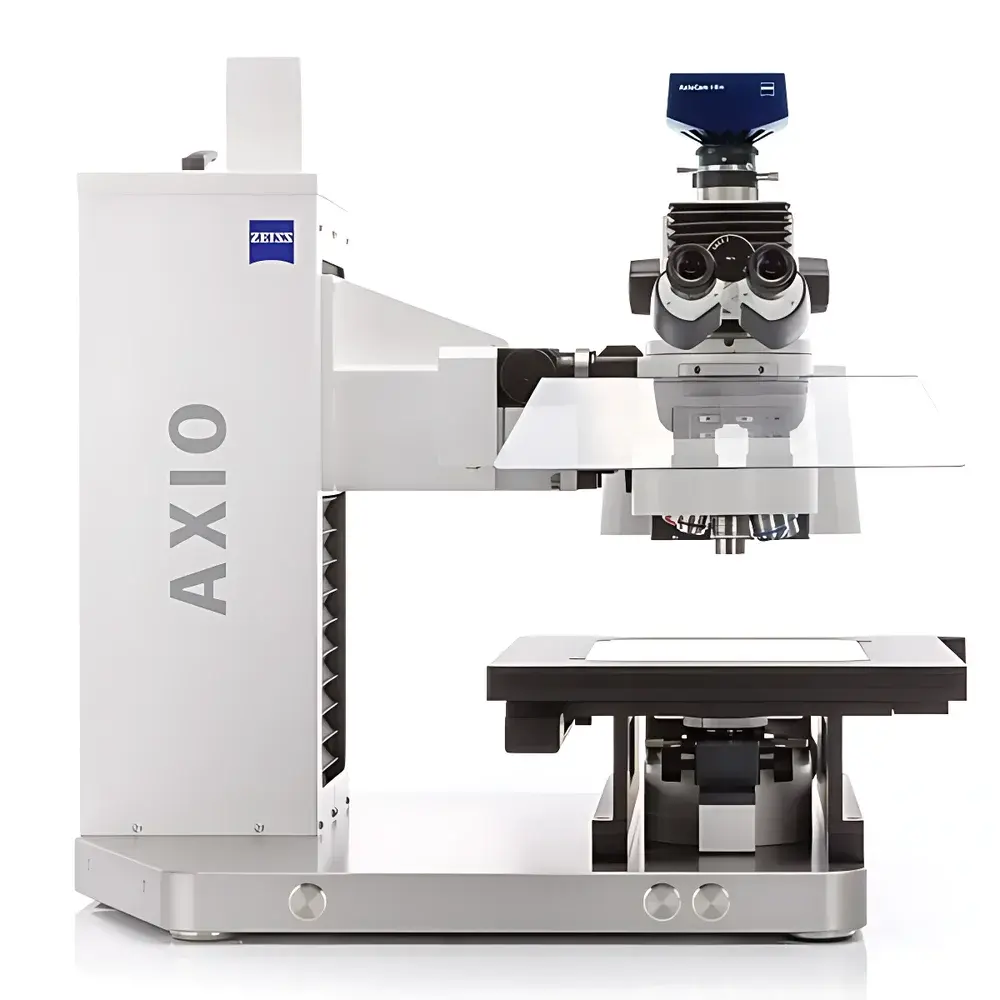
Zeiss Axio Imager 2 Vario Large-Format Materials Microscope
| Brand | Zeiss |
|---|---|
| Origin | Germany |
| Model | Axio Imager 2 Vario |
| Sample Stage Travel (X-Y) | 300 × 300 mm |
| Vertical Working Distance | 254 mm |
| Auto-Focus Range | up to 12,000 µm |
| Cleanroom Compliance | ISO 5 (DIN EN ISO 14644-1) |
| Optical Configuration | Reflected & Transmitted Brightfield, 10× Objective Included |
| Application Focus | Wafer Inspection, TFT Array Metrology, Photovoltaic Quality Control, Cultural Heritage Analysis |
Overview
The Zeiss Axio Imager 2 Vario is an advanced upright materials microscope engineered for high-precision optical analysis of large-format, non-standard, and industrially critical specimens. Built upon Carl Zeiss’s legacy in precision optics and modular microscopy architecture, the system employs a rigid, thermally stable frame and apochromatic, infinity-corrected optical path to deliver diffraction-limited resolution across extended working distances. Its core measurement principle relies on high-fidelity brightfield illumination—both reflected and transmitted—combined with parfocal, plan-apochromatic objectives to ensure quantitative morphological and defect characterization without geometric distortion. Unlike conventional microscopes constrained by limited stage travel or short working distances, the Axio Imager 2 Vario is specifically designed for applications where sample size, thickness, or handling constraints preclude standard mounting—such as full 300-mm silicon wafers, laminated glass substrates, heritage artifacts, or automotive composite panels. The system operates as a platform for both routine inspection and metrologically traceable analysis when integrated with calibrated stage encoders and digital imaging systems compliant with ISO/IEC 17025-aligned workflows.
Key Features
- Extended X-Y mechanical stage with 300 × 300 mm travel range—enabling full-field scanning of oversized specimens without repositioning or tiling artifacts.
- 254 mm vertical working distance accommodates tall or multi-layered samples, including packaged semiconductor devices, encapsulated photovoltaic cells, and relief-carved cultural objects.
- ISO 5-certified cleanroom-compatible components—including dust-shielded objective turrets, sealed focus mechanisms, and particle-trapped air pathways—validated per DIN EN ISO 14644-1 for use in controlled manufacturing environments.
- High-speed, closed-loop auto-focus system with ±0.1 µm repeatability over a 12,000 µm Z-range; supports z-stack acquisition, focus mapping, and surface topography reconstruction via focus variation algorithms.
- Modular illumination architecture supporting Köhler-optimized reflected brightfield (for metallographic contrast), transmitted brightfield (for transparent or semi-transparent substrates), and optional polarization or DIC modules for strain or birefringence analysis.
- Motorized nosepiece with six-position objective turret and automatic magnification recognition—ensuring consistent calibration across 5×, 10×, 20×, 50×, and 100× plan-apochromat objectives (10× included standard).
Sample Compatibility & Compliance
The Axio Imager 2 Vario accepts specimens up to 400 mm in width and 50 mm in height without modification, making it suitable for uncut wafers, display glass panels (Gen 4–Gen 6), solar cell strings, and conservation-grade archaeological fragments. All optical and mechanical components are RoHS-compliant and CE-marked per Directive 2014/30/EU (EMC) and 2014/35/EU (LVD). For regulated industries, the system supports GLP/GMP documentation protocols when paired with Zeiss ZEN Blue software configured for audit trail logging, electronic signatures, and 21 CFR Part 11 compliance (requires validated installation and user access controls). It meets ASTM E1558 (Standard Guide for Metallographic Specimen Preparation) and ISO 10474 (Steel—Sampling and Testing) for metallurgical evaluation workflows.
Software & Data Management
ZEN Blue (v3.6+) serves as the native acquisition and analysis environment, providing automated stitching of large-area mosaics (up to 10,000 × 10,000 pixels), particle detection with ISO 13322-2–aligned sizing algorithms, and measurement traceability via embedded NIST-traceable scale bars. Raw image data is stored in TIFF or CZI format with full metadata embedding (objective ID, exposure time, stage coordinates, illumination settings). Batch processing pipelines support export to LIMS-compatible CSV/XML schemas and integration with enterprise MES platforms via OPC UA or RESTful API extensions. Image annotation, report generation, and PDF export comply with ISO/IEC 17025 clause 7.8 requirements for result reporting integrity.
Applications
- Semiconductor process control: Defect localization and classification on 200–300 mm wafers, photomask inspection, and post-etch residue analysis.
- Photovoltaic R&D: Evaluation of screen-printed busbar morphology, solder joint integrity, and bulk silicon dislocation density using differential interference contrast (DIC) add-ons.
- Flat-panel display manufacturing: TFT array uniformity assessment, gate line continuity verification, and pixel defect mapping on Gen 4–Gen 6 glass substrates.
- Automotive material science: Cross-sectional analysis of coated steel, thermal barrier coatings, and fiber-reinforced polymer composites under reflected brightfield and polarized light.
- Cultural heritage science: Non-invasive pigment layer stratigraphy, corrosion product identification on bronze artifacts, and parchment fiber orientation analysis using low-intensity transmitted illumination.
FAQ
Can the Axio Imager 2 Vario be integrated into an automated production line?
Yes—via TTL-triggered imaging, RS-232/RS-485 serial control, and programmable I/O ports, enabling synchronization with conveyor positioning systems and PLC-based inspection stations.
Is motorized Z-axis compensation available for tilted or warped samples?
Yes—the system supports dynamic focus tracking using real-time surface profiling, allowing continuous focus maintenance during X-Y raster scans of non-planar surfaces.
Does Zeiss provide application-specific validation packages for ISO 17025 laboratories?
Yes—custom IQ/OQ/PQ documentation, uncertainty budget templates, and traceable calibration certificates for stage encoders and photometric sensors are available upon request.
What is the maximum usable field of view at 10× magnification with the standard eyepieces?
Approximately 2.5 mm diameter (with 23 mm field number eyepieces), scalable to >12 mm via tile-scan mosaic acquisition.
Are third-party image analysis plugins supported in ZEN Blue?
Yes—ZEN SDK enables integration of Python- or MATLAB-based algorithms for custom segmentation, machine learning inference, or statistical process control charting.




