
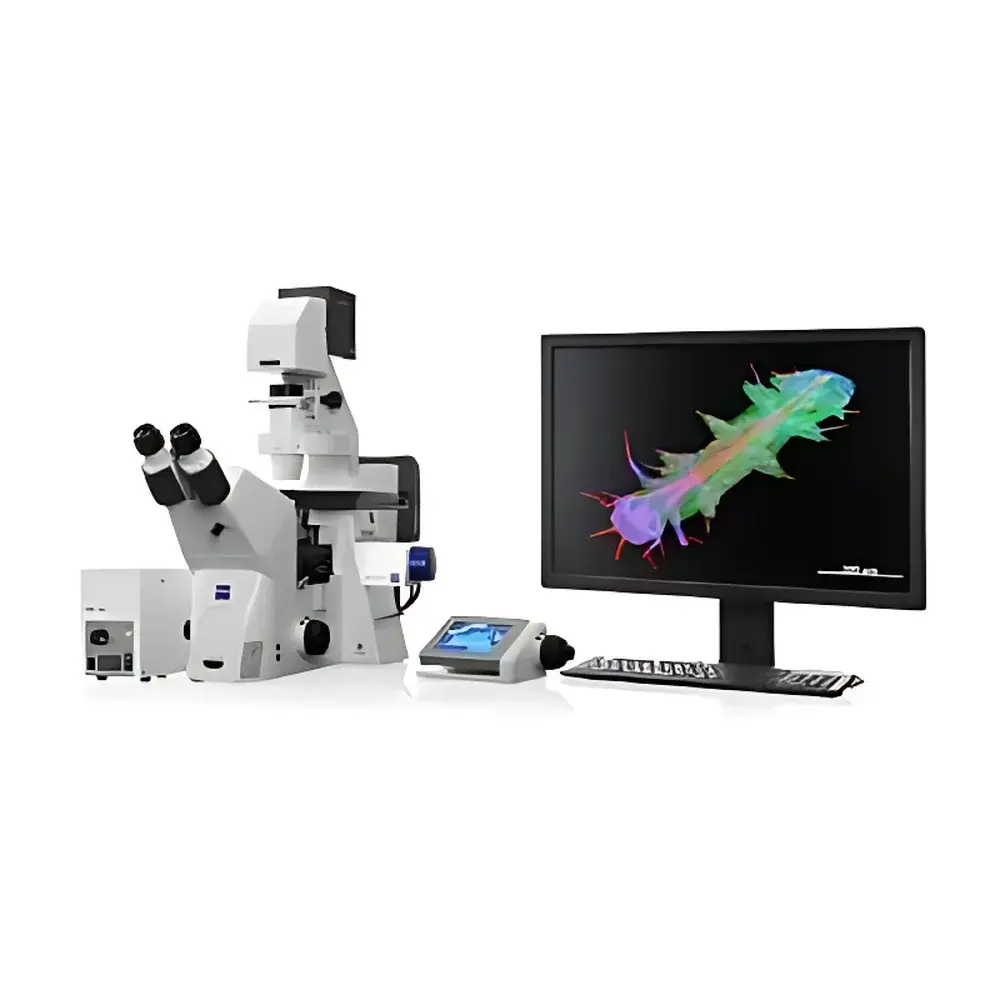
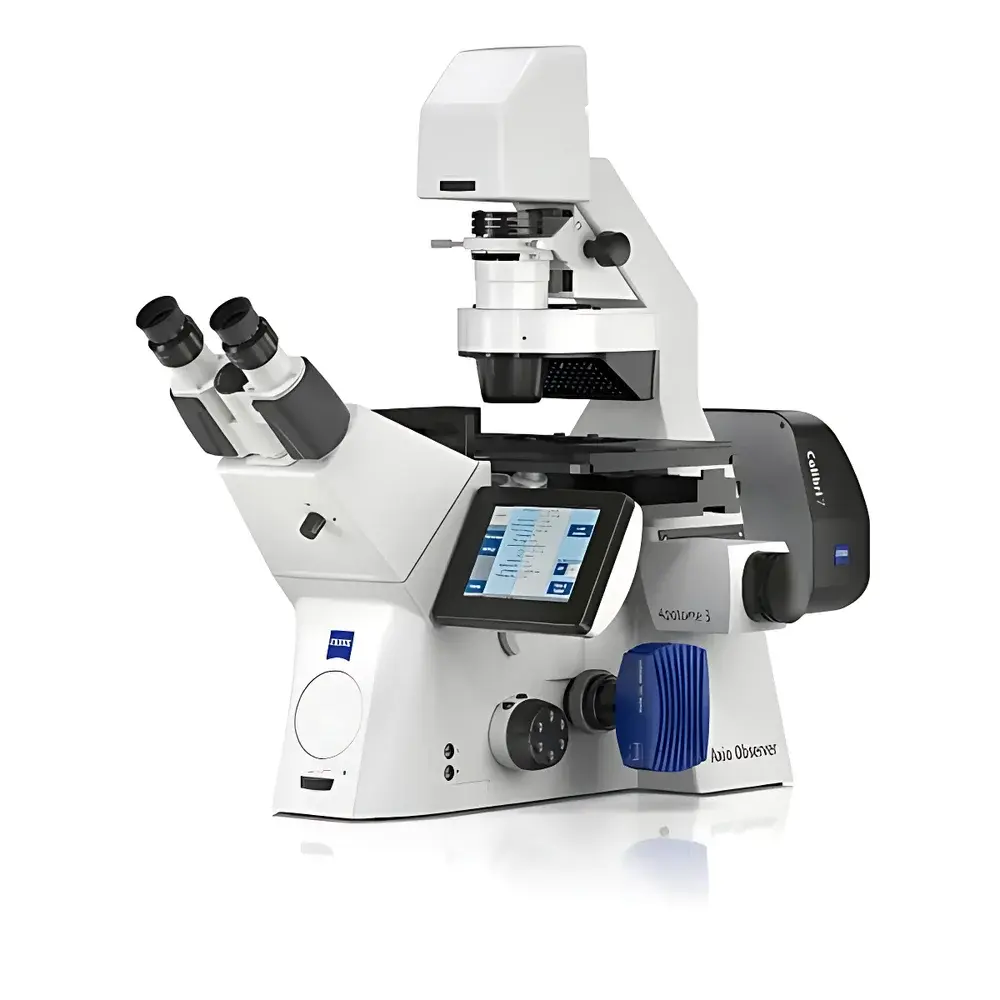
Zeiss Axio Observer Research-Grade Inverted Microscope
| Brand | Zeiss |
|---|---|
| Origin | Germany |
| Model | Axio Observer |
| Optical Path | V-shaped (shortest optical path) |
| Z-axis Resolution | 10 nm |
| Optical System | IC2S Chromatic & Contrast Correction |
| Fluorescence Pathway | Apochromatic with Fluorescence Trap Technology |
| AI Function | Automated Sample Recognition System |
| Sample Access Space | Large open stage for incubation-compatible setups |
| Compliance | Designed for GLP/GMP-aligned workflows, compatible with ISO 13694 (laser-based measurement traceability), ASTM E2857 (microscopy validation guidelines) |
Overview
The Zeiss Axio Observer is a research-grade inverted microscope engineered for high-precision, multi-modal live-cell and fixed-sample imaging in demanding academic, pharmaceutical, and industrial laboratories. Its core architecture employs a proprietary V-shaped optical pathway—minimizing light path length and maximizing photon throughput—thereby preserving signal integrity across brightfield, phase contrast, differential interference contrast (DIC), and widefield fluorescence modalities. Unlike conventional inverted platforms, the Axio Observer integrates a rigid, thermally stable mechanical base and an optomechanically decoupled optical column to suppress vibration-induced drift and thermal lensing effects. This design ensures sub-10 nm Z-axis repeatability over extended acquisition periods, critical for time-lapse Z-stack reconstruction, 3D deconvolution, and quantitative colocalization analysis. The system supports both upright and inverted optical configurations via modular turret integration, enabling seamless transition between routine inspection and advanced correlative microscopy workflows.
Key Features
- IC2S (Improved Contrast and Chromatic Correction System): Dual-corrected optics delivering diffraction-limited resolution across visible and near-UV spectra, with optimized transmission for Alexa Fluor 488, DAPI, and other common fluorophores.
- Apochromatic fluorescence pathway with integrated fluorescence trap technology: Reduces stray light by >99.9% at emission wavelengths, significantly improving signal-to-noise ratio in low-light applications such as single-molecule tracking or sparse-labeling experiments.
- V-shaped optical architecture: Shortens total optical path by up to 35% versus traditional L-shaped designs—reducing spherical aberration and enabling higher numerical aperture (NA) performance with long-working-distance objectives (e.g., 50×/0.80 LD Plan-Neofluar).
- Motorized Z-drive with 10 nm closed-loop resolution: Maintains positional fidelity during multi-hour acquisitions; calibrated traceably to NIST-traceable interferometric standards.
- AI-powered automated sample recognition: Trained on >20,000 annotated slide and dish configurations, the system identifies coverslip thickness, culture vessel type (e.g., µ-Slide 8-well, Petri dish), and region-of-interest boundaries without user calibration—reducing setup time from minutes to seconds.
- Ergonomic stage design with ≥70 mm vertical clearance: Accommodates standard incubation chambers (37°C/5% CO₂), perfusion systems, micromanipulators, and electrophysiology rigs while maintaining full Köhler illumination alignment.
Sample Compatibility & Compliance
The Axio Observer supports a broad range of specimen formats—from standard glass slides and #1.5 coverslips to high-content screening microplates (96-/384-well), organ-on-chip devices, and custom-engineered substrates. Its large-stage aperture and motorized X-Y-Z coordinates enable unattended scanning of heterogeneous samples (e.g., tissue explants, bioengineered scaffolds, or semiconductor wafers). All optical components comply with ISO 10110-7 (surface quality) and DIN EN 61000-6-3 (EMC immunity). For regulated environments, the platform supports audit-trail-enabled operation when paired with Zeiss ZEN Blue/Core software under 21 CFR Part 11-compliant configuration (electronic signatures, change control logs, and user role-based access). Validation documentation aligns with ASTM E2857 (Standard Guide for Validation of Microscopy-Based Measurement Systems) and ISO/IEC 17025 requirements for accredited testing laboratories.
Software & Data Management
Control and image acquisition are managed through Zeiss ZEN software (Blue or Core edition), offering deterministic timing synchronization between camera exposure, stage movement, filter wheel positioning, and environmental chamber feedback loops. The software provides native support for TIFF, CZI, and OME-TIFF export formats, with metadata embedded per MIAME/MINSEQE standards. Batch processing pipelines integrate with Python-based analysis frameworks (e.g., scikit-image, napari) via Zeiss ZEN Connect API. Raw data integrity is preserved through checksummed file writing and optional AES-256 encryption at rest. Audit trails record every hardware state change—including objective selection, illumination intensity, and Z-position—with timestamps traceable to UTC-synchronized NTP servers.
Applications
The Axio Observer serves as a foundational imaging platform across disciplines requiring quantitative spatial and temporal resolution. In cell biology, it enables long-term monitoring of cortical neurons labeled with DAPI (nuclei), anti-tubulin (microtubules), and MAP2 (dendritic markers) under physiological conditions. In materials science, its reflection darkfield and DIC modes resolve grain boundaries in aerospace-grade aluminum alloys and surface topography of medical-grade stainless steel implants. In microelectronics, the system characterizes fluorescent labeling patterns on silicon photomasks and detects micron-scale delamination in multilayer ceramic capacitors. Additional validated use cases include microbial colony morphology analysis (e.g., Candida albicans hyphal growth kinetics), plant root tip mitotic staging, and preclinical evaluation of biodegradable polymer scaffolds.
FAQ
Does the Axio Observer support super-resolution techniques such as SIM or TIRF?
Yes—when equipped with the appropriate laser launch unit, EMCCD/sCMOS camera, and specialized objectives (e.g., α-Plan-Apochromat 100×/1.46 Oil), the platform is certified for structured illumination microscopy (SIM) and total internal reflection fluorescence (TIRF) with Zeiss ELYRA 7 integration.
Can the system be validated for GxP-regulated environments?
Yes—the hardware and ZEN software can be configured to meet FDA 21 CFR Part 11, EU Annex 11, and ISO 13485 requirements, including electronic signatures, permission-based access control, and immutable audit trails.
What incubation solutions are mechanically and optically compatible?
The stage accommodates PeCon GmbH, OkoLab, and Tokai Hit environmental chambers; all maintain parfocality and lateral stability during temperature ramping from 4°C to 40°C and CO₂ modulation from 0–20%.
Is remote operation supported?
Yes—via Zeiss ZEN Connect web interface or third-party VNC/RDP protocols with TLS 1.2+ encryption; full hardware control, including autofocus and AI-based ROI detection, remains available remotely.
How is chromatic aberration corrected across fluorescence channels?
Through IC2S optics combined with Zeiss’s multi-layer anti-reflection coatings and apochromatic lens design—validated to ≤0.1 µm lateral shift between 405 nm and 640 nm excitation bands at Nyquist sampling.




