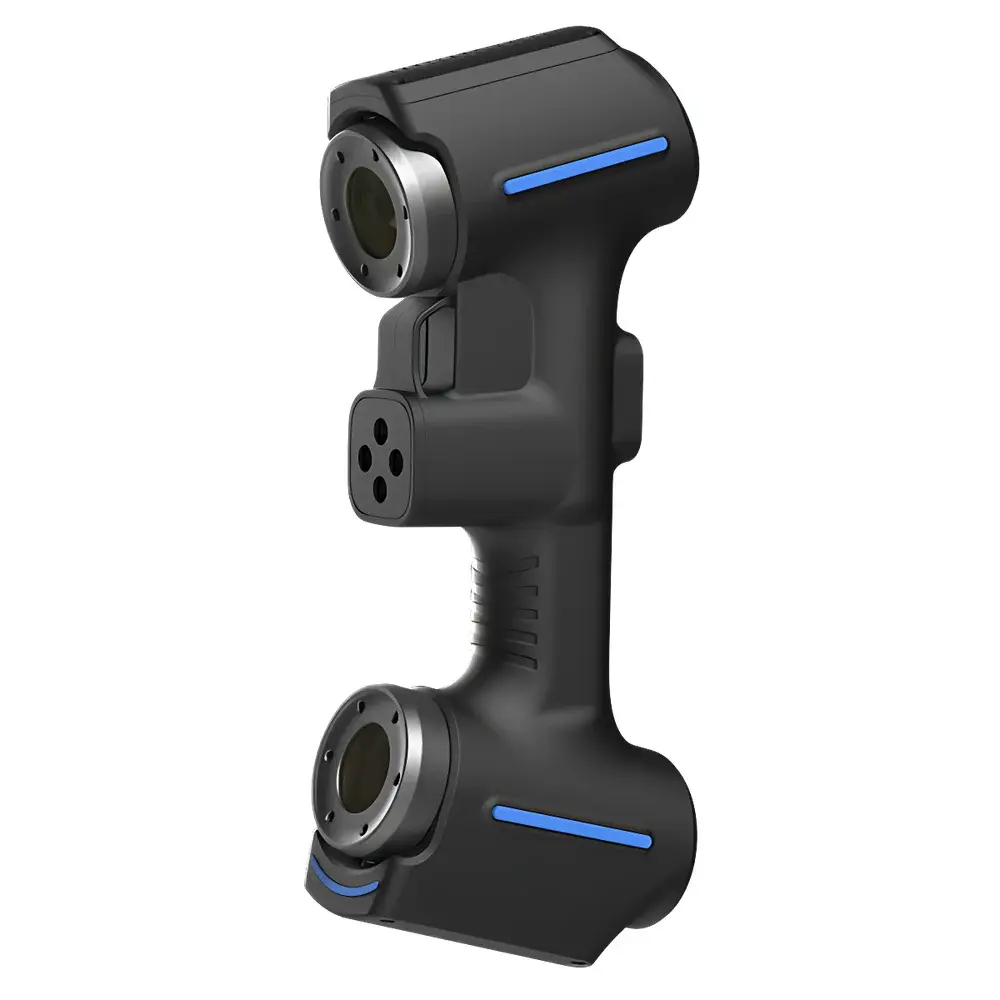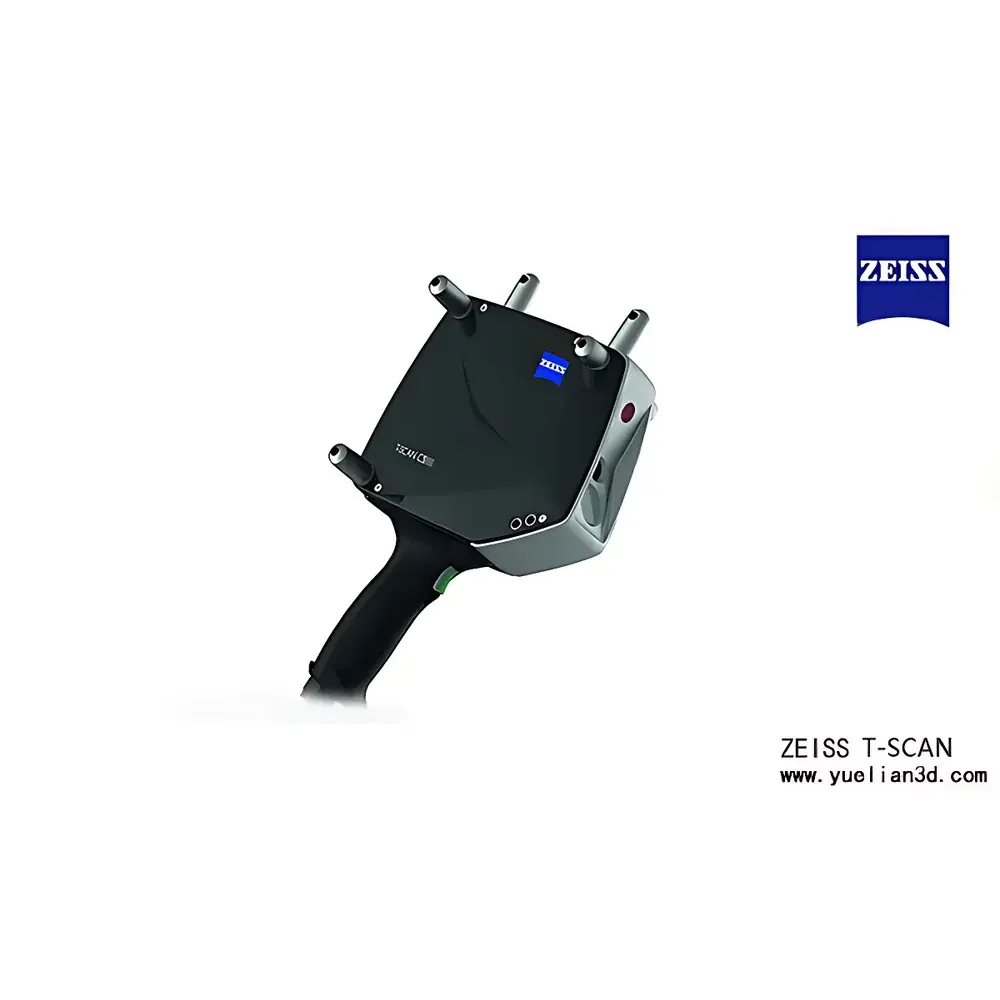
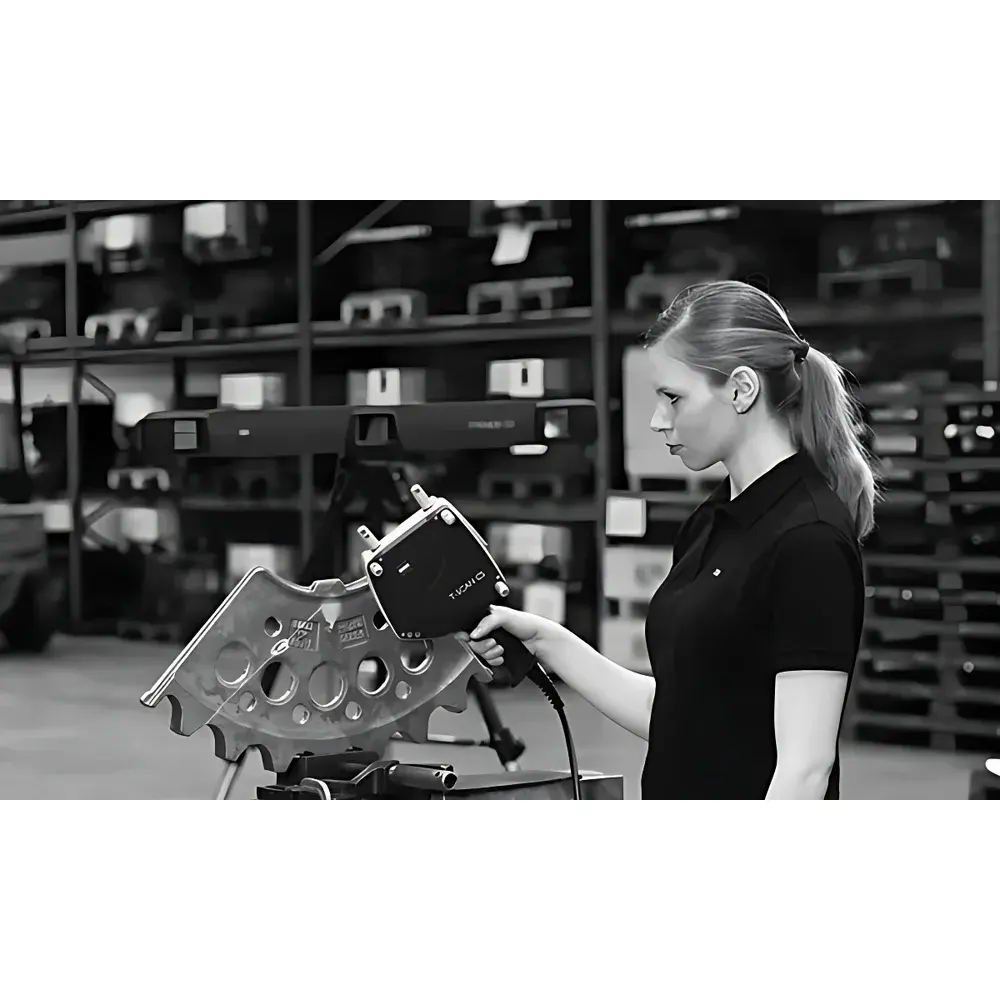
ZEISS T-SCAN Handheld Laser 3D Scanner
| Brand | ZEISS |
|---|---|
| Origin | Germany |
| Model | T-SCAN |
| Measurement Volume | Up to 35 m³ |
| Depth of Field | ±50 mm |
| Laser Line Width | 125 mm |
| Working Distance | 150 mm (nominal) |
| Laser Line Frequency | up to 330 Hz |
| Point Acquisition Rate | 210,000 pts/sec |
| Average Point Spacing | 0.075 mm |
| Resolution per Scan Line | 1312 points |
| Laser Type | Diode |
| Wavelength | 658 nm |
| Laser Class | 2M |
| Scanner Weight | 1100 g |
| Scanner Dimensions | 300 × 170 × 150 mm |
| Standard Cable Length (Scanner–PC) | 10 m |
| Software Platform | ZEISS colin3D |
Overview
The ZEISS T-SCAN is a high-precision handheld laser 3D scanner engineered for industrial metrology applications requiring rapid, traceable, and geometrically accurate surface digitization. Based on triangulation-based laser line scanning, the system projects a structured red diode laser (658 nm, Class 2M) onto the object surface and captures the deformed line profile via a high-resolution CMOS sensor. Real-time triangulation algorithms compute 3D coordinates with sub-millimeter repeatability, enabling direct integration into coordinate measuring machine (CMM) workflows and GD&T evaluation pipelines. Designed for use in conjunction with ZEISS optical tracking systems—including the T-TRACK CS+ and T-TRACK LV—the T-SCAN delivers dynamic referencing capability, allowing stable measurement even on vibrating or moving components such as automotive doors during assembly-line CAV (Coordinate Acceptance Verification) inspections. Its ergonomic, lightweight (1100 g) housing and compact form factor (300 × 170 × 150 mm) support extended operator use without fatigue, while the modular interface permits seamless switching between non-contact laser scanning and tactile probing via the optional ZEISS T-POINT contact probe.
Key Features
- Ergonomic handheld design optimized for prolonged use in production environments—fully adjustable grip configuration and balanced weight distribution reduce operator strain.
- High-speed data acquisition at up to 210,000 points per second with consistent point spacing of 0.075 mm and 1312-point resolution per laser line.
- Dynamic referencing technology enables robust 3D capture on moving or vibration-prone targets (e.g., press shop environments or live vehicle door sealing verification).
- Integrated compatibility with ZEISS T-TRACK optical tracking systems—CS+ for mid-volume applications and LV for large-scale volumes up to 35 m³—ensuring scalability across part sizes from small castings to full-body automotive assemblies.
- Modular probe ecosystem: supports rapid interchange between the T-SCAN laser head and the T-POINT tactile probe for hybrid measurement strategies combining dense surface data with discrete feature-based verification (e.g., edges, holes, datums).
- Laser line frequency up to 330 Hz and ±50 mm depth of field ensure reliable capture across complex geometries, including deep recesses, sharp transitions, and low-reflectivity surfaces.
Sample Compatibility & Compliance
The ZEISS T-SCAN is validated for use on metallic, painted, plastic, composite, and textured surfaces common in automotive, aerospace, and tooling industries. Surface preparation requirements are minimal—matte finishes yield optimal signal-to-noise ratio; highly reflective or transparent materials may require temporary matting spray compliant with ISO 10360-8 and VDI/VDE 2634 Part 3 standards. The system adheres to EU Machinery Directive 2006/42/EC and laser safety requirements per IEC 60825-1:2014. All measurement workflows support audit-ready documentation aligned with ISO 9001, AS9100, and IATF 16949 quality management frameworks. When operated with ZEISS colin3D software under controlled calibration protocols, measurement uncertainty is traceable to national metrology institutes (e.g., PTB, NIST) per ISO/IEC 17025 guidelines.
Software & Data Management
ZEISS colin3D serves as the unified software platform for real-time visualization, alignment, mesh processing, deviation analysis, and GD&T reporting. It provides project-centric workflow navigation with intuitive drag-and-drop operation, eliminating steep learning curves for metrology technicians. Native support for ISO 10360-compliant calibration routines ensures long-term stability of volumetric accuracy. Data exchange conforms to industry-standard formats including STL, ASCII XYZ, PLY, and STEP AP214, enabling interoperability with PolyWorks, GOM Inspect, Metrolog X4, and CAD platforms (CATIA, NX, Creo). The software architecture complies with FDA 21 CFR Part 11 requirements when deployed in regulated environments, offering electronic signatures, audit trails, and role-based access control. Batch reporting templates automate pass/fail evaluation against engineering tolerances and generate PDF/PPT export-ready inspection reports.
Applications
- Automotive CAV: In-process verification of body-in-white (BIW), four-door/two-hood assemblies, and stamping die validation using full-field deviation color mapping.
- Aerospace component inspection: Rapid digitization of turbine blades, wing ribs, and composite fuselage sections for first-article and periodic conformance checks.
- Tool & die manufacturing: Reverse engineering of worn molds, cavity verification pre- and post-polishing, and shrinkage analysis of injection-molded parts.
- Quality assurance in high-mix production: On-the-fly comparison of as-built vs. nominal geometry for welded subassemblies, chassis frames, and battery enclosures.
- GD&T compliance testing: Direct evaluation of position, profile, flatness, and symmetry tolerances per ASME Y14.5 and ISO 1101 standards using cloud-of-points alignment and best-fit algorithms.
FAQ
What tracking systems are compatible with the ZEISS T-SCAN?
The T-SCAN integrates exclusively with ZEISS T-TRACK optical tracking solutions—T-TRACK CS+ for measurement volumes up to 4 m³ and T-TRACK LV for volumes up to 35 m³. Both support dynamic referencing and are calibrated per ISO 10360-11.
Can the T-SCAN be used without an external tracker?
No. The T-SCAN requires optical tracking for absolute 3D positioning; it does not feature onboard IMU or SLAM-based self-localization.
Is the T-SCAN suitable for measuring shiny or black surfaces?
Yes—with appropriate surface treatment (e.g., certified matte spray) and optimized exposure settings, the system achieves stable capture on challenging surfaces per VDI/VDE 2634 Part 3 test procedures.
Does colin3D support automated reporting for ISO/TS 16949 audits?
Yes—colin3D includes configurable report templates with embedded GD&T results, measurement uncertainty statements, and full traceability logs required for IATF 16949 and ISO 9001 certification audits.
What is the typical recalibration interval for the T-SCAN system?
ZEISS recommends annual system-level verification using certified artifacts per ISO 10360-8; tracker and scanner calibration should be performed before each critical measurement campaign or after physical impact.