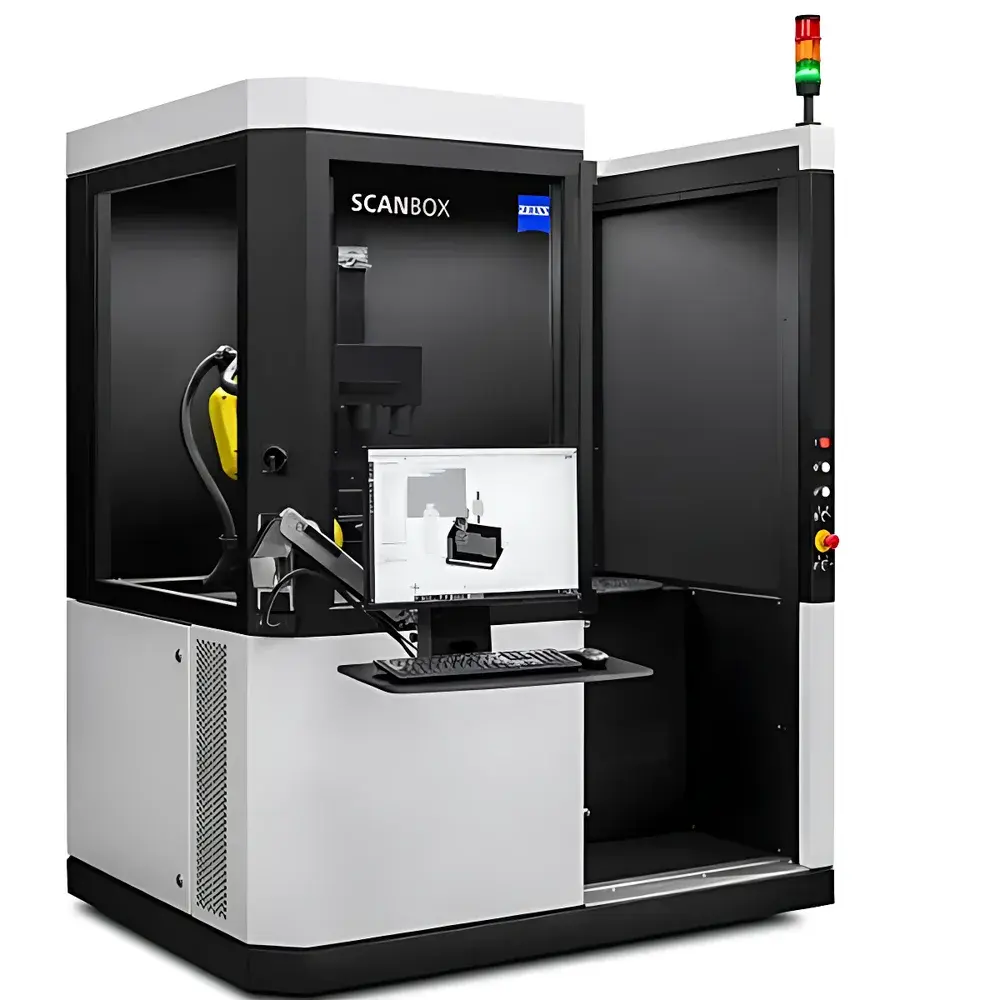
ZEISS ScanBox 4 Series Optical 3D Coordinate Measuring Machine
| Brand | ZEISS |
|---|---|
| Origin | Shanghai, China |
| Manufacturer Type | Original Equipment Manufacturer (OEM) |
| Product Origin | Domestic (China) |
| Model | ScanBox 4105 / ScanBox 4 RC |
| Instrument Category | Laser-Based 3D Scanning CMM |
| Maximum Scanning Volume | 500 mm (diameter) |
| Sensor | Integrated ATOS Q optical 3D sensor |
| Automation | Robotic loading compatible (ScanBox 4 RC), motorized sliding door, rotary table module |
| Human-Machine Interface | Kiosk-mode touchscreen UI |
| Software Platform | Virtual Measuring Room (VMR) + ZEISS INSPECT |
| Compliance | Supports ISO 10360, VDI/VDE 2634 Part 2, and GLP/GMP-aligned audit trails via INSPECT reporting |
Overview
The ZEISS ScanBox 4 Series is an industrial-grade optical 3D coordinate measuring machine (CMM) engineered for high-throughput, non-contact geometric inspection of medium-sized manufactured parts. It operates on the principle of structured-light triangulation—using calibrated blue-light ATOS Q sensors to capture dense point clouds with sub-micron depth resolution and high surface fidelity. Unlike traditional tactile CMMs, the ScanBox 4 Series eliminates mechanical probing constraints, enabling full-field measurement of complex freeform surfaces, thin-walled structures, and textured geometries typical in injection-molded, die-cast, stamped, and bent components. Designed for shop-floor integration, it delivers metrologically traceable results directly within production environments—supporting first-article inspection, in-process verification, and final quality gate validation without requiring climate-controlled metrology labs.
Key Features
- Plug-and-play deployment: Operates from standard 230 V AC power; no external cooling, compressed air, or vibration isolation required.
- Kiosk-mode user interface: Intuitive touchscreen workflow enables operators with minimal metrology training to load parts, select pre-validated measurement programs, and initiate automated scans with a single button press.
- Ergonomic workstation design: Adjustable-height table with integrated motorized rotation arm supports both standing and seated operation—optimized for operator comfort during extended shift cycles.
- Modular automation readiness: The ScanBox 4 RC variant features a motorized sliding door and programmable rotary table, enabling seamless integration with collaborative robots (cobots) or third-party part-handling systems for lights-out, unattended operation.
- Multi-part fixture capability: Accommodates up to six identical parts per scan cycle using custom fixturing—reducing per-part measurement time and increasing throughput by up to 400% compared to single-part workflows.
- Real-time sensor diagnostics: Built-in ATOS Q self-calibration routines verify optical alignment, light intensity, and focus stability before each measurement—ensuring repeatability within ±2.5 µm (ISO 10360-2 compliant).
Sample Compatibility & Compliance
The ScanBox 4 Series accommodates parts with maximum dimensions of Ø500 mm × 300 mm height and weights up to 15 kg. It supports matte, semi-gloss, and lightly textured surfaces—including thermoplastics, aluminum alloys, magnesium die-casts, and sheet metal stampings. Highly reflective or transparent materials require optional matting spray or reference targets, applied per VDI/VDE 2634 Part 2 guidelines. All measurement data paths comply with ISO/IEC 17025 documentation requirements. ZEISS INSPECT software provides full 21 CFR Part 11–compliant electronic signatures, audit trails, and version-controlled report generation—meeting GMP and automotive PPAP Level 3 submission standards.
Software & Data Management
The Virtual Measuring Room (VMR) serves as the central digital twin environment for offline programming, robot path simulation, and collision-free motion planning. Users define measurement strategies—including sensor positioning, lighting angles, and scan overlap—within VMR prior to physical execution. All robotic motions undergo kinematic validation and safety envelope checks before deployment. ZEISS INSPECT integrates raw scan data, GD&T evaluation (per ASME Y14.5 and ISO 1101), nominal-actual deviation mapping, and statistical process control (SPC) charts into a unified interface. Export formats include STEP AP242, ASCII point cloud (.xyz), and XML-based inspection reports compatible with MES and PLM systems (e.g., Teamcenter, Windchill).
Applications
- Automotive: Validation of Class-A body panels, interior trim modules, and engine bracket castings against CAD master models.
- Medical device manufacturing: Dimensional verification of polymer housings for diagnostic equipment and surgical instrument handles.
- Consumer electronics: Form-and-fit testing of injection-molded enclosures, including snap-fit geometry and tolerance stack-up analysis.
- Tool & die shops: Rapid verification of EDM-machined electrode geometry and mold cavity surface integrity post-polishing.
- Electronics assembly: Warpage analysis of PCB substrates and BGA package coplanarity assessment.
FAQ
Is the ScanBox 4 Series certified to international metrology standards?
Yes—the system is validated per ISO 10360-2 for volumetric accuracy and VDI/VDE 2634 Part 2 for optical 3D scanning performance. Calibration certificates are issued annually by ZEISS-accredited service centers.
Can existing CAD models be imported directly into VMR for measurement planning?
Yes—VMR accepts native CAD files (CATIA, NX, Creo, SolidWorks) and neutral formats (STEP, IGES, JT). GD&T annotations and datum references are preserved during import.
Does the system support automated report generation for quality audits?
Yes—ZEISS INSPECT generates PDF and Excel reports with embedded color deviation maps, statistical summaries, and revision-controlled metadata—fully compliant with ISO 9001 and IATF 16949 documentation requirements.
What is the typical lead time for custom fixture design and integration?
Standard multi-part fixtures are available off-the-shelf; custom tooling projects follow a 4–6 week engineering cycle, including FEA-based rigidity analysis and dry-run validation in VMR.
How does the system handle measurement uncertainty for complex freeform surfaces?
Uncertainty budgets are calculated per ISO/IEC Guide 98-3 (GUM), incorporating sensor noise, environmental drift (temperature/humidity compensation), and part positioning repeatability—reported alongside each measurement result in INSPECT.