ZEISS SPECTRUM Family Coordinate Measuring Machine
| Brand | ZEISS |
|---|---|
| Origin | Germany |
| Model | ZEISS SPECTRUM |
| Type | Bridge-type CMM with Active Scanning Capability |
| Sensor Compatibility | VAST XT gold, VAST XXT, RDS C with CAA |
| Angular Resolution | 2.5° step angle, 20,736 programmable probe orientations |
| MPE E₀ (Length Measurement Error) | Compliant with ISO 10360-2 |
| MPE RONₜ (Form Measurement Error) | Compliant with ISO 10360-4 |
| Thermal Stability | Glass-ceramic scale suspension system, no active temperature compensation required |
| Calibration Time | ~12 minutes for full angular calibration (RDS C + CAA) |
| Footprint | Compact design with integrated backpack-style controller and passive vibration isolation |
| Compliance | ISO 10360 series, VDI/VDE 2617, ASTM E1379, GLP/GMP-ready data traceability |
Overview
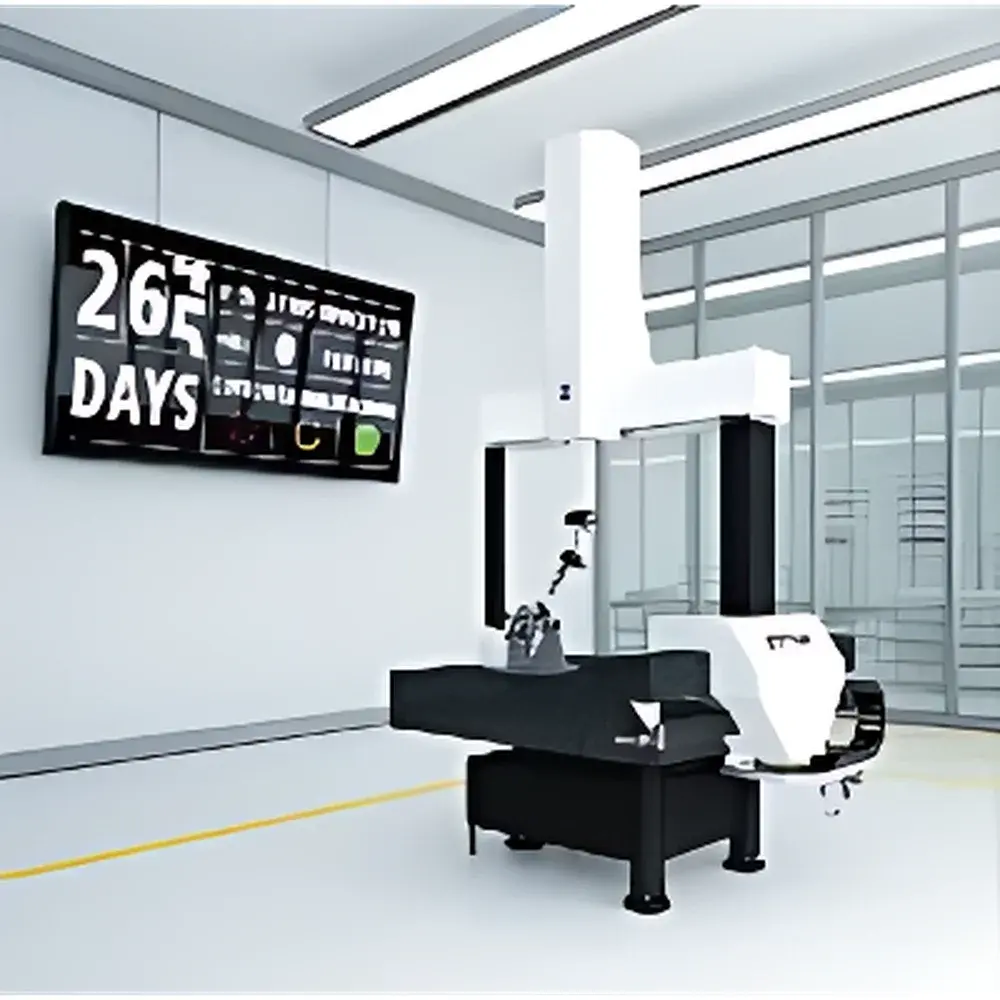
The ZEISS SPECTRUM Family is a high-precision bridge-type coordinate measuring machine (CMM) engineered for metrology laboratories and production-integrated quality assurance environments requiring traceable geometric measurement of complex parts. Built on ZEISS’s proprietary kinematic architecture and calibrated to ISO 10360-2 (length measurement) and ISO 10360-4 (form measurement), the SPECTRUM platform delivers certified maximum permissible errors (MPE) across its entire volumetric envelope. Its core measurement principle relies on interferometric-grade glass-ceramic linear encoders with suspended mounting—eliminating thermally induced scale distortion without dependency on ambient temperature sensors or real-time compensation algorithms. This passive thermal stability mechanism ensures long-term repeatability under fluctuating shop-floor conditions, making it suitable for both climate-controlled labs and semi-conditioned manufacturing cells.
Key Features
- Active scanning capability enabled by ZEISS VAST XT gold and VAST XXT tactile sensors—supporting continuous path acquisition at up to 300 points/second with sub-micron vector accuracy.
- RDS C (Rotational Drive System) with CAA (Calibration-Aware Automation) module enabling full 20,736 angular probe orientations via 2.5° incremental stepping—optimized for multi-feature inspection of turbine blades, gear housings, and medical implants.
- Backpack-style control cabinet integration reduces floor space requirements by up to 35% compared to conventional CMM configurations; includes passive air-spring vibration isolation and seismic anchoring provisions.
- Glass-ceramic linear scales mounted in floating suspension—designed to decouple mechanical expansion from structural frame movement, achieving intrinsic thermal drift suppression per VDI/VDE 2617 Part 6.
- Modular sensor interface supporting interchangeable probe heads (PH10M, PH20, RDS C), extension modules, and optional optical sensors (ZEISS Optiv Vision or CT add-ons) within a unified software environment.
Sample Compatibility & Compliance
The ZEISS SPECTRUM accommodates workpieces ranging from 300 mm × 200 mm × 200 mm (SPECTRUM 343) to 1000 mm × 800 mm × 600 mm (SPECTRUM 1086), with load capacities up to 50 kg. It supports aluminum, steel, titanium, ceramics, and polymer-based components—including molded plastic assemblies with draft angles and thin-walled castings. All measurement routines comply with ISO/IEC 17025 documentation standards, and raw coordinate data export meets FDA 21 CFR Part 11 requirements when paired with ZEISS CALYPSO software configured for audit trail logging and electronic signature enforcement. Certified test reports include traceability to PTB (Physikalisch-Technische Bundesanstalt) reference standards.
Software & Data Management
Operation is managed through ZEISS CALYPSO v7.x or higher, offering parametric programming, GD&T evaluation per ASME Y14.5 and ISO 1101, and automated report generation in PDF, XML, or Q-DAS QDB format. The system supports secure network deployment with role-based access control, encrypted database storage, and version-controlled inspection plans. Raw point cloud and vector data are stored in native .cmm format with embedded metadata (timestamp, operator ID, environmental logs, calibration status). Integration with MES/ERP systems is achieved via OPC UA or RESTful API interfaces—enabling real-time SPC dashboards and nonconformance escalation workflows.
Applications
- Aerospace: Blade root profile verification, housing concentricity, and composite layup alignment validation per NAS970 and SAE ARP9013.
- Automotive: Cylinder head port geometry, transmission gear tooth form, and EV battery tray flatness assessment aligned with VDA Volume 5 guidelines.
- Medical Devices: Orthopedic implant surface finish mapping, dental CAD/CAM model deviation analysis, and ISO 13485-compliant dimensional release testing.
- Energy: Turbine disc runout, heat exchanger tube sheet hole pattern, and nuclear valve seat roundness per ASME Section III Appendix VIII.
FAQ
What standards does the ZEISS SPECTRUM Family comply with for length and form measurement?
It conforms to ISO 10360-2 (MPE E₀) and ISO 10360-4 (MPE RONₜ), validated annually using certified step gauges and sphere artifacts traceable to national metrology institutes.
Can the SPECTRUM operate without climate control?
Yes—the suspended glass-ceramic scale system provides inherent thermal stability; however, optimal performance over extended runs requires ambient temperature variation ≤ ±1°C/hour per VDI/VDE 2617.
Is FDA 21 CFR Part 11 compliance supported out-of-the-box?
When deployed with CALYPSO in validated configuration (including audit trail, electronic signatures, and user access controls), it satisfies Part 11 requirements for regulated industries.
How is probe calibration performed across all 20,736 angular positions?
RDS C with CAA executes an automated 12-minute calibration sequence using a master sphere, generating orientation-specific error maps stored in the controller’s non-volatile memory.
Does the system support integration with statistical process control platforms?
Yes—via native Q-DAS QDB export or OPC UA connectivity, enabling direct ingestion into Minitab, InfinityQS, or custom SPC dashboards.