
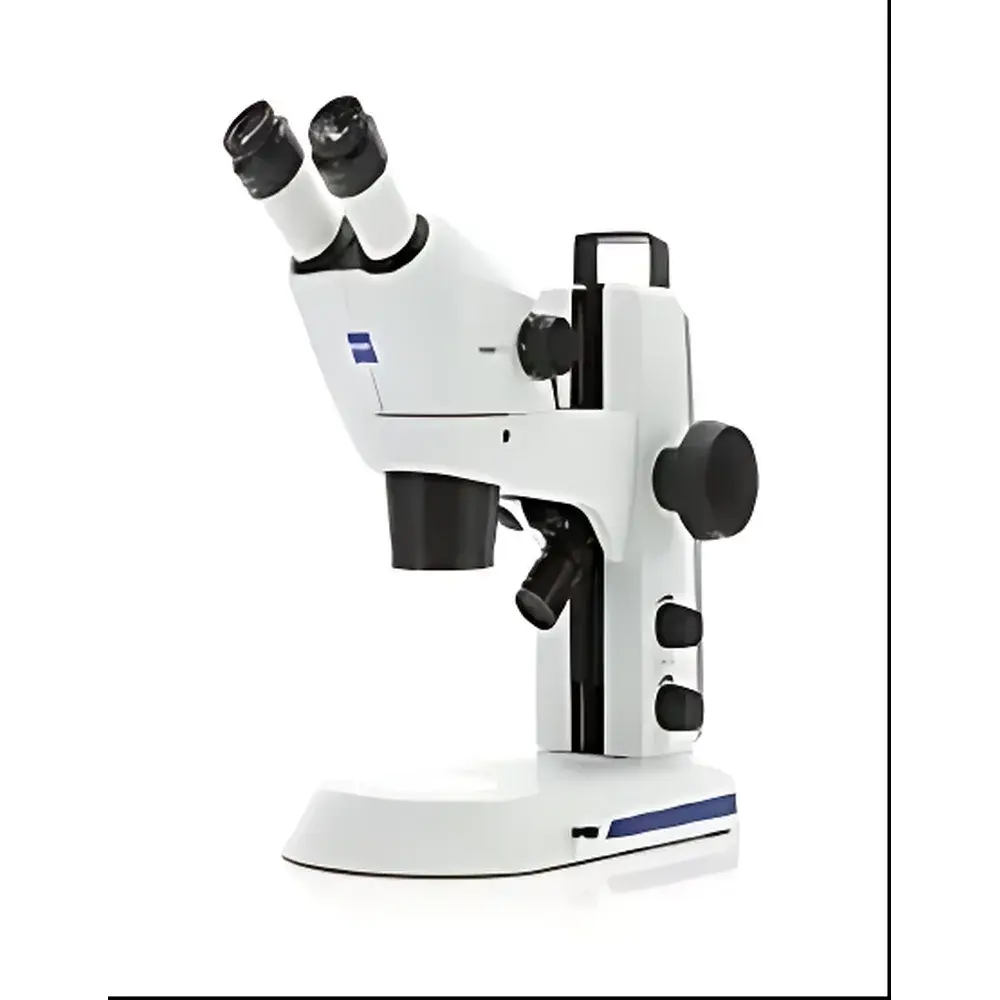
ZEISS Stemi 305 Inspection-Grade Stereo Microscope
| Brand | ZEISS |
|---|---|
| Origin | Germany |
| Model | Stemi 305 |
| Total Magnification | 8×–40× (optional 4×–200×) |
| Zoom Ratio | 5:1 |
| Field Diameter | 23 mm |
| Working Distance | 110 mm (upgradable to 185 mm) |
| Illumination | Integrated LED (reflected & transmitted) |
Overview
The ZEISS Stemi 305 is an inspection-grade stereo microscope engineered for precision visual examination in industrial quality control, failure analysis, and laboratory-based forensic and materials evaluation. Built upon the Greenough optical principle—where two separate objective paths generate independent, slightly angled views—the Stemi 305 delivers natural 3D depth perception, high-resolution stereoscopic imaging, and exceptional contrast across its entire zoom range. Designed and manufactured in Oberkochen, Germany, the instrument features a robust, modular architecture optimized for long-term stability, ergonomic operation, and repeatable optical performance under routine production or analytical lab conditions. Its fixed base configuration supports rapid deployment without alignment calibration, while the integrated illumination system eliminates external light source dependencies—enabling consistent, standardized observation protocols compliant with ISO/IEC 17025 and ASTM E2932 guidelines for optical inspection systems.
Key Features
- Greenough-style dual-path optical design ensuring true stereoscopic vision, minimal parallax, and high depth-of-field at all magnifications
- Continuous zoom optics with 5:1 ratio (8×–40× standard; optional 4×–200× via auxiliary objectives and eyepiece combinations)
- Integrated multi-mode LED illumination: coaxial reflected light, oblique reflected light, and transmitted light—all independently controllable and intensity-adjustable
- Color-accurate white LEDs (6,000 K CCT) delivering uniform, flicker-free illumination with >50,000-hour lifetime and negligible thermal drift
- Ergonomic viewing head with 45° inclined binocular tube, interpupillary adjustment (55–75 mm), and diopter compensation
- Modular trinocular port supporting C-mount interface for direct coupling to ZEISS Axiocam cameras or third-party digital imaging systems
- Optional Wi-Fi-enabled camera module compatible with ZEISS Labscope software for real-time image streaming, annotation, and collaborative review on iOS devices
Sample Compatibility & Compliance
The Stemi 305 accommodates a broad spectrum of opaque, translucent, and semi-transparent specimens—from metallurgical cross-sections and PCB assemblies to textile fibers and biological tissue sections—without requiring complex sample preparation. Its 110 mm standard working distance (extendable to 185 mm with optional long-working-distance objectives) permits unobstructed manipulation of tools, probes, or micro-manipulators beneath the objective. The microscope meets CE marking requirements for medical and industrial equipment and complies with IEC 61000-6-3 (EMC emission standards) and IEC 61000-6-2 (immunity). When used with ZEISS-certified digital imaging modules and audit-trail-enabled software, it supports GLP/GMP documentation workflows aligned with FDA 21 CFR Part 11 for regulated environments.
Software & Data Management
Digital integration is achieved through ZEISS Labscope—a platform designed for secure, traceable image acquisition and annotation. Labscope supports DICOM-compliant metadata embedding, timestamped image capture with operator ID tagging, and encrypted local storage or networked repository export. When paired with ZEISS ZEN Core software, users gain access to measurement tools (length, angle, area), multi-focus stacking, and batch-processing pipelines for comparative analysis across sample sets. All software modules undergo periodic validation per ISO/IEC 17025 Annex A.2 and are compatible with Windows 10/11 LTSB editions in locked-down enterprise configurations.
Applications
- Materials science: Fracture surface analysis, coating integrity assessment, porosity evaluation in sintered metals and composites
- Electronics manufacturing: Solder joint inspection, wire bond verification, IC package defect screening, and rework process monitoring
- Semiconductor metrology: Post-etch alignment verification, probe card contact point assessment, and wafer-level bump inspection
- Forensic science: Fiber morphology comparison, gunshot residue particle characterization, document authenticity evaluation, and trace evidence documentation
- Life sciences: Dissection support for small-animal models, embryonic staging, and histological slide pre-screening prior to high-magnification compound microscopy
- Quality assurance labs: Incoming material inspection, finished product release testing, and non-destructive evaluation (NDE) per ASTM E2737 and ISO 10933
FAQ
What is the optical resolution limit of the Stemi 305 at maximum magnification?
The theoretical lateral resolution at 200× (with optional accessories) is approximately 1.2 µm, governed by the Abbe diffraction limit and effective NA of the objective system.
Can the Stemi 305 be integrated into automated inspection stations?
Yes—via TTL trigger input, RS-232/USB serial control, and programmable illumination sequencing, enabling synchronization with motorized stages and PLC-driven production lines.
Is calibration documentation provided with the instrument?
Each unit ships with a factory-issued Certificate of Conformance and optional NIST-traceable calibration report for magnification accuracy and illumination uniformity (per ISO 9336-2).
Does ZEISS offer service contracts covering preventive maintenance and optical recalibration?
Yes—ZEISS ServicePlus includes biannual on-site inspections, cleaning of optical pathways, mechanical alignment verification, and firmware updates aligned with ISO 13485-certified service processes.
How does the Stemi 305 compare to the Stemi 508 in terms of optical performance?
The Stemi 305 prioritizes cost-effective robustness and ease-of-use for routine inspection; the Stemi 508 adds apochromatic correction, higher NA objectives, and motorized zoom/focus for quantitative metrology applications requiring sub-micron measurement repeatability.




