
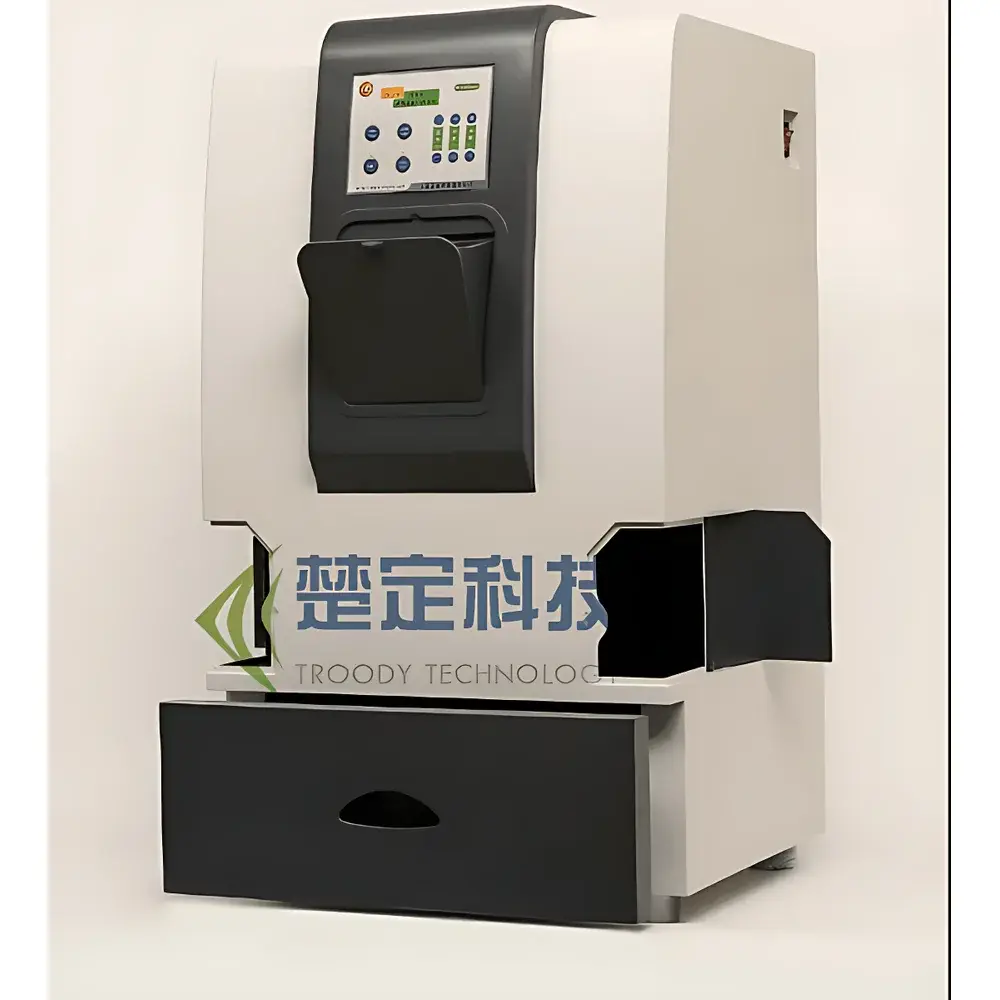
ZF-258 Fully Automated Gel Documentation and Analysis System
| Origin | Shanghai, China |
|---|---|
| Manufacturer Type | Authorized Distributor |
| Origin Category | Domestic (PRC) |
| Model | ZF-258 |
| Price | USD 7,500 (FOB Shanghai) |
| CCD Sensor | U.S.-sourced Microvision 1.3 MP (1280×1024), 16-bit digitization |
| Sensitivity | <20 pg dsDNA (EtBr-stained) |
| Dynamic Range | >3.0 log units |
| Lens | Motorized Computar 8–48 mm, f/1.2 |
| UV Transillumination | 300 nm (200×250 mm), optional 254/365 nm reflectance |
| White Light | Transmitted & reflected cold LED (210×260 mm imaging area) |
| Filter | Standard 590 nm emission filter (compatible with EtBr, SYBR® Gold/Green/Safe, GelStar®, Fluorescein, Texas Red) |
| Software | U.S.-developed 1D gel analysis suite (bilingual UI), GLP-compliant audit trail optional |
| Safety | Interlocked UV shutter, automatic 10-min timeout, UV-blocking observation window (60×125 mm), dual-side cut-gel ports (100×125 mm), drawer-style lamp housing with auto-shutoff |
Overview
The ZF-258 Fully Automated Gel Documentation and Analysis System is an integrated benchtop platform engineered for high-fidelity digital acquisition, quantitative densitometry, and reproducible molecular biology image analysis. It operates on the principle of fluorescence or chemiluminescence detection—where nucleic acids or proteins labeled with intercalating dyes (e.g., ethidium bromide, SYBR dyes) or covalent fluorophores (e.g., Pro-Q Diamond, Deep Purple) absorb excitation energy from precisely controlled UV or visible light sources and emit photons captured by a scientific-grade CCD sensor. The system’s sealed dark chamber eliminates ambient light interference, while its motorized optical train—including variable focal length lens, programmable iris, and synchronized illumination control—ensures consistent exposure geometry across repeated runs. Designed for compliance-driven environments, the ZF-258 supports traceable workflows under GLP and GMP frameworks when paired with optional audit-trail-enabled software modules compliant with FDA 21 CFR Part 11 requirements.
Key Features
- Fully motorized optics: Electric zoom (8–48 mm), autofocus, and aperture control via software interface or front-panel touchscreen—enabling repeatable magnification and depth-of-field optimization without manual intervention.
- Multi-modal illumination architecture: Standard 300 nm trans-UV (200 × 250 mm), white-light transmission (LED, 210 × 260 mm), and cold-white reflective lighting; optional 254/365 nm UV reflectance and blue-light (470 nm) trans-illumination for safer nucleic acid staining alternatives.
- High-sensitivity imaging core: U.S.-manufactured Microvision CCD sensor with 16-bit analog-to-digital conversion, ≥56 dB signal-to-noise ratio, and dynamic range exceeding three orders of magnitude—capable of resolving sub-20 pg bands of EtBr-stained dsDNA under low-exposure conditions.
- Integrated safety engineering: Interlocked UV shutter mechanism, automatic lamp deactivation after 10 minutes of inactivity, UV-absorbing acrylic observation window (60 × 125 mm), and dual-side cut-gel access ports (100 × 125 mm) to minimize ethidium bromide exposure during downstream processing.
- Thermal management system: Drawer-mounted lamp assembly with dual axial fans; drawer extension triggers immediate UV cutoff, preventing accidental irradiation during maintenance or gel excision.
Sample Compatibility & Compliance
The ZF-258 accommodates a broad spectrum of electrophoretic and blotting substrates including agarose and polyacrylamide gels (DNA/RNA), SDS-PAGE and native protein gels, Western/Northern/Southern blot membranes, slot/dot blots, autoradiography films, ELISA microplates, and thin-layer chromatography (TLC) plates. Its illumination flexibility supports common fluorescent dyes (SYBR Safe, GelStar, Fluorescein, Texas Red), protein stains (Coomassie Blue, silver nitrate), and phosphorimaging-compatible emulsions. For regulated laboratories, the system meets ISO/IEC 17025 documentation standards when used with version-locked analysis software featuring electronic signatures, user access levels, and immutable audit logs. Optional validation packages support IQ/OQ protocols aligned with pharmaceutical QC labs operating under USP and ICH Q5E guidelines.
Software & Data Management
The bundled U.S.-developed 1D analysis software provides a unified interface for image acquisition, background subtraction, lane/strip detection, band quantification, molecular weight calibration (via standard ladders), and relative intensity normalization. All operations—including brightness/contrast adjustment, rotation, cropping, inversion, and annotation—are non-destructive and metadata-tagged. Raw TIFF and PNG exports retain full 16-bit depth for third-party statistical processing. The software supports batch processing of multi-gel experiments and generates exportable reports in PDF, Excel, or XML formats compliant with LIMS integration. Optional 2D gel module enables spot detection, matching, and differential expression analysis using established algorithms (e.g., Warping, MatchSet). When configured with GLP mode, the system enforces electronic signatures, session time stamps, and change history tracking per FDA 21 CFR Part 11 Subpart B requirements.
Applications
The ZF-258 serves as a primary imaging tool in molecular biology core facilities, academic research labs, and biomanufacturing quality control departments. Typical use cases include: quantitative PCR product verification; restriction digest pattern analysis; RNA integrity assessment (RIN estimation); protein expression profiling via Western blot densitometry; colony-forming unit (CFU) enumeration on agar plates; enzyme-linked immunosorbent assay (ELISA) plate scanning; and TLC solvent front migration analysis. Its low-light sensitivity and calibrated intensity linearity make it suitable for publication-grade figure generation requiring pixel-level reproducibility across timepoints and operators. In teaching laboratories, the intuitive touch interface and real-time preview function reduce training overhead while maintaining analytical rigor.
FAQ
Does the ZF-258 support chemiluminescent detection?
Yes—when equipped with optional high-sensitivity chemiluminescence mode and compatible HRP/AP substrate kits, the system captures low-intensity signals from Western blots without film, delivering digital equivalents of X-ray film with linear dynamic response.
Can the software perform molecular weight extrapolation for unknown bands?
Yes—the 1D analysis module uses polynomial regression or spline fitting against reference ladder bands to calculate apparent molecular weights with ±3% accuracy across standard SDS-PAGE and agarose gel ranges.
Is USB 2.0 connectivity sufficient for high-resolution image transfer?
Yes—16-bit, 1.3 MP images (typically 2–4 MB per frame) are transferred at sustained rates exceeding 25 MB/s, eliminating bottlenecks during multi-gel acquisition sessions.
What safety certifications does the dark chamber carry?
The enclosure complies with IEC 61010-1 (Safety Requirements for Electrical Equipment for Measurement, Control, and Laboratory Use) and incorporates UV leakage testing per ANSI Z136.1 standards, with measured irradiance <0.1 µW/cm² at 25 cm distance during operation.
Is remote instrument control supported?
Yes—via TCP/IP-enabled software client, allowing centralized management of multiple ZF-258 units across a LAN, including scheduled shutdown, firmware updates, and diagnostic logging.




