
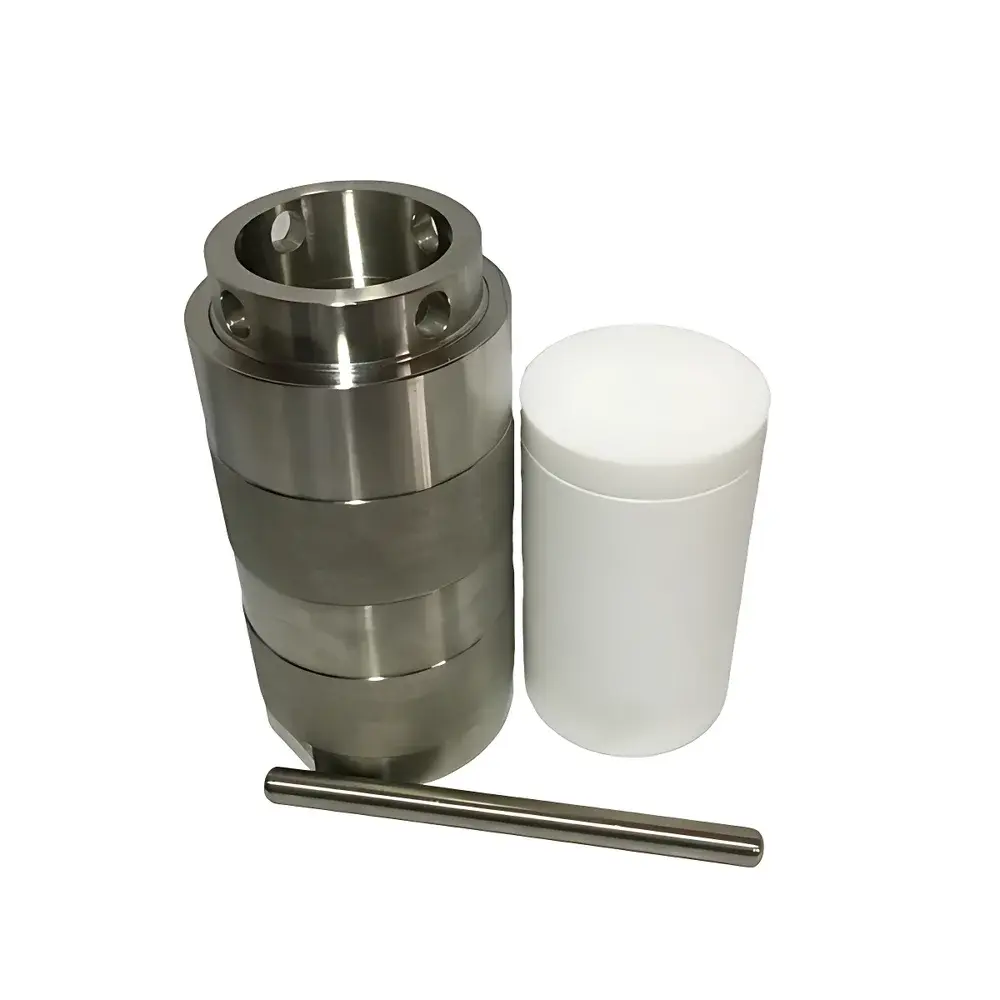
Zhengxin PF-1000ml PTFE-Lined Hydrothermal Synthesis Reactor
| [Brand | Zhengxin Instrument Factory |
|---|---|
| Origin | Jiangsu, China |
| Model | PF-1000ml |
| Vessel Capacity | 1000 mL |
| Construction | Forged 304 Stainless Steel Body with PTFE (F4) Liner |
| Maximum Operating Pressure | ≤6 MPa |
| Maximum Temperature (PTFE liner) | 240 °C |
| Sealing | Circular Tenon-Groove + Manual Spiral Tightening |
| Safety Features | Dual Anti-Explosion Relief Vents on Lid and Inner Cap |
| Compliance | Designed for ASTM E29, ISO/IEC 17025-compliant sample preparation workflows |
| Vacuum Compatibility | Yes (typical ultimate vacuum ≤10⁻² MPa)] |
Overview
The Zhengxin PF-1000ml PTFE-Lined Hydrothermal Synthesis Reactor is a sealed, high-pressure, high-temperature reaction vessel engineered for controlled solvothermal synthesis, acid/alkali digestion, and trace-element sample preparation under inert or reactive atmospheres. It operates on the principle of confined thermal energy transfer within a chemically inert cavity, where elevated temperature and autogenous pressure—generated by solvent expansion in a hermetically sealed environment—accelerate reaction kinetics and enhance dissolution efficiency. Unlike open-vessel digestion, this reactor enables complete decomposition of refractory matrices—including silicates, oxides, biological tissues, and polymeric residues—without volatilization loss of volatile analytes (e.g., Hg, As, Se, Sb). Its design conforms to fundamental requirements for trace-metal analysis as outlined in EPA Method 3052, USP , and ISO 11885, making it suitable for laboratories engaged in environmental monitoring, geochemical profiling, food safety testing, and advanced materials synthesis.
Key Features
- Forged 304 stainless steel body with precision-machined circular tenon-groove sealing interface ensures uniform load distribution and long-term mechanical integrity under cyclic pressurization.
- Chemically inert PTFE (polytetrafluoroethylene) liner rated for continuous use up to 240 °C and resistant to concentrated HNO₃, HF/HCl mixtures, aqua regia, and organic solvents—meeting ultra-low metal blank specifications (Pb < 10⁻¹¹ g/mL; U < 10⁻¹² g/mL).
- Dual independent pressure-relief mechanisms: one integrated into the stainless-steel lid and another in the PTFE inner cap—designed to activate sequentially at defined overpressure thresholds (≥6.2 MPa), preventing catastrophic failure during exothermic reactions.
- Manual spiral tightening system with calibrated torque feedback eliminates reliance on external wrenches; ensures repeatable seal compression and minimizes operator-induced variability.
- Optimized fill ratio guidance (recommended 30–66% internal volume) balances thermal expansion headspace and reaction efficiency while maintaining safe vapor-phase equilibrium.
- Compatible with standard laboratory ovens, muffle furnaces, and programmable heating blocks—no specialized controllers required.
Sample Compatibility & Compliance
This reactor accommodates solid, semi-solid, and liquid samples across diverse matrices: geological sediments (clays, ores), biological specimens (tissues, hair, plant matter), food products (spices, dairy, seafood), environmental solids (sludge, fly ash, soil), and synthetic precursors (metal-organic frameworks, perovskites, nanomaterials). It supports digestion protocols compliant with ASTM D3682 (trace metals in water), ISO 17294-2 (ICP-MS sample prep), and Chinese GB/T 5009 series standards. The PTFE liner’s low elemental blank profile satisfies GLP/GMP requirements for trace-level quantification in clinical toxicology and regulatory food testing. All components are non-pyrogenic and meet USP Class VI biocompatibility criteria for potential use in pharmaceutical excipient synthesis validation.
Software & Data Management
While the PF-1000ml reactor is a passive, manually operated device without embedded electronics, its operational parameters integrate seamlessly into digital lab workflows. Users log batch-specific metadata—including charge mass, acid type/volume, ramp rate, hold time, and cooling profile—in LIMS-compatible templates aligned with 21 CFR Part 11 audit-trail requirements. Optional QR-coded labeling kits enable traceability from digestion vessel to final ICP-OES/ICP-MS run ID. Documentation templates follow ISO/IEC 17025 clause 7.5.2 for equipment usage records, including pre-use visual inspection logs (seal integrity, liner discoloration, thread wear) and post-cycle cleaning verification.
Applications
- Trace metal determination in environmental samples (Pb, Cd, Cr, As in soils per EPA 6010D)
- Decomposition of rare-earth oxide powders for REE pattern analysis via LA-ICP-MS
- Solvothermal growth of ZnO nanorods, TiO₂ mesoporous films, and MOF-5 crystals
- Hydrothermal carbonization of biomass for functional carbon material synthesis
- Routine digestion of seafood and infant formula for EU-regulated contaminant screening (EU No 1881/2006)
- Preparation of certified reference material (CRM) homogenates for interlaboratory validation studies
FAQ
What is the maximum recommended fill volume for the PF-1000ml reactor?
Do not exceed 660 mL (66% of nominal capacity) when using PTFE liners. This allows sufficient headspace for solvent expansion and pressure equilibration during heating.
Can this reactor be used with hydrofluoric acid (HF)?
Yes—provided the PTFE liner remains intact and undamaged. However, HF digestion must be conducted in ventilated fume hoods with appropriate PPE; post-digestion neutralization and fluoride-specific electrode verification are mandatory.
Is the PTFE liner reusable?
It is conditionally reusable: inspect for discoloration, pitting, or deformation before each use. Discard if exposed to temperatures exceeding 240 °C or after ≥20 cycles involving aggressive oxidants (e.g., HNO₃/HF mixtures).
How should the reactor be cleaned after use?
Rinse immediately with deionized water, followed by ultrasonic cleaning in dilute NaOH (1% w/v) for organic residues or citric acid (5% w/v) for metal salt deposits. Air-dry completely before storage; never use abrasive tools on sealing surfaces.
Does the reactor comply with FDA or CLIA requirements?
As a sample preparation tool—not an in vitro diagnostic device—it supports compliance with analytical method validation guidelines referenced in FDA Guidance for Industry (2022) and CLIA ’88 proficiency testing standards when operated within documented SOPs.



