
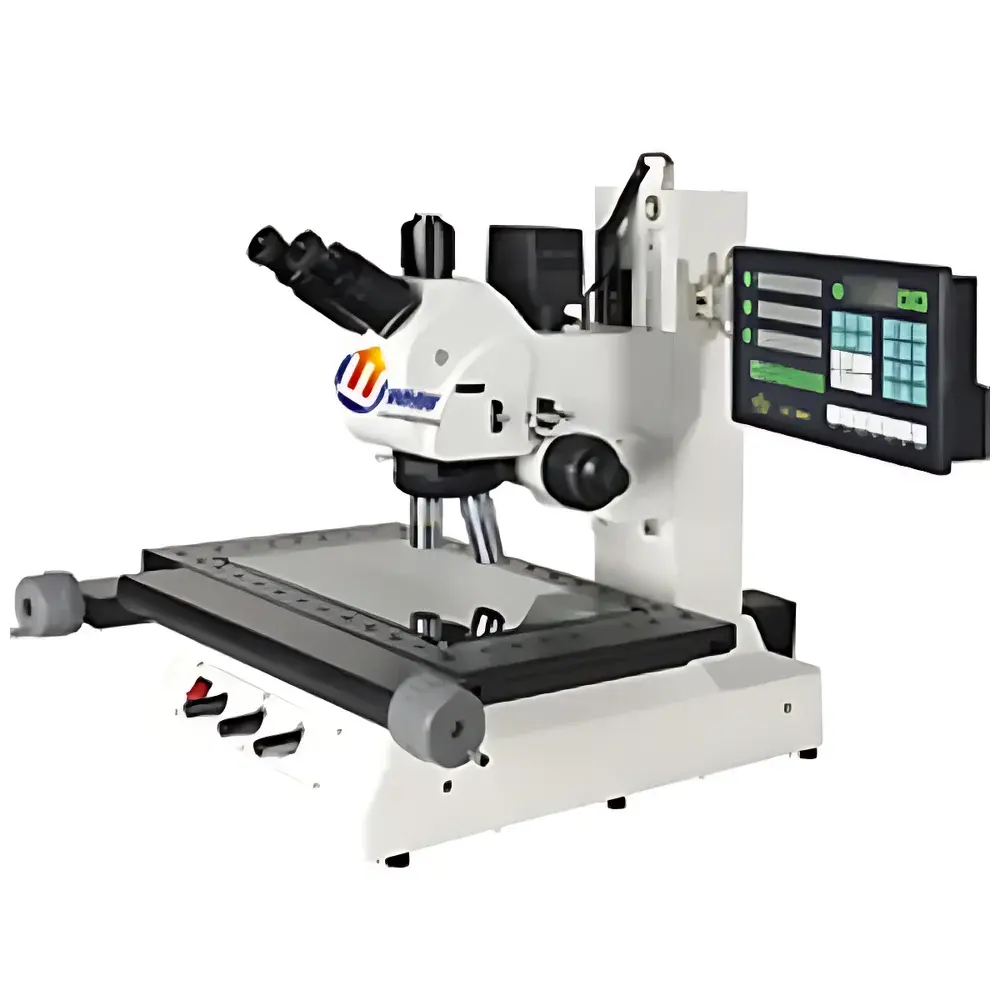
YANRUN 11XB Research-Grade Upright Metallurgical Microscope with Transmitted/Reflected Light, Polarization, and Darkfield Capabilities
| Brand | YANRUN |
|---|---|
| Origin | Shanghai, China |
| Manufacturer Type | Direct Manufacturer |
| Origin Category | Domestic (China) |
| Model | 11XB Research-Grade Upright Metallurgical Microscope with Transmitted/Reflected Light, Polarization, and Darkfield Capabilities |
| Configuration | Upright |
| Image Analysis System | Not Included |
| Eyepieces | Widefield 10× (23 mm field number), Widefield 10× (20 mm field number) with 0.1 mm reticle scale |
| Objectives | 5×, 10×, 20×, 50× (Infinity-Corrected Plan Apochromatic Long Working Distance) |
Overview
The YANRUN 11XB is a high-precision upright metallurgical microscope engineered for advanced microstructural analysis of opaque and reflective specimens—particularly metals, alloys, ceramics, and composites. Designed around an infinity-corrected optical path, it supports simultaneous transmitted and reflected illumination pathways, enabling comprehensive multimodal observation including brightfield, darkfield, polarized light, and differential interference contrast (DIC)—with DIC compatibility built into the nosepiece. Its modular architecture integrates standardized Köhler illumination for surface imaging and telecentric illumination for contour inspection, ensuring uniform intensity, minimal glare, and high axial resolution across variable magnifications. The instrument adheres to international optical metrology conventions—including ISO 8578 (microscope mechanical tube length equivalence), ISO 10934-1 (optical component labeling), and ASTM E3 (standard guide for preparation of metallographic specimens)—making it suitable for QC laboratories operating under GLP or ISO/IEC 17025 frameworks.
Key Features
- Upright configuration with 30° inclined, hinge-type trinocular head delivering erect image output—optimized for ergonomic extended use and seamless integration with digital capture systems.
- Four-position objective turret with DIC slot and centering adjustment capability; accepts standard RMS-threaded infinity-corrected objectives.
- Plan apochromatic long working distance objectives (5×/0.15, 10×/0.30, 20×/0.35, 50×/0.50), each featuring 44 mm working distance—enabling unobstructed access for stage-mounted accessories and thick specimen observation.
- Large-format mechanical stage (290 × 290 mm) with 100 × 100 mm travel range and dual-speed X/Y translation—supporting precise navigation across large-area metallographic mounts.
- Coaxial coarse/fine focusing mechanism with 2 µm fine-focus graduation and 150 mm Z-axis vertical travel—facilitating depth-resolved examination of sectioned or coated samples.
- Dual independent illumination systems: surface illumination via 12 V/50 W halogen lamp with adjustable aperture and field diaphragms; contour illumination via telecentric design—both AC 85–230 V compatible with continuous brightness control.
- Full polarization module: rotatable analyzer (0–360° calibrated scale), removable polarizer and analyzer—enabling quantitative birefringence assessment and stress-induced anisotropy mapping.
Sample Compatibility & Compliance
The 11XB accommodates standard metallographic specimens up to 50 mm in diameter and 30 mm in height, including mounted cross-sections, polished wafers, and as-cast fracture surfaces. Its long-working-distance optics permit observation of specimens with surface topography or protective coatings without collision risk. The system complies with mechanical safety standards per IEC 61000-6-3 (EMC emission limits) and IEC 61010-1 (electrical safety for laboratory equipment). While not pre-certified for FDA 21 CFR Part 11, its analog signal architecture and TTL-compatible display interface allow integration into validated environments when paired with compliant third-party image acquisition and audit-trail software.
Software & Data Management
The base configuration includes a dedicated monitor system (0.5 µm resolution) with zero-reset, axis inversion, data export (RS-232/TTL), and real-time coordinate readout. Though no proprietary image analysis suite is bundled, the microscope’s trinocular port and standardized C-mount adapter (optional) support integration with industry-standard platforms—including Olympus Stream, Zeiss ZEN Blue, or open-source solutions like ImageJ/Fiji—enabling particle size distribution, phase fraction quantification, grain boundary tracing, and ASTM E112 grain size evaluation. All hardware interfaces conform to USB 2.0 and HDMI 1.4 specifications for plug-and-play compatibility.
Applications
- Metallographic quality control in foundries and heat-treatment facilities per ASTM E3, E407, and ISO 643.
- Failure analysis of fatigue cracks, intergranular corrosion, and weld zone heterogeneity.
- Mineralogical identification and crystallographic orientation mapping in geoscience labs using conoscopic interference figures.
- Thin-film coating thickness estimation via interference color correlation (Michelson fringe analysis).
- Research-grade microstructure evolution studies during thermal cycling or creep testing—leveraging polarized contrast for twin boundary detection and strain field visualization.
FAQ
Is the 11XB compatible with digital camera systems?
Yes—the trinocular port features a standard C-mount interface; optional adapters support DSLR, industrial CMOS, or scientific CCD cameras.
Can the microscope be upgraded to support DIC or fluorescence?
DIC functionality is enabled via the built-in nosepiece slot; fluorescence requires external epi-illumination modules and filter cubes—not included in base configuration.
What is the maximum specimen weight supported on the stage?
The mechanical stage is rated for static loads up to 5 kg; dynamic stability is maintained for specimens ≤ 3 kg during fine focusing or stage translation.
Are calibration certificates provided for the reticle eyepieces and measuring tools?
A traceable 0.01 mm stage micrometer is supplied; NIST-traceable calibration documentation is available upon request at time of order.
Does the system meet CE or UKCA marking requirements?
The instrument meets CE essential requirements under the Low Voltage Directive (2014/35/EU) and EMC Directive (2014/30/EU); UKCA compliance may require additional conformity assessment by an appointed UK-based body.



