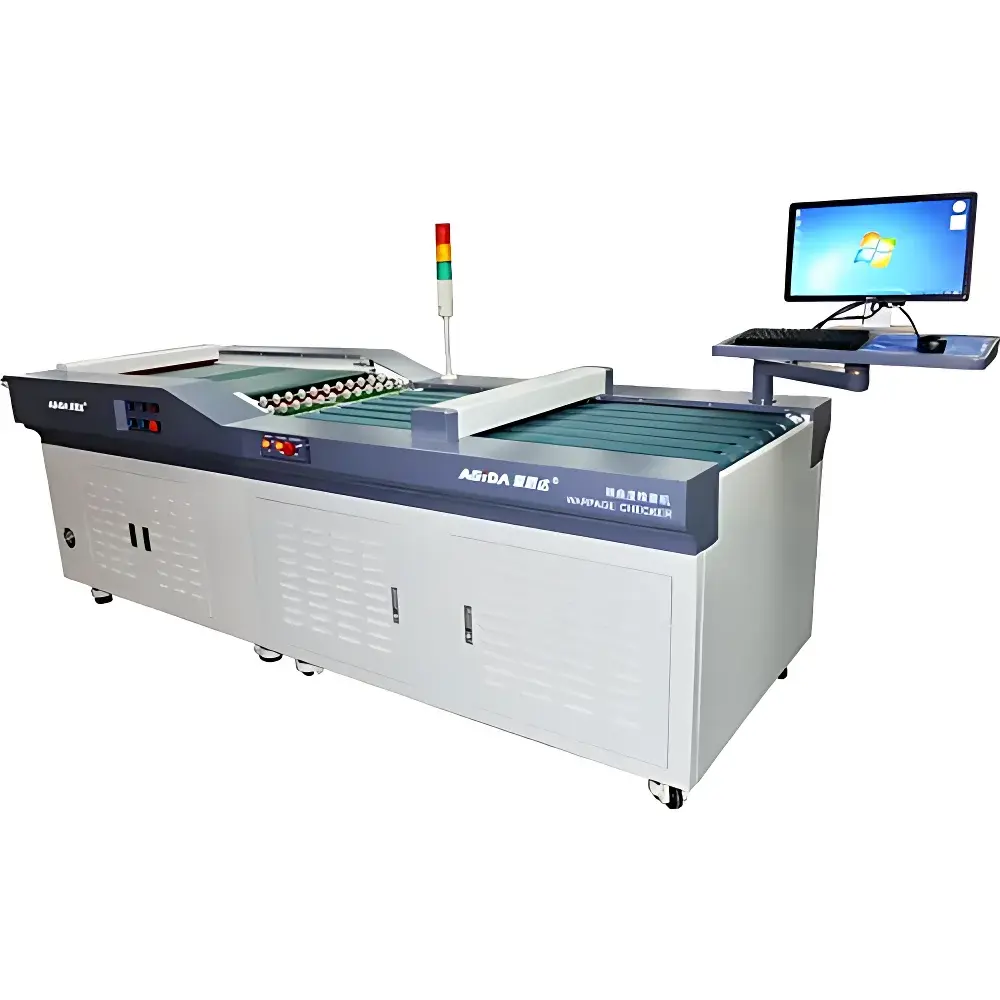
Zhengye QQ1000 PCB Warpage Measurement System
| Brand | Zhengye |
|---|---|
| Origin | Guangdong, China |
| Manufacturer Type | OEM/ODM Manufacturer |
| Country of Origin | China |
| Model | QQ1000 |
| Pricing | Available Upon Request |
| Measurement Accuracy | ±0.1 mm (verified with gauge blocks) |
| Maximum Detection Speed | 12.5 m/min |
| Measurable Board Thickness | 0.5–5.0 mm |
| Measurable Warpage Range | 0.5–3.0 mm |
| Minimum PCB Size | 40 mm × 80 mm |
| Maximum PCB Size | 480 mm × 500 mm |
| Equipment Dimensions (L×W×H) | 3510 mm × 1160 mm × 1050 mm |
| Weight | 450 kg |
Overview
The Zhengye QQ1000 PCB Warpage Measurement System is an industrial-grade, non-contact optical metrology platform engineered for high-throughput, automated warpage and bow evaluation of rigid printed circuit boards (PCBs) and copper-clad laminates (CCLs). It employs a dual-axis CCD-based laser displacement sensor array operating in triangulation mode, delivering sub-millimeter spatial resolution across the full board surface. The system captures vertical displacement profiles along predefined scan paths—typically spanning diagonal, centerline, and edge trajectories—to compute maximum bow (BOW) and twist (TWIST) values per IPC-TM-650 2.4.22 and IPC-6012D Annex A standards. Designed for integration into final QA stations or inline manufacturing cells, the QQ1000 performs real-time geometric deviation analysis without mechanical contact, eliminating risk of surface damage or measurement-induced deformation.
Key Features
- Non-contact, high-speed laser triangulation sensing with ±0.1 mm traceable accuracy (validated against NIST-traceable gauge blocks)
- Dual-sensor synchronized scanning architecture enabling simultaneous top-surface profile acquisition at up to 12.5 meters per minute
- Programmable motion control system with precision linear stages and servo-driven conveyor interface
- Real-time image overlay and 3D surface contour visualization via embedded industrial display
- Automated pass/fail classification logic compliant with IPC-defined warpage thresholds (e.g., ≤0.75% for Class 2, ≤0.5% for Class 3)
- Modular mechanical design supporting retrofit integration into existing SMT lines or standalone benchtop deployment
- Robust aluminum-alloy frame with vibration-damped base structure ensuring measurement stability under factory-floor conditions
Sample Compatibility & Compliance
The QQ1000 accommodates rigid PCBs and CCL substrates ranging from 0.5 mm to 5.0 mm in thickness, with planar dimensions between 40 mm × 80 mm and 480 mm × 500 mm. Boards are conveyed horizontally on a low-friction, static-dissipative belt; optional vacuum hold-down fixtures are available for thin or warped specimens exhibiting lateral instability. All measurement algorithms adhere to IPC-TM-650 Test Method 2.4.22 (“Board Warpage”) and support configurable reference plane definitions (least-squares best-fit, three-point, or corner-based). Data outputs include raw Z-height point clouds, 2D cross-sectional plots, and summary reports aligned with IPC-6012D, J-STD-020, and JEDEC JESD22-A113 qualification frameworks. The system meets CE machinery directive requirements and incorporates electrical safety compliance per IEC 61000-6-2/6-4.
Software & Data Management
Control and analysis are managed through Zhengye’s proprietary WarpageView™ software suite, built on a Windows 10 IoT Enterprise platform. The interface supports multi-language UI (English, Simplified Chinese, Korean), audit-trail-enabled user authentication, and role-based access control (operator, engineer, admin). Measurement data—including timestamped warpage values, pass/fail status, image snapshots, and process logs—is stored in SQLite databases with optional export to CSV, XML, or PDF formats. Integration with MES/SCADA systems is enabled via TCP/IP socket communication, Modbus RTU/TCP, and OPC UA protocol stacks. For regulated environments, optional 21 CFR Part 11-compliant electronic signature modules and ALCOA+ data integrity features (Attributable, Legible, Contemporaneous, Original, Accurate, Complete, Consistent, Enduring, Available) are available upon configuration.
Applications
- Final QA verification of multilayer PCBs prior to component assembly
- In-process warpage screening of copper-clad laminates after lamination and cooling cycles
- Process capability studies (Cp/Cpk) for thermal stress validation in reflow and wave soldering lines
- Root cause analysis of dimensional instability linked to material selection (e.g., FR-4 vs. high-Tg laminates) or stack-up asymmetry
- Supplier qualification audits requiring objective, repeatable warpage quantification
- Reliability testing labs performing IPC-9701 thermal cycling correlation with post-test warpage assessment
FAQ
What standards does the QQ1000 comply with for PCB warpage measurement?
The system implements IPC-TM-650 2.4.22 as its primary test methodology and supports configurable pass/fail criteria per IPC-6012D, IPC-A-600, and JEDEC JESD22-A113.
Can the QQ1000 measure both bow and twist independently?
Yes—dual-axis scanning enables independent computation of maximum bow (single-axis curvature) and twist (diagonal differential height), with results reported in millimeters and percentage-of-diagonal metrics.
Is offline calibration supported, and how often is it required?
Field calibration using certified gauge blocks is supported via the service menu; Zhengye recommends quarterly verification under normal operation and after any mechanical impact or relocation.
Does the system support custom board outlines or fiducial-based alignment?
Yes—WarpageView™ includes CAD-based board template import (DXF/DWG), automatic fiducial detection, and adaptive ROI definition for irregular or panelized boards.
What environmental conditions are required for stable operation?
Ambient temperature: 15–28°C; relative humidity: 30–70% non-condensing; floor vibration isolation recommended (ISO 23828 Class B); no direct sunlight or strong EMI sources within 1 meter.