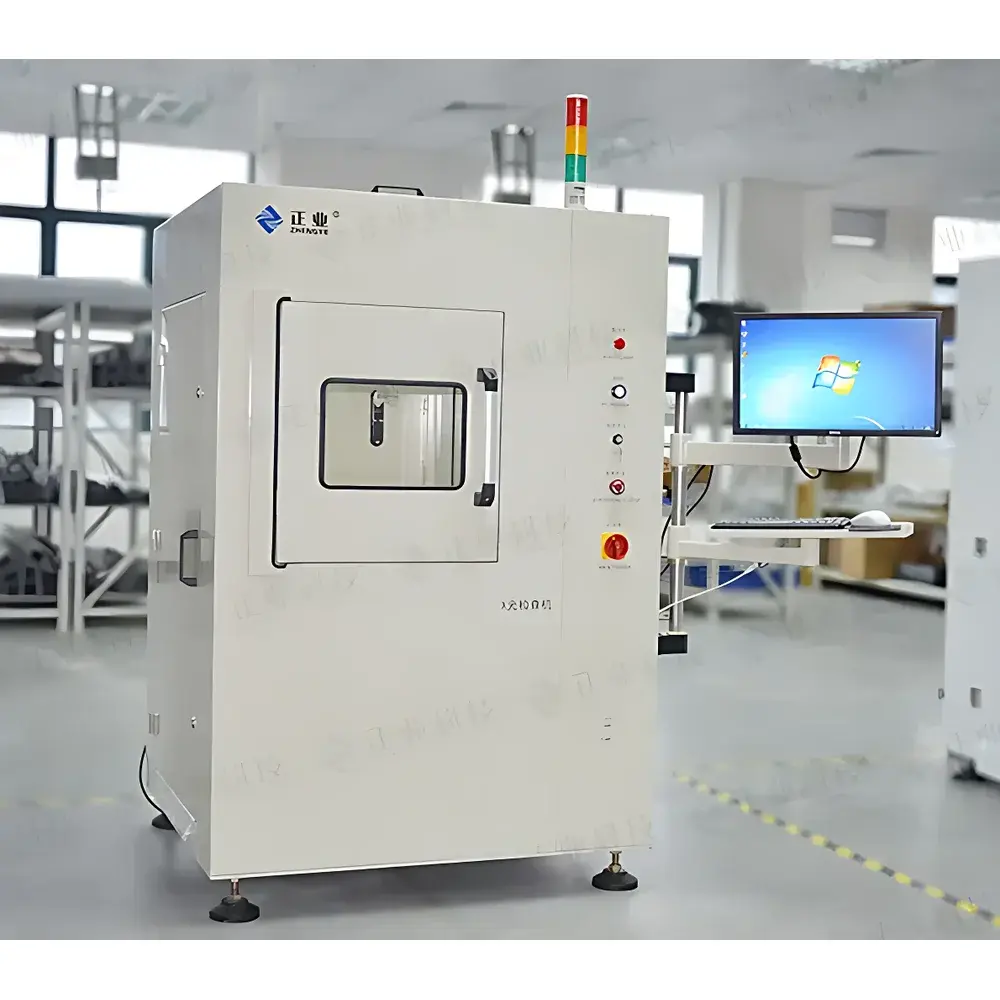
Zhengye XG5010 Aluminum-Encased Lithium-Ion Cell X-ray Inspection System
| Brand | Zhengye |
|---|---|
| Origin | Guangdong, China |
| Manufacturer Type | OEM/ODM Manufacturer |
| Origin Category | Domestic (China) |
| Model | XG5010 |
| X-ray Tube Voltage | 90–130 kV (configurable) |
| X-ray Tube Current | 89–455 µA (configurable) |
| Focal Spot Size | 5–15 µm |
| Cooling Method | Forced Air Cooling |
| Detector Type | Image Intensifier / Flat Panel Detector |
| Field of View | Φ100 mm / 114.9 mm × 64.6 mm (configurable) |
| Image Resolution | 1392 × 1040 / 1536 × 864 pixels (configurable) |
| Geometric Magnification | 12×–48× |
| Repeatability Accuracy | ±60 µm |
| Inspection Speed | ≥1.5 pts/sec (excluding loading/unloading & stage motion) |
| Stage Dimensions | 515 mm × 460 mm |
| Effective Inspection Area | 450 mm × 410 mm |
| Max Payload | ≤5 kg |
| Radiation Safety | ≤1 µSv/hr (compliant with IEC 61331-1 & GBZ 130-2020) |
| Computer | 22" widescreen LCD/touch display, Intel Core i5, 4 GB RAM, 500 GB HDD |
| System Dimensions | 1136 mm × 1076 mm × 1730 mm |
| Weight | ~750 kg |
| Power Supply | AC 220 V, 10 A |
| Operating Environment | 25 °C ±3 °C, RH 50% ±10% |
Overview
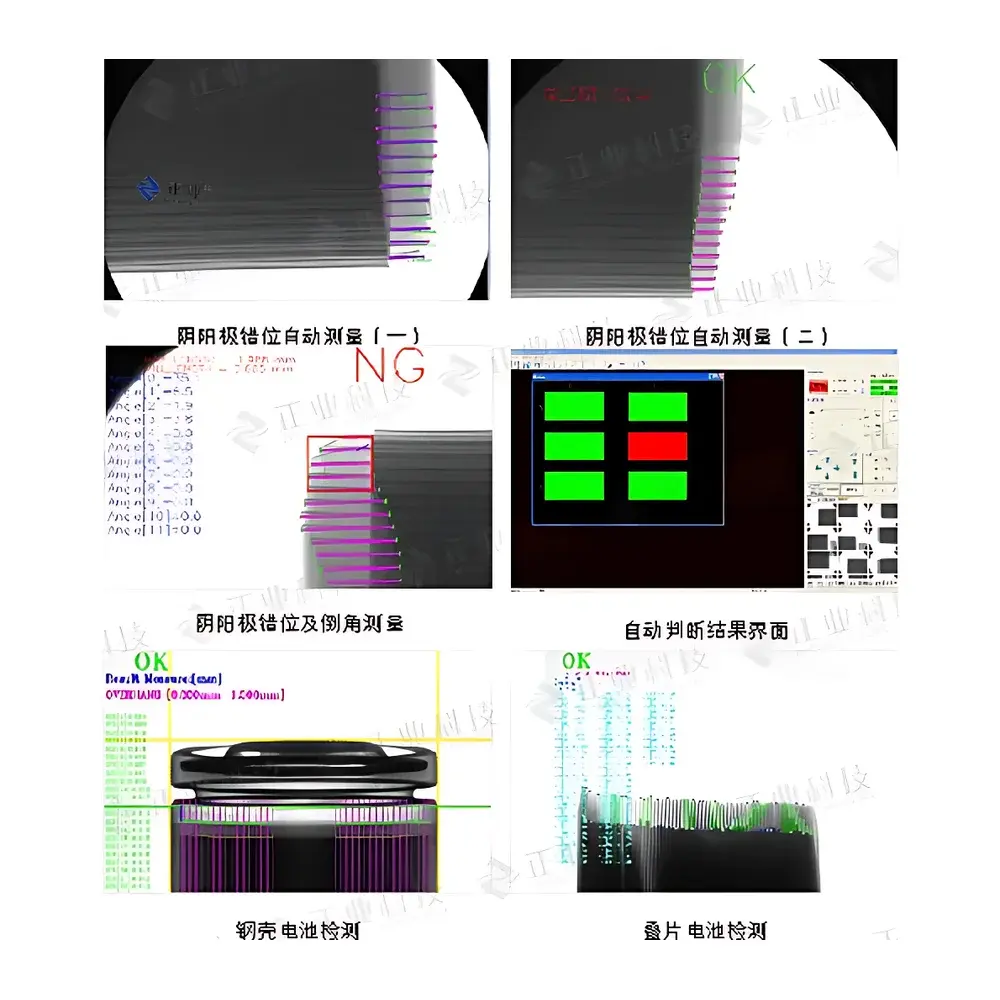
The Zhengye XG5010 is a high-precision, industrial-grade X-ray inspection system engineered specifically for non-destructive evaluation (NDE) of aluminum-encased lithium-ion battery cells. Utilizing transmission-based X-ray imaging, the system generates high-contrast radiographic projections to visualize internal structural features—including electrode alignment, weld integrity, separator positioning, tab bonding, voids, foreign particles, and anode/cathode delamination—without physical contact or sample preparation. Designed for integration into battery manufacturing quality control lines, the XG5010 supports both offline laboratory analysis and inline process monitoring environments. Its modular architecture enables configuration flexibility in radiation source parameters, detector selection, and geometric magnification to meet application-specific resolution and throughput requirements. All operational parameters comply with international radiation safety standards including IEC 61331-1, IEC 62495, and China’s GBZ 130-2020, ensuring operator safety and regulatory readiness for ISO 13485 and IATF 16949-aligned production facilities.
Key Features
- 2.5D Metrology Engine: Integrated measurement algorithms support precise quantification of linear distances, circle diameters, concentricity between nested electrodes, and radial offsets from center points—enabling dimensional verification beyond simple defect detection.
- CNC Path Programming: User-defined inspection sequences can be recorded, saved, and recalled for repeatable multi-point scanning across small-batch or prototype cell formats, minimizing operator dependency and inter-run variability.
- Real-Time Navigation Interface: A large-field-of-view overview window allows intuitive mouse-driven navigation; clicking any region in the preview image triggers automatic stage repositioning to that coordinate with sub-60 µm repeatability.
- Multi-Format Image Processing: Supports DICOM, TIFF, BMP, and JPEG export; includes real-time contrast enhancement, edge sharpening, dynamic range compression, and noise reduction filters optimized for low-dose X-ray acquisition.
- Automated Pass/Fail Classification: Rule-based decision logic—configurable via thresholding, pattern matching, and geometric tolerance bands—generates annotated result overlays and binary pass/fail flags synchronized with MES data streams.
Sample Compatibility & Compliance
The XG5010 accommodates cylindrical, prismatic, and pouch-type aluminum-housed Li-ion cells up to 450 mm × 410 mm in footprint and 5 kg in mass. Its open-stage design permits rapid fixture adaptation for varying cell geometries and busbar configurations. Radiation shielding meets Class I cabinet requirements per IEC 61331-1, with leakage dose consistently maintained below 1 µSv/hr at 5 cm from any external surface during operation. The system is CE-marked (EMC Directive 2014/30/EU, Low Voltage Directive 2014/35/EU), RoHS-compliant, and documented for GLP/GMP audit trails—including full calibration history, user access logs, and image metadata stamping (DICOM-SR). Optional FDA 21 CFR Part 11 compliance packages are available for regulated pharmaceutical or medical device battery applications.
Software & Data Management
Zhengye’s proprietary XInsight™ software provides a unified interface for acquisition, analysis, reporting, and database archiving. It supports DICOM-compliant PACS integration, SQL-based result logging, and CSV/Excel export for SPC charting. Audit trails record all parameter changes, measurement actions, and classification decisions with timestamp, operator ID, and IP address. Raw projection images and reconstructed cross-sections are stored with embedded EXIF-style metadata—including kV, µA, exposure time, magnification factor, and stage coordinates—to ensure traceability throughout product lifecycle validation. Software updates follow ISO/IEC 17025-aligned change control procedures, with version-controlled release notes and regression test reports provided upon request.
Applications
- Electrode stack misalignment detection in Jelly-roll and stacked prismatic cells
- Weld seam integrity assessment of aluminum tabs and busbars
- Separator wrinkling, tearing, or displacement under compression
- Foreign metallic or polymeric contaminant identification (≥25 µm detectability at 30 kV equivalent)
- Void quantification in thermal interface materials and potting compounds
- Post-cycle degradation analysis (e.g., lithium plating, dendrite growth, foil corrosion)
- Pre-shipment QA for EV battery module suppliers requiring ASIL-B traceability
FAQ
What X-ray tube options are supported for higher-resolution imaging?
The XG5010 accepts microfocus tungsten-target tubes with focal spot sizes down to 5 µm. Optional dual-tube configurations (e.g., 90 kV + 130 kV) enable material-specific contrast optimization for multi-layer aluminum-copper-nickel architectures.
Can the system interface with factory automation protocols?
Yes—it supports Ethernet/IP, Modbus TCP, and OPC UA for bidirectional communication with PLCs and MES platforms. Trigger signals, pass/fail status, and measurement data can be streamed in real time without host PC intervention.
Is remote diagnostics and software update capability available?
All units include secure TLS-encrypted remote access via Zhengye’s authorized service portal, enabling firmware updates, log retrieval, and collaborative troubleshooting under ISO/IEC 27001-certified infrastructure.
How is measurement uncertainty validated for metrology tasks?
Each system ships with NIST-traceable step gauges and certified reference objects. Uncertainty budgets—per ISO/IEC 17025 Annex A.4—are documented in the Factory Acceptance Test (FAT) report, covering geometric distortion, pixel pitch calibration, and stage encoder linearity.