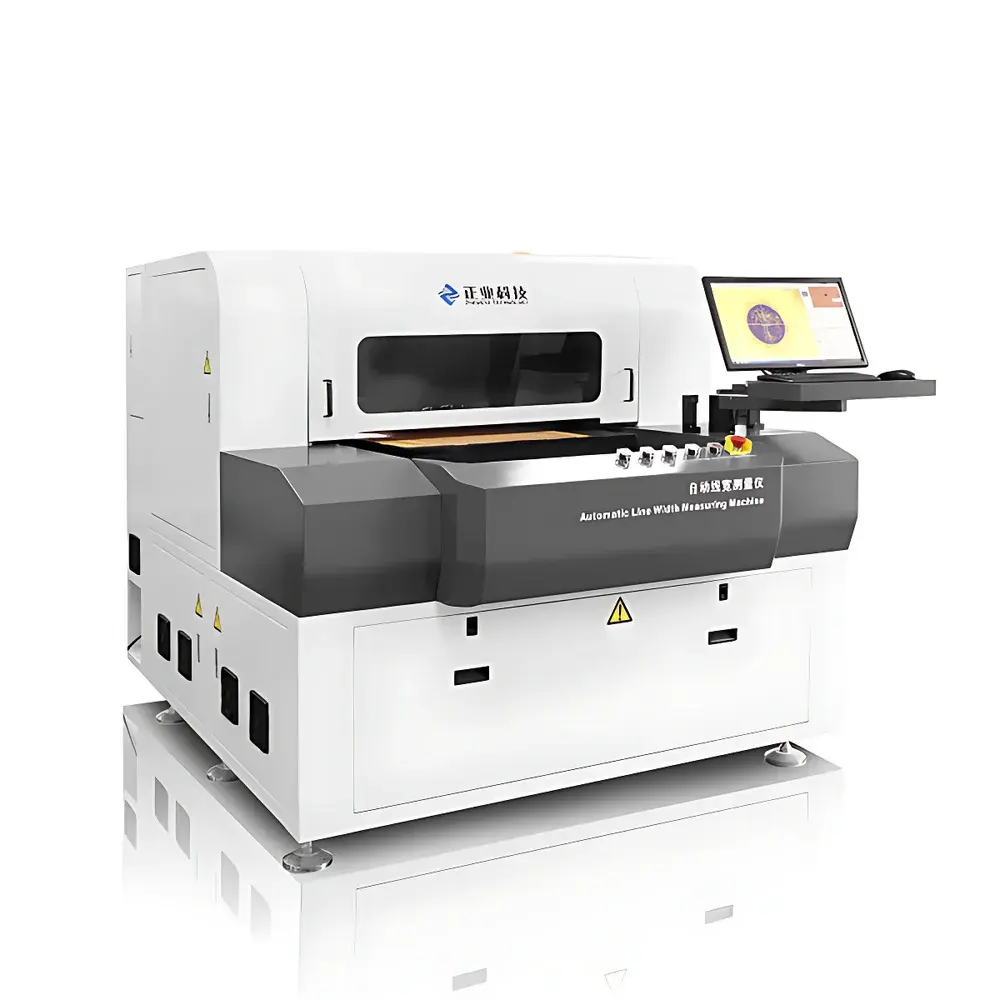
Zhengye XK32 Automated PCB Line Width Inspection System
| Brand | Zhengye |
|---|---|
| Origin | Guangdong, China |
| Manufacturer Type | OEM/ODM Manufacturer |
| Country of Origin | China |
| Model | XK32 |
| Pricing | Available Upon Request |
| Dimensions (W×D×H) | 1700 mm × 2050 mm × 1600 mm |
| Weight | ~1750 kg (excluding PC) |
| Power Supply | 3P AC 380 V + N + PE, 50 Hz, 5 kW |
| Operating Temperature | 20–40 °C |
| Relative Humidity | 40–70 % RH |
| Lens | Motorized Zoom Lens (0.7×–4.5×) |
| Measurement Field of View (at specified magnifications) | 0.7× = 3.5 mm, 1× = 3.2 mm, 2× = 2.2 mm, 3× = 1.5 mm, 4× = 1.0 mm (±5 % tolerance) |
| Line Width Measurement Range | 20 µm – 1200 µm |
| Line Width Measurement Accuracy | 3 µm @ 1×, 2 µm @ 2×, 1 µm @ 3× and 4× (calibrated using NIST-traceable standard wafer |
| Maximum Sample Size | ≤ 600 mm × 650 mm |
| Illumination | High-Uniformity LED Ring Light |
| Navigation System | CCD-based Macro Navigation Imaging Module |
| Edge Detection | Auto-edge detection with sub-pixel interpolation |
| Data Export | Native Excel (.xlsx) export with statistical summaries (mean, σ, Cp/Cpk, histogram, trend charts) |
| Software Control | Programmable measurement sequence with DXF-based coordinate referencing and scriptable batch execution |
Overview
The Zhengye XK32 Automated PCB Line Width Inspection System is a high-precision optical metrology platform engineered for non-contact, quantitative dimensional verification of photolithographically defined conductive features on printed circuit boards (PCBs), IC substrates, and flat-panel display (FPD) panels. Built upon a rigid granite base and integrated motion-controlled XY stage, the system implements machine vision–based measurement using calibrated telecentric imaging optics and sub-pixel edge localization algorithms. Its core measurement principle relies on digital image acquisition under controlled coaxial and ring illumination, followed by real-time centroid and edge-gradient analysis to determine line width (top/bottom cross-section), line-to-line spacing, pad-to-line clearance, via diameter (through-hole and blind), and feature positional deviation. Designed specifically for post-etch and pre-solder-mask process validation, the XK32 supports full traceability in high-mix, high-volume manufacturing environments where IPC-6012, IPC-A-600, and JIS C 5012 compliance are required.
Key Features
- DXF-driven automated programming: Import industry-standard Gerber/DXF layout files to define measurement points, regions of interest (ROIs), and geometric tolerances—enabling rapid setup without manual coordinate entry.
- Motorized zoom lens system (0.7×–4.5×) with software-controlled magnification switching—eliminates mechanical lens exchange and ensures consistent optical calibration across all magnifications.
- Auto-focus algorithm synchronized with Z-axis actuation, maintaining optimal depth-of-field and edge contrast at each measurement location.
- CCD-based macro navigation camera providing real-time wide-field preview (≥10× field reduction) for rapid coarse positioning and fiducial alignment prior to high-magnification inspection.
- Sub-pixel edge detection engine supporting both single-edge and dual-edge (top/bottom) width computation with configurable sensitivity thresholds and noise filtering.
- Fully programmable measurement sequences—including conditional logic, loop iterations, and pass/fail flagging—with persistent storage and version-controlled recall.
Sample Compatibility & Compliance
The XK32 accommodates PCB panels up to 600 mm × 650 mm and thicknesses from 0.05 mm to 6.0 mm, including rigid FR-4, flexible polyimide, and rigid-flex hybrids. It supports measurement of fine-pitch traces (≥20 µm), microvias (≥50 µm), and solder mask openings with high repeatability (R&R < 5 % per AIAG MSA guidelines). All measurement data logs include timestamp, operator ID, program name, environmental conditions (recorded via onboard sensors), and image thumbnails—ensuring alignment with ISO 9001, IATF 16949, and FDA 21 CFR Part 11 requirements when deployed with audit-trail-enabled software configuration. Calibration certificates are issued per ISO/IEC 17025-accredited procedures using traceable step gauges and linewidth standards.
Software & Data Management
The proprietary inspection software provides a Windows-based GUI with dual-mode operation: guided wizard mode for first-time users and expert scripting mode (Python API supported) for advanced automation integration. All measurement results are stored in a structured SQLite database with relational links to original images, DXF references, and SPC metadata. Statistical process control outputs include X̄-R charts, capability indices (Cp, Cpk, Pp, Ppk), defect Pareto analysis, and automated PDF/Excel report generation. Data export conforms to ASTM E2913-20 (Standard Practice for Digital Image Data Exchange) and supports direct OPC UA or Modbus TCP interfacing for MES/SCADA connectivity.
Applications
- Post-etch line width uniformity verification on inner/outer layer PCBs before solder mask application.
- IC substrate trace geometry validation (e.g., ABF film, silicon interposers).
- LCD/TFT array line/space metrology for gate/data bus patterning.
- Automotive ADAS module PCB critical dimension (CD) monitoring per AEC-Q200 stress screening protocols.
- Failure analysis correlation between AOI false calls and actual dimensional deviations.
- Process window qualification during dry/wet etch development and photoresist optimization.
FAQ
Does the XK32 support multi-layer registration measurement?
Yes—the system enables overlay accuracy assessment between layers using fiducial alignment and coordinate transformation matrices derived from imported stack-up DXF files.
Can measurement programs be exported for use on other XK32 units?
Yes—programs are saved as encrypted .xkp files with embedded calibration offsets and can be deployed across identical hardware configurations with zero revalidation.
Is GLP/GMP-compliant audit trail functionality available?
Yes—when configured with optional electronic signature and role-based access control modules, the software meets ALCOA+ data integrity principles and supports 21 CFR Part 11 compliance.
What is the recommended recalibration interval?
Annual calibration is advised; however, daily verification using a certified reference standard (included) is required per ISO 10012 and internal quality procedures.
Does the system integrate with factory MES or QMS platforms?
Yes—via RESTful API, OPC UA server, or flat-file watchfolder protocols, enabling bidirectional data flow with Siemens Opcenter, Rockwell FactoryTalk, or ETQ Reliance.