
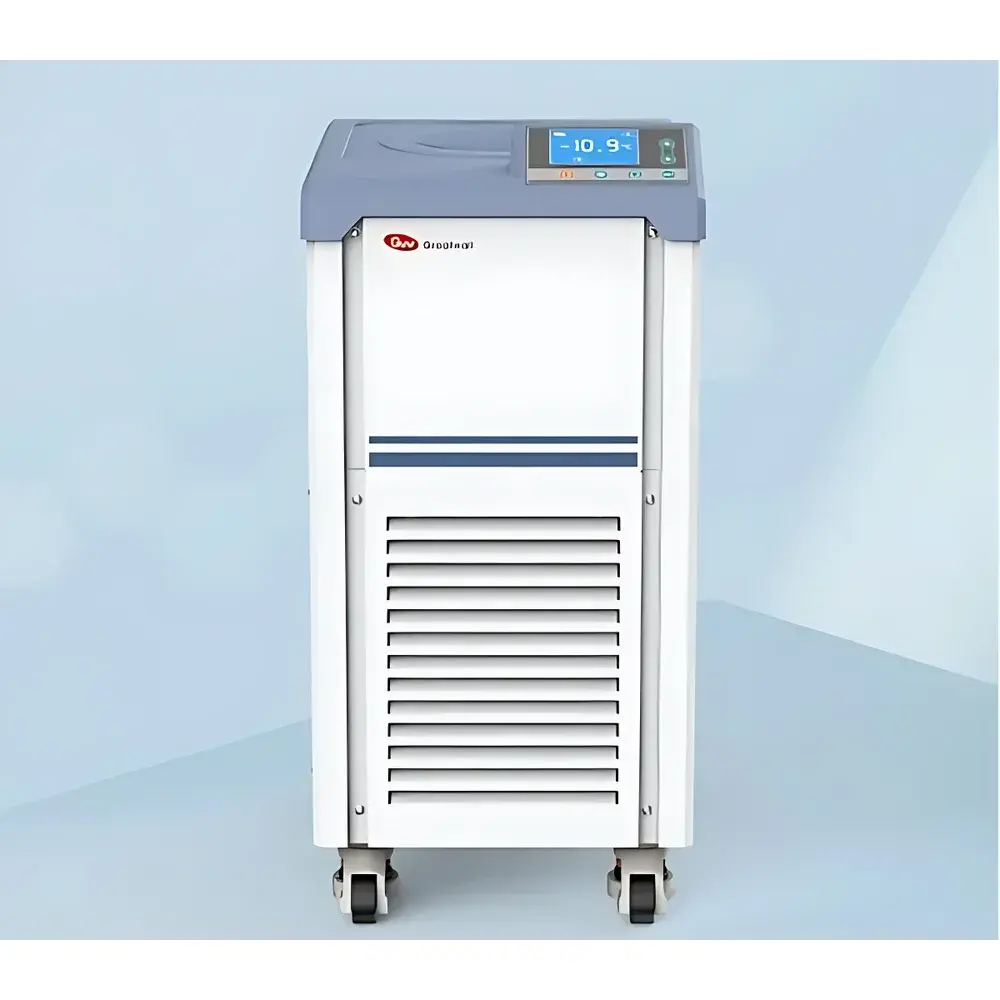
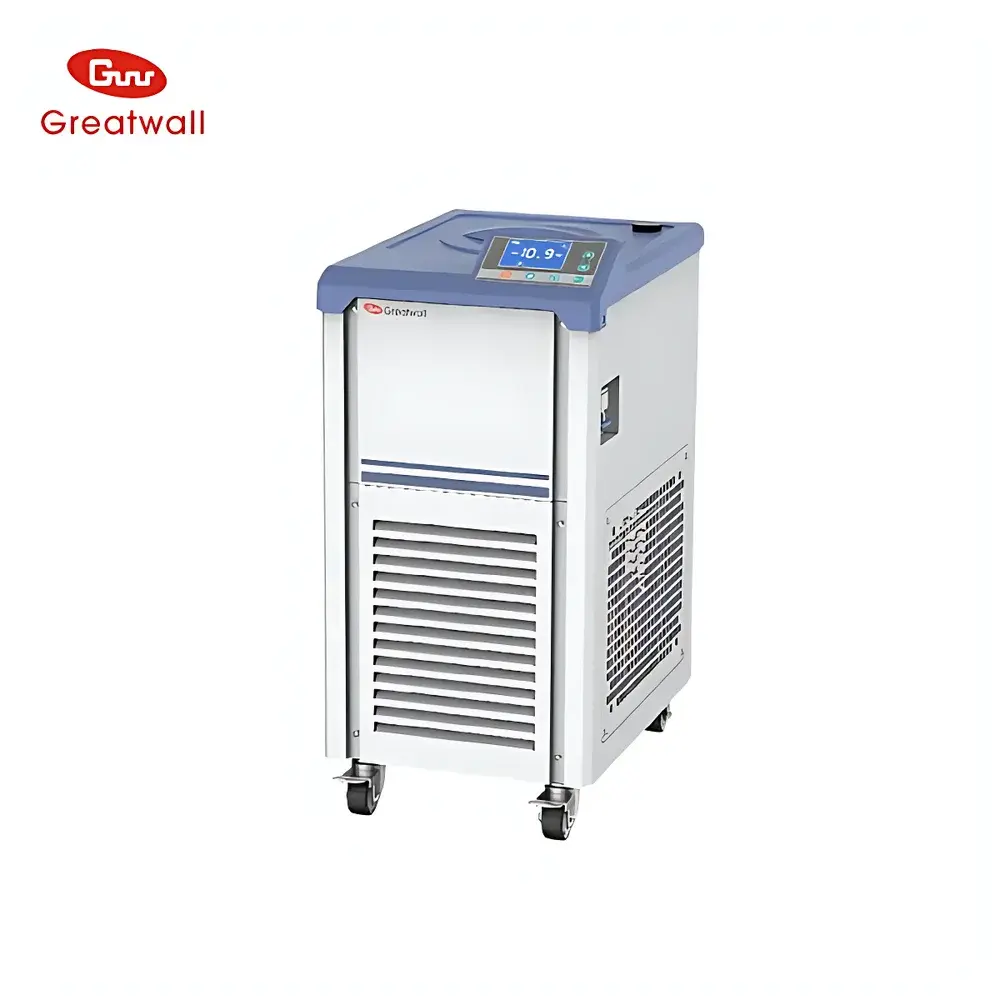
Zhengzhou Great Wall Scientific Industrial & Trading Co., Ltd. DLSB-5/20 Low-Temperature Circulating Chiller
| Brand | The Great Wall |
|---|---|
| Origin | Henan, China |
| Manufacturer Type | OEM Manufacturer |
| Country of Origin | China |
| Model | DLSB-5/20 |
| Price | USD 1,080 (FOB Zhengzhou) |
| Empty-Load Minimum Temperature | -20 °C |
| Operating Temperature Range | -20 °C to +25 °C |
| Reservoir Capacity | 5 L |
| Temperature Stability | ±2 °C |
| Temperature Sensor | Pt100 |
| Display Resolution | 0.1 °C |
| Communication Interface | RS485 with Modbus RTU Protocol |
| Refrigerant | R404A |
| Cooling Capacity (W) | 680 @ 10 °C |
| Pump Max Flow Rate | 22 L/min |
| Pump Max Pressure | 1.1 bar |
| IP Rating | IP20 |
| Ambient Operating Temp | 5–35 °C |
| Max Relative Humidity | ≤70% RH |
| Power Supply | 220 V~, 50 Hz |
| Fluid Port Size | 1/2″ BSP |
| Tubing Compatibility | Silicone Rubber Hose (Φ13×Φ9 mm) |
| Reservoir Material | AISI 304 Stainless Steel |
| Dimensions (W×D×H) | 335×473×684 mm |
| Net Weight | 40 kg |
| CE Certification | TÜV-certified (selected models) |
Overview
The Zhengzhou Great Wall Scientific Industrial & Trading Co., Ltd. DLSB-5/20 Low-Temperature Circulating Chiller is an engineered thermal management system designed for precise, stable, and continuous external cooling in laboratory and pilot-scale process environments. Based on vapor-compression refrigeration using R404A — a zeotropic blend compliant with industrial low-temperature applications — the unit delivers consistent cold fluid circulation across a controlled temperature range from –20 °C to +25 °C. Its core architecture integrates a hermetic scroll compressor, high-efficiency plate heat exchanger, and a 5-liter AISI 304 stainless steel reservoir with integrated immersion sensor (Pt100), enabling accurate thermal feedback control. Unlike open-bath chillers, this closed-loop system maintains fluid integrity, minimizes evaporation loss, and eliminates contamination risk—critical for sensitive applications such as rotary evaporation condenser cooling, material property testing under thermal stress, semiconductor thermal cycling, and laser diode stabilization.
Key Features
- High-resolution LCD interface with 0.1 °C display resolution and real-time monitoring of setpoint, actual bath temperature, and operational status
- RS485 serial communication port supporting Modbus RTU protocol for integration into centralized lab automation systems or SCADA platforms
- Comprehensive safety architecture including compressor delay start (preventing short-cycling), overcurrent protection, high-pressure cut-off, ground-fault detection, and overtemperature shutdown
- Robust mechanical design: IP20-rated enclosure suitable for indoor laboratory use; vibration-damped mounting; reinforced silicone hose connections (Φ13×Φ9 mm) compatible with standard 1/2″ BSP ports
- TÜV-certified CE marking (applicable to DLSB series units meeting EN 61000-6-3, EN 61000-6-4, and EN 61010-1 requirements) — supporting compliance with EU Machinery Directive 2006/42/EC and Low Voltage Directive 2014/35/EU
Sample Compatibility & Compliance
The DLSB-5/20 accommodates common heat-transfer fluids including aqueous ethylene glycol solutions (20–50% v/v), silicone oils, and specialized low-temperature synthetic coolants — all chemically compatible with its 304 stainless steel reservoir and fluorocarbon-sealed pump head. It is routinely deployed in GLP-compliant laboratories where traceable temperature control is required per ISO/IEC 17025:2017 clause 7.2.2. While not intrinsically rated for hazardous locations, its electrical isolation and grounding provisions meet IEC 61010-1 Edition 3 safety requirements for laboratory equipment. For regulated pharmaceutical manufacturing, the unit may be qualified as ancillary support equipment under FDA 21 CFR Part 11 when paired with validated Modbus-based data logging software that enforces user access controls and audit trail generation.
Software & Data Management
Although the DLSB-5/20 operates autonomously via front-panel control, its RS485 interface enables bidirectional communication with third-party software platforms—including LabVIEW™, MATLAB® Instrument Control Toolbox, and custom Python-based controllers using PyModbus. Users can remotely configure setpoints, query real-time temperature readings, monitor alarm states, and log time-stamped thermal profiles at configurable intervals. When integrated into a validated environment, the chiller supports electronic record retention aligned with ALCOA+ principles (Attributable, Legible, Contemporaneous, Original, Accurate, Complete, Consistent, Enduring, Available) — particularly relevant for QC labs performing ASTM E2877-22 (Standard Guide for Thermal Stability Testing of Heat Transfer Fluids) or ISO 11357-3 (DSC characterization protocols).
Applications
- Cooling of rotary evaporator condensers to improve solvent recovery efficiency and prevent vapor breakthrough
- Temperature-controlled material testing: tensile strength evaluation of polymers at sub-zero conditions, thermal expansion coefficient measurement, and cryogenic fatigue analysis
- Simulated process temperature profiling for reaction calorimetry and kinetic studies in fine chemical synthesis
- Stabilization of high-power laser sources (e.g., CO₂, DPSS) requiring constant coolant inlet temperature within ±0.5 °C drift over 8-hour cycles
- Low-temperature sample storage and pre-conditioning for XRD, SEM, or TEM specimen preparation workflows
FAQ
What is the minimum ambient temperature for reliable operation?
The unit is rated for continuous operation between 5 °C and 35 °C ambient. Below 5 °C, compressor oil viscosity increases and refrigerant return may become unstable — potentially triggering high-pressure cutouts.
Can this chiller be used with deionized water alone?
No. Pure deionized water is not recommended due to corrosion risk and freezing point limitations. A minimum 20% ethylene glycol/water mixture is required for operation below 0 °C and to ensure long-term compatibility with copper-alloy components.
Is the RS485 interface optically isolated?
No. The interface is electrically referenced to chassis ground. For noise-prone industrial environments, users should install a galvanically isolated RS485 repeater or signal conditioner to maintain communication integrity.
Does the unit include a built-in data logger?
No. Internal memory stores only the current setpoint and last alarm event. Continuous data acquisition requires external logging via Modbus polling or analog output (if equipped with optional 4–20 mA module).
What maintenance intervals are recommended?
Compressor oil and filter dryer replacement every 24 months under normal lab usage (≤8 hrs/day); annual inspection of refrigerant charge integrity via manifold gauge set; quarterly verification of Pt100 calibration against NIST-traceable reference thermometer.



