
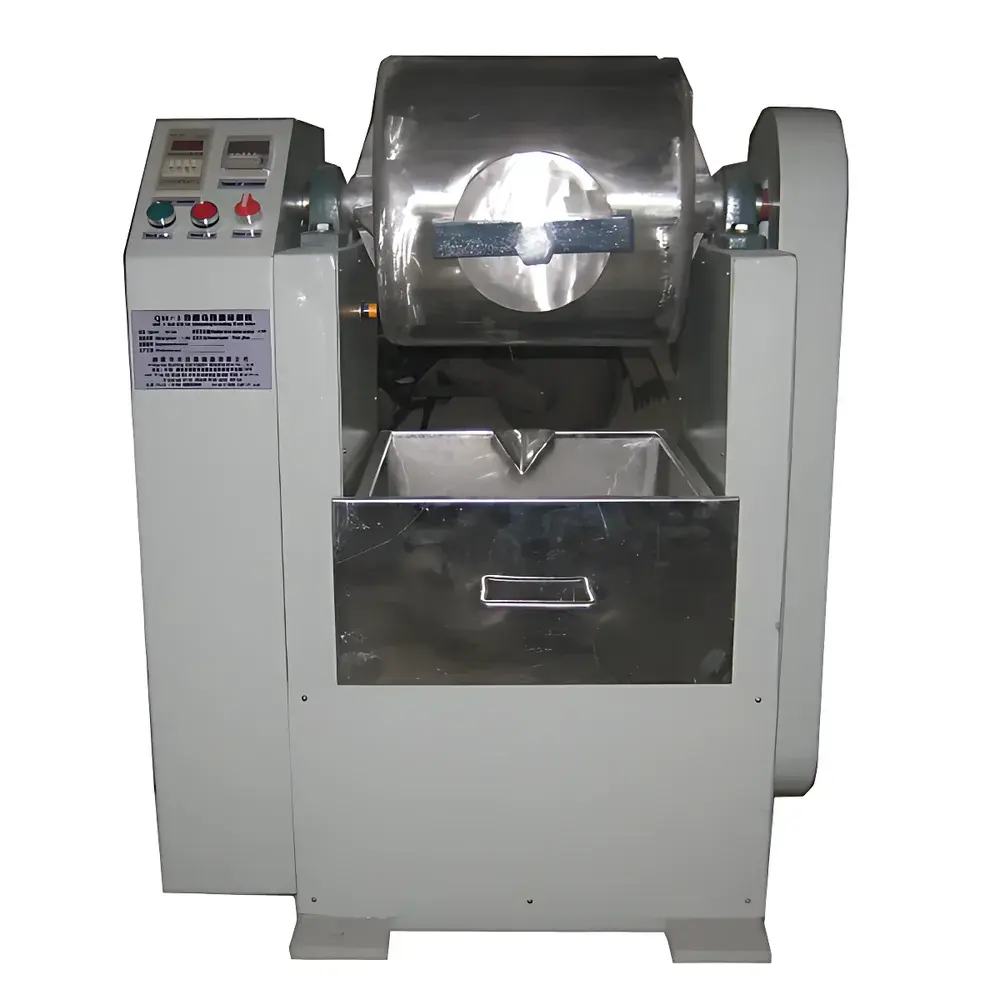
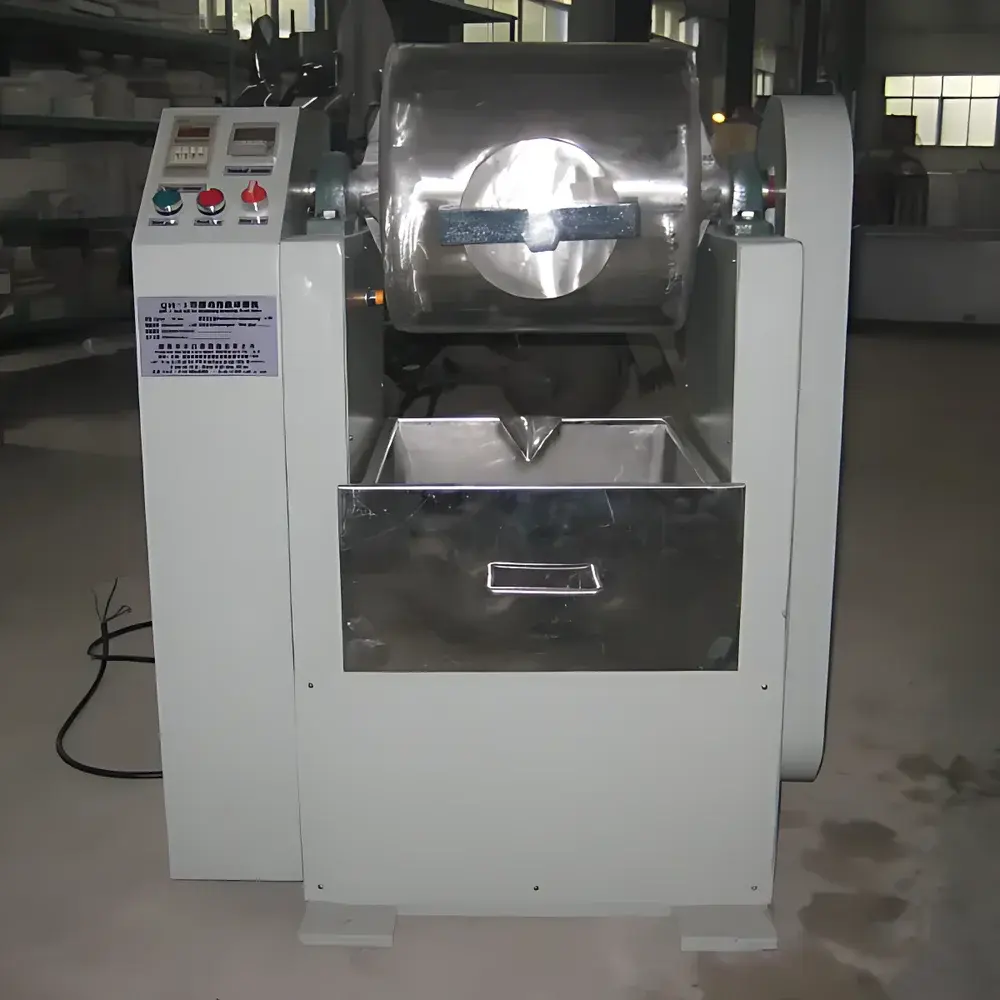
ZHENHUAFENXI QM-3 Bond Work Index Ball Mill
| Brand | ZHENHUAFENXI |
|---|---|
| Origin | Hunan, China |
| Manufacturer Type | Authorized Distributor |
| Country of Origin | China |
| Model | QM-3 |
| Price | Upon Request |
| Grinding Chamber Dimensions | Φ305 × 305 mm |
| Rotational Speed | 70 rpm |
| Motor Power | 1.5 kW |
| Supply Voltage | 380 V AC, 4-pole |
| Motor Output Speed | 960 rpm |
| Ball Charge | 285 precision steel balls (ASTM A29/A29M Grade 52100 bearing steel), comprising: 43 × Φ36.5 mm, 67 × Φ30.2 mm, 10 × Φ25.4 mm, 71 × Φ19.1 mm, 94 × Φ15.9 mm |
| Lining Material | Stainless Steel (AISI 304) |
| Counter | 4-digit programmable revolution counter with auto-stop function |
| Compliance | GB/T 26567–2011 (Bond Ball Mill Work Index Test Method) |
Overview
The ZHENHUAFENXI QM-3 Bond Work Index Ball Mill is a precision-engineered laboratory-scale grinding apparatus designed specifically for determining the Bond Work Index (BWI) of cement raw materials, clinker, slag, limestone, and other mineral feedstocks according to GB/T 26567–2011 — the Chinese national standard aligned with the internationally recognized Bond ball mill grindability test methodology. The BWI quantifies the specific energy (kWh/short ton) required to reduce a material from theoretically infinite particle size to a product P80 of 100 µm under standardized closed-circuit grinding conditions. This value serves as a fundamental input parameter in industrial-scale mill circuit design, power draw prediction, and comparative assessment of raw material grindability across geological sources or blending scenarios. The QM-3 replicates the geometry, rotational dynamics, and charge configuration of the canonical 305 mm × 305 mm Bond standard mill, ensuring metrological traceability to the original Bond protocol while maintaining robust mechanical integrity for repeated use in academic, R&D, and quality control laboratories.
Key Features
- Standardized grinding chamber: Cylindrical stainless steel (AISI 304) drum with internal dimensions of Φ305 mm × 305 mm effective length — fully compliant with Bond’s geometric specifications.
- Precise rotational control: Fixed-speed drive delivering 70 ± 0.5 rpm, calibrated against ISO 2788–1:2017 requirements for rotational speed stability during grindability testing.
- Authentic Bond ball charge: 285 high-hardness, spherically ground steel balls conforming to ASTM A29/A29M Grade 52100 (62–66 HRC), distributed across five discrete diameter classes per Bond’s original mass distribution ratio.
- Programmable revolution counter: Four-digit digital counter enabling precise setting of grinding duration (e.g., 100–1,000 revolutions); automatically interrupts motor power upon reaching target count to eliminate operator-dependent timing errors.
- Thermally stable motor system: 1.5 kW, 380 V AC, 4-pole induction motor with nominal output speed of 960 rpm, coupled via gear reduction to maintain consistent torque delivery throughout the test cycle.
- Modular mechanical architecture: Separated drive train, electrical control panel, and grinding vessel facilitate routine maintenance, calibration verification, and ISO/IEC 17025-compliant equipment qualification.
Sample Compatibility & Compliance
The QM-3 is validated for use with dry, non-agglomerating inorganic particulates having Mohs hardness ≤7 and moisture content <1.5 wt%. Typical applications include Portland cement clinker, granulated blast furnace slag, fly ash, natural pozzolans, limestone, and siliceous sand. All operational parameters adhere strictly to GB/T 26567–2011, which references the foundational principles of Bond’s 1952 and 1961 publications and maintains technical equivalence with ASTM C115–22 (Standard Test Method for Fineness of Hydraulic Cement by the Turbidimeter) and ISO 5074:2015 (Hard coal — Determination of grindability index). The stainless-steel lining prevents contamination during analysis of reactive or trace-element-sensitive samples, supporting GLP-aligned workflows where sample integrity and instrument blank characterization are critical.
Software & Data Management
While the QM-3 operates as a stand-alone electromechanical instrument without embedded firmware or network connectivity, its programmable counter provides deterministic, audit-ready test records essential for regulatory documentation. Each test cycle generates a timestamped, manually logged entry including initial mass, final sieve residue (per ASTM E11), revolutions completed, and calculated BWI using the Bond equation:
Wi = 43.9 × (P10.23 × Gbp0.82 × (10/√P80 − 10/√F80)).
Laboratories integrating the QM-3 into validated quality systems may document results in LIMS platforms compliant with FDA 21 CFR Part 11 (electronic records and signatures) or ISO/IEC 17025:2017 Clause 7.5 (control of data and information management), leveraging the instrument’s repeatable mechanical behavior as a foundation for method validation per ICH Q2(R2).
Applications
- Determination of Bond Work Index for cement raw mix optimization and kiln feed formulation.
- Comparative grindability screening of alternative supplementary cementitious materials (SCMs) prior to industrial-scale trials.
- Teaching laboratory implementation of comminution theory, energy-size reduction relationships, and empirical modeling of grinding efficiency.
- Pre-feasibility studies for mineral processing circuits involving hard-rock ores, requiring standardized grindability benchmarks.
- Quality assurance of incoming limestone and clay feedstocks in cement manufacturing QA/QC protocols.
- Research on particle breakage mechanics, including impact vs. attrition dominance analysis through controlled charge composition variation.
FAQ
What standards does the QM-3 comply with for Bond Work Index testing?
The QM-3 is engineered to meet the dimensional, rotational, and charge specifications defined in GB/T 26567–2011, which is technically harmonized with the original Bond methodology and functionally equivalent to ASTM C115–22 Annex A1 and ISO 5074:2015 for grindability index determination.
Can the QM-3 be used for wet grinding or organic materials?
No. The QM-3 is configured exclusively for dry grinding of inorganic, non-corrosive, low-moisture mineral samples. Wet grinding requires sealed, corrosion-resistant vessels and specialized slurry handling — not supported by this model.
Is calibration certification available for the revolution counter and rotational speed?
Yes. Third-party calibration certificates traceable to NIM (National Institute of Metrology, China) or ISO/IEC 17025-accredited providers can be arranged upon request for both the digital counter and tachometric verification of drum RPM.
How is the steel ball charge replenished or verified?
Ball mass and diameter distribution must be verified before each BWI test series using calibrated micrometers and analytical balances (±0.01 g resolution). Replacement balls are supplied with certified hardness (62–66 HRC) and sphericity (≤0.5 µm deviation) documentation.
Does the QM-3 support integration with automated sieving or particle size analyzers?
It does not include built-in interfaces; however, its standardized output (ground sample in sealed containers) is fully compatible with downstream laser diffraction (ISO 13320), sieve analysis (ISO 3310-1), or image-based particle characterization systems.
Related Products



