
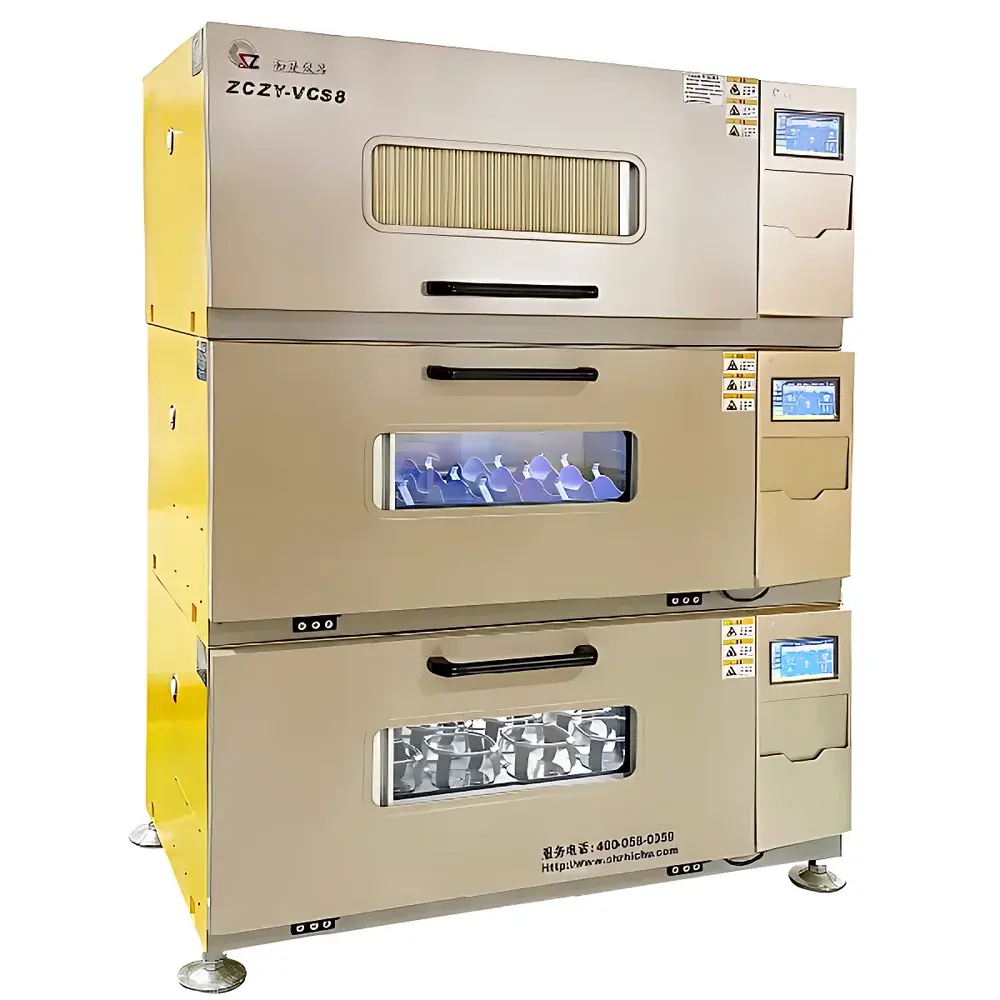
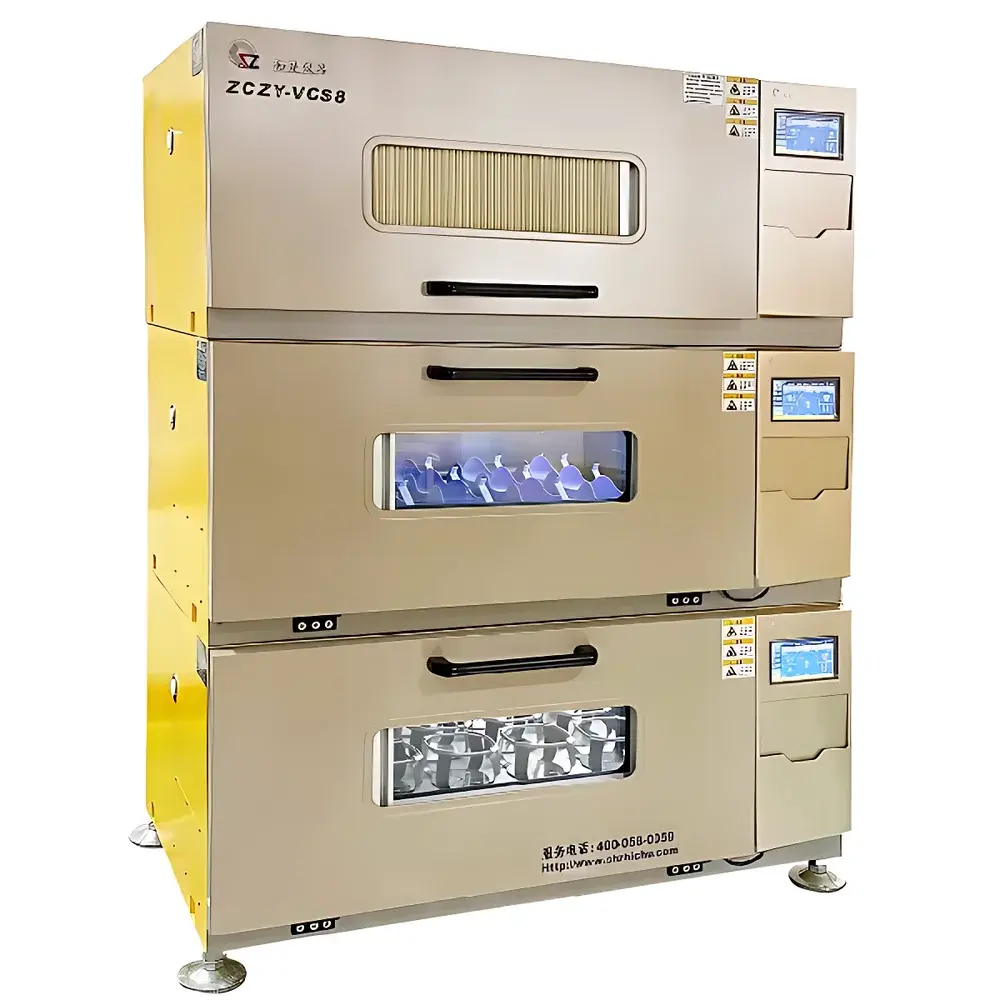
ZhiChu ZCZY-VCS8 Triple-Layer CO₂-Regulated Orbital Shaking Incubator
| Brand | ZhiChu |
|---|---|
| Origin | Guangdong, China |
| Model | ZCZY-VCS8 |
| Instrument Type | CO₂-Regulated Temperature-Controlled Orbital Shaker |
| Timer Range | 0–999.9 h |
| Oscillation Frequency | 10–250 rpm (Ø50 mm), 10–300 rpm (Ø26 mm) |
| Oscillation Amplitude | Ø50 mm (standard), Ø26 mm (optional) |
| Temperature Range | 4–60 °C (ambient 23–25 °C) |
| Number of Shaking Decks | 3 |
| Temperature Uniformity | ±0.3 °C at 37 °C |
| Temperature Accuracy | ±0.1 °C |
| CO₂ Control Range | 0–20 % |
| CO₂ Control Accuracy | ±0.1 % |
| CO₂ Decay Time | 30 min (from 5.0 % to 4.5 %) |
| Deck Dimensions (L×W) | 900 × 530 mm |
| Noise Level | <55 dB(A) |
| Power Supply | AC 220 V ±10 %, 50–60 Hz |
Overview
The ZhiChu ZCZY-VCS8 is a triple-layer, CO₂-regulated orbital shaking incubator engineered for high-throughput cell culture, microbial fermentation, and suspension-based bioprocess development under tightly controlled environmental conditions. It integrates precise temperature regulation (4–60 °C), dynamic CO₂ concentration control (0–20 %), and programmable orbital agitation—enabling simultaneous cultivation across three independently controlled decks. Its core operational principle relies on PID-driven microcomputer control of heating/cooling circuits, infrared CO₂ sensing with real-time feedback compensation, and servo-motor-driven eccentric triple-cam motion transmission, ensuring stable, low-vibration oscillation even at high frequencies (up to 300 rpm). Designed for GMP-aligned laboratories and academic core facilities, the system supports reproducible aerobic and anaerobic culture workflows where gas composition, thermal homogeneity, and mechanical stimulation are critical parameters.
Key Features
- Triple-deck modular architecture: Each deck operates independently—allowing concurrent experiments at distinct temperatures (e.g., 37 °C mammalian culture + 30 °C yeast expression + 25 °C insect cell expansion), speeds (10–300 rpm), and CO₂ levels (0–20 %).
- High-fidelity CO₂ regulation: Uses imported NDIR infrared sensor with ±0.1 % accuracy and automatic zero-point drift correction; sealed chamber design achieves CO₂ decay half-life >30 minutes (5.0 % → 4.5 %), minimizing gas replenishment frequency.
- Thermal precision engineering: Refrigeration system employs eco-friendly R134a-free compressor with adjustable cooling capacity; combined with double-wall insulation, heated glass door, and front-panel integrated mold design, delivers ±0.3 °C uniformity at 37 °C (per ISO 13732-1 validated methodology).
- Human-centered mechanical interface: Patented one-handed clamp plate locking mechanism; seamless stainless-steel interior with R-corner geometry (304 grade, antibacterial finish, >99 % microbial inhibition); UV sterilization cycle (timer-adjustable) and auto-defrost function (1–250 s duration, 30–600 min interval) ensure long-term hygienic operation.
- Robust data integrity framework: Touchscreen LCD displays real-time and setpoint values for temperature, CO₂, speed, time, and direction—all on a single screen. Supports encrypted parameter locking, user-defined password protection, and audit-trail-capable data logging (5-year internal storage, USB export compatible with CSV/PDF).
Sample Compatibility & Compliance
The ZCZY-VCS8 accommodates standard Erlenmeyer flasks (250–2000 mL), culture bottles, and deep-well plates via interchangeable polypropylene universal clamps or custom stainless-steel fixtures. Its chamber geometry permits up to 24 × 1000 mL flasks per deck (stainless clamp) or 23 × 1000 mL (polymer clamp), with optimized clearance (335 mm from clamp plate to ceiling) for tall vessel handling. The unit complies with IEC 61000-6-3 (EMC emissions), IEC 61000-6-2 (immunity), and meets mechanical safety requirements per ISO 13857. While not certified for medical device manufacturing, its architecture aligns with GLP documentation standards and supports 21 CFR Part 11-compliant workflows when paired with validated third-party LIMS integration.
Software & Data Management
The embedded firmware provides native support for time-series recording of temperature, CO₂, speed, and elapsed runtime. All logged variables are timestamped with millisecond resolution and stored in non-volatile memory. USB export enables traceable data transfer to external analysis platforms (e.g., MATLAB, GraphPad Prism, or LabArchives). Optional remote monitoring via secure mobile application (iOS/Android) allows real-time status checks, alarm notifications, and emergency parameter override—subject to network authentication and TLS 1.2 encryption. For regulated environments, optional role-based access control (RBAC) with three-tier permission hierarchy (Admin/Operator/Viewer) facilitates SOP enforcement and change management.
Applications
- Mammalian cell line expansion under 5 % CO₂ and 37 °C with continuous orbital agitation (e.g., CHO, HEK293 suspension cultures)
- Microbial kinetic studies requiring dual-variable control (e.g., E. coli expression at 30 °C + 0 % CO₂ vs. S. cerevisiae fermentation at 30 °C + 5 % CO₂)
- Stem cell differentiation protocols demanding precise oxygen-CO₂ interplay and gentle shear stress
- Antibiotic susceptibility testing using broth microdilution under agitated, gas-controlled conditions
- Algal photobioreactor pre-cultivation with optional light-shielding curtain (fabric-integrated, UV-stabilized polyester)
FAQ
What is the maximum flask volume supported per deck?
Each deck accommodates up to 24 × 1000 mL Erlenmeyer flasks using stainless-steel universal clamps—or 15 × 2000 mL flasks—within the 900 × 530 mm deck area.
Does the system support validation documentation (IQ/OQ/PQ)?
Yes—ZhiChu provides factory-verified calibration certificates for temperature (NIST-traceable probe), CO₂ sensor (certified gas standard), and speed (tachometer reference). Full validation protocol templates are available upon request.
Can the shaker operate without CO₂ supply?
Yes—the CO₂ control loop is fully decoupled from temperature and agitation systems; users may disable CO₂ regulation while maintaining precise thermal and mechanical control.
Is the touchscreen interface compliant with FDA 21 CFR Part 11?
The base firmware supports electronic signatures, audit trails, and user-level permissions. Full Part 11 compliance requires deployment with validated third-party electronic lab notebook (ELN) software and documented procedural controls.
What maintenance intervals are recommended?
CO₂ sensor recalibration every 12 months; door gasket inspection quarterly; condensate tray cleaning after each defrost cycle; compressor oil level verification annually by authorized service technician.





