
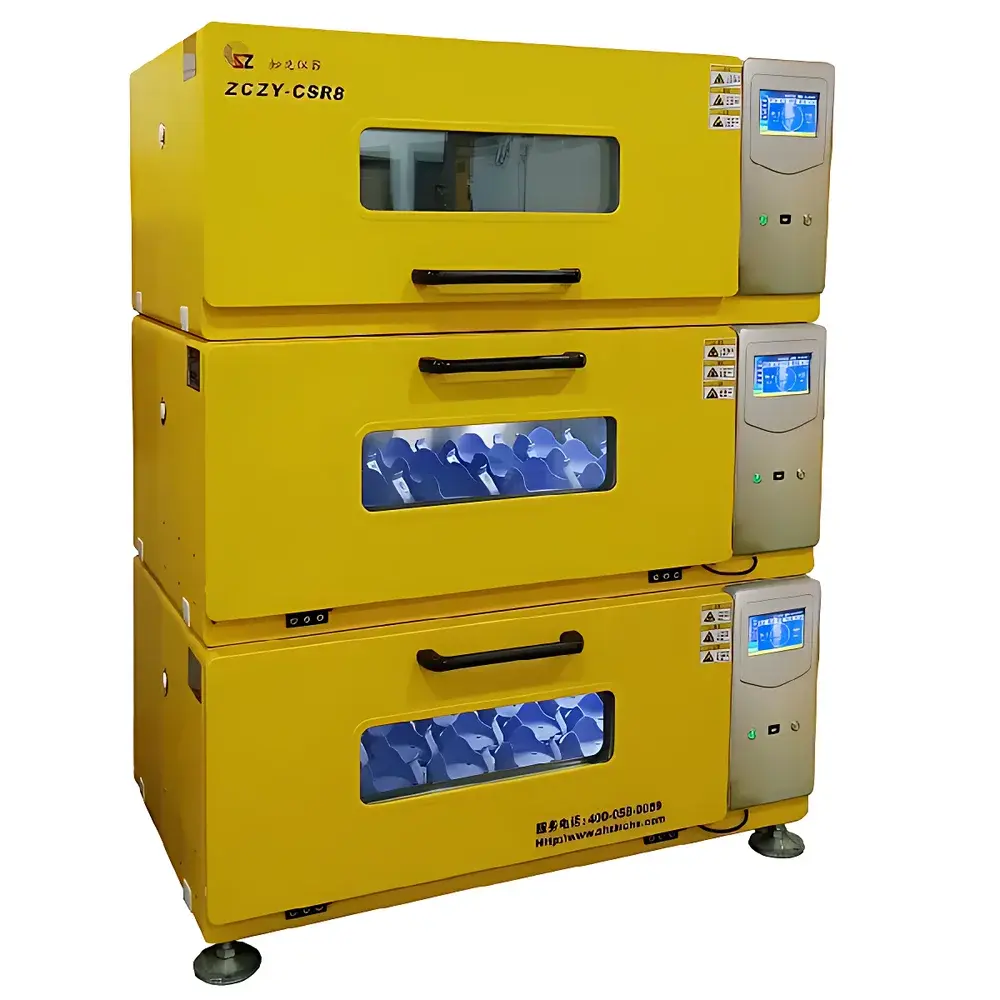
Zhilchu ZCZY-CSR8 Modular CO₂ Orbital Shaker Incubator with Rounded Corners
| Brand | Zhilchu |
|---|---|
| Origin | Guangdong, China |
| Manufacturer Type | Authorized Distributor |
| Product Category | Domestic |
| Model | ZCZY-CSR8 |
| Instrument Type | CO₂-Controlled Temperature-Shaking Incubator |
| Timer Range | 0–999.9 h |
| Oscillation Frequency | 10–250 rpm (Φ50 mm platform) |
| Oscillation Amplitude | Φ50 mm (standard), Φ26 mm (optional) |
| Temperature Range | 4–60 °C (ambient: 23–25 °C) |
| Number of Shaking Decks | 3 |
| Temperature Uniformity | ±0.5 °C at 37 °C |
| Temperature Accuracy | ±0.1 °C |
| CO₂ Control Range | 0–20% |
| CO₂ Control Accuracy | ±0.1% |
| Noise Level | <55 dB(A) |
| Max Load Capacity (stainless steel clamp) | 250 mL × 66 / 500 mL × 45 / 1000 mL × 28 / 2000 mL × 15 per deck |
| Deck Dimensions (L×W) | 928 mm × 530 mm |
| External Dimensions (L×W×H) | 1360 mm × 845 mm × 1740 mm (3-deck configuration) |
| Net Weight | ~596 kg |
Overview
The Zhilchu ZCZY-CSR8 Modular CO₂ Orbital Shaker Incubator is an integrated life science platform engineered for simultaneous control of temperature, CO₂ concentration, humidity, and orbital shaking—optimized for mammalian cell culture, suspension bioreactor development, microbial fermentation, and recombinant protein expression under physiologically relevant conditions. Its tri-deck modular architecture employs a precision-engineered three-dimensional eccentric cam drive system to deliver smooth, low-vibration oscillation across all decks, minimizing shear stress on sensitive biological samples while ensuring mechanical stability over extended operation cycles (≥10,000 hours MTBF). The unit operates on a P.I.D. microprocessor-based control architecture with independent regulation per deck—enabling heterogeneous experimental conditions within a single footprint. Core environmental parameters—including chamber temperature (4–60 °C), CO₂ (0–20%, ±0.1% accuracy), and relative humidity (up to 90% RH at 37 °C via dual-stage humidification)—are continuously monitored and actively stabilized using feedback-coupled actuators, including a variable-capacity eco-friendly refrigerant circuit and IR-based CO₂ sensing calibrated traceably to NIST-standard gas mixtures.
Key Features
- Modular 1–3 deck configuration with identical control logic per level—each deck supports independent setpoint programming for temperature, CO₂, RPM, direction (forward/reverse), and timer
- Rounded-corner (R-angle) 304 stainless steel interior chamber—electropolished finish with >99% antibacterial efficacy per ISO 22196; fully drainable floor with zero dead zones for autoclavable or chemical decontamination
- Triple-glazed, heated, tempered observation window with anti-fog coating—enables real-time visual monitoring without thermal or humidity perturbation
- Imported NDIR infrared CO₂ sensor with automatic baseline compensation and drift correction—ensures long-term stability and compliance with ASTM E2912-22 for incubator CO₂ verification
- Programmable defrost cycle (1–250 s duration; 30–600 min interval)—prevents evaporator icing during prolonged low-temperature operation (e.g., 4 °C + 5% CO₂)
- Touchscreen LCD interface with encrypted parameter lockout, multi-user password management, and unified real-time display of setpoints and actuals (temp, CO₂, RPM, time remaining)
- Integrated data logging: stores ≥5 years of timestamped records (temperature, CO₂, RPM, humidity) with USB export capability—supports audit-ready traceability per FDA 21 CFR Part 11 requirements when paired with validated software
- Low-noise servo motor drive (≤55 dB[A]) with ±1 rpm speed resolution and programmable acceleration/deceleration profiles
Sample Compatibility & Compliance
The ZCZY-CSR8 accommodates standard microbiological and cell culture vessels—including Erlenmeyer flasks (250–2000 mL), baffled bottles, and roller bottles—via interchangeable Φ50 mm (standard) or Φ26 mm (optional) orbital platforms. All clamping systems utilize one-piece molded polymer fixtures with tactile release mechanisms, enabling single-hand loading/unloading without tools. The chamber’s hermetic seal design achieves CO₂ retention performance exceeding ISO 13408-2:2018 benchmarks (5% → 4.5% decay time ≥30 min). Structural integrity meets IEC 61010-1:2010 for laboratory equipment safety; electromagnetic compatibility complies with EN 61326-1:2013. Optional UV-C sterilization cycle (timed, 254 nm) provides supplementary surface decontamination between runs in GLP/GMP-aligned workflows.
Software & Data Management
Onboard firmware supports continuous acquisition of environmental and motion parameters at 1 Hz resolution. Logged datasets are stored internally in non-volatile memory with cyclic overwrite protection and time-stamped metadata (operator ID, protocol name, deck assignment). USB export generates CSV files compatible with LIMS integration and statistical analysis platforms (e.g., JMP, GraphPad Prism). When configured with optional Wi-Fi module, remote monitoring and alarm notification (email/SMS) are enabled via secure TLS 1.2–encrypted API endpoints—facilitating 24/7 oversight in core facility or multi-site research environments. Audit trail functionality includes user login history, parameter change logs, and calibration event timestamps—fully compliant with ALCOA+ principles for data integrity.
Applications
- Mammalian cell line expansion under controlled hypoxia (5% CO₂, 37 °C, 90% RH) with scalable agitation for bioreactor seed train development
- Microbial growth kinetics studies requiring precise CO₂ modulation (e.g., Escherichia coli anaerobic metabolism, Lactobacillus acidification assays)
- Stem cell differentiation protocols where mechanical stimulation (orbital shear) synergizes with gaseous microenvironment control
- Antibiotic susceptibility testing (AST) in liquid media under standardized atmospheric conditions per CLSI M07-A11
- Enzyme production optimization in Aspergillus or Trichoderma cultures where dissolved CO₂ affects pH-dependent activity profiles
FAQ
What is the maximum flask capacity per deck?
Each deck supports up to 250 mL × 66, 500 mL × 45, 1000 mL × 28, or 2000 mL × 15 vessels using stainless steel universal clamps—or slightly reduced counts with polymer fixtures.
Does the unit support GLP-compliant data archiving?
Yes—when used with validated USB data export and external timestamped storage, the system meets ALCOA+ criteria for attributable, legible, contemporaneous, original, and accurate records.
Can individual decks operate at different temperatures and CO₂ levels simultaneously?
Yes—each of the three decks features fully independent PID controllers for temperature and CO₂, with no cross-deck interference.
Is the CO₂ sensor factory-calibrated and field-serviceable?
The NDIR sensor is pre-calibrated against certified reference gases and includes user-accessible zero/span adjustment routines; recalibration kits and service documentation are available through Zhilchu technical support.
What maintenance intervals are recommended for long-term reliability?
Compressor oil and refrigerant pressure checks every 24 months; CO₂ sensor verification annually; door gasket inspection quarterly; UV lamp replacement every 8,000 hours or per manufacturer’s photometric output decay curve.



