
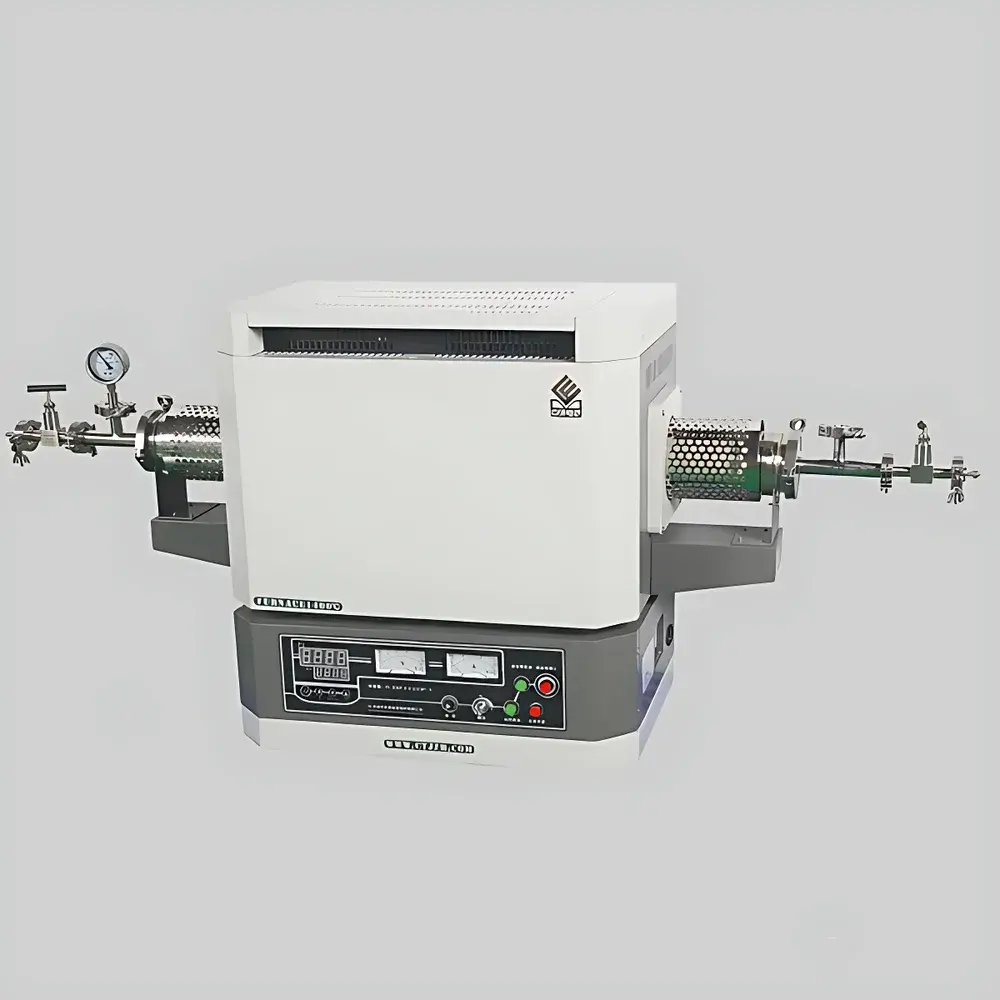
ZHONGHUAN FURNACE 1400°C Dual-Zone Vacuum & Atmosphere Tube Furnace
| Brand | ZHONGHUAN FURNACE |
|---|---|
| Origin | Tianjin, China |
| Model | 1400°C Dual-Zone Vacuum & Atmosphere Tube Furnace |
| Maximum Temperature | 1400°C |
| Temperature Control Accuracy | ±1°C |
| Rated Power | 7.5 kW |
| Heating Rate (to max temp) | ≤5°C/min (≤500°C), ≤10°C/min (500–800°C), ≤5°C/min (800–1000°C), ≤3°C/min (1000–1200°C), ≤2°C/min (1200–1400°C) |
| Heating Element | Silicon Carbide Rods |
| Internal Chamber Dimensions | 530 × 836 × 785 mm (W × H × D) |
| Heating Configuration | Dual Independent Temperature Zones |
| Atmosphere Compatibility | Vacuum, Inert, Reducing, Oxidizing (with optional gas control system) |
| Vacuum Level | Down to 10⁻³ Pa (with optional vacuum pump package) |
| Safety Features | Over-Temperature Cut-Off, Earth-Leakage Protection, Auto-Cooling Fan Activation at Surface Temp ≥50°C |
| Control Interface | RS-485 for PC connectivity |
Overview
The ZHONGHUAN FURNACE 1400°C Dual-Zone Vacuum & Atmosphere Tube Furnace is an engineered solution for high-precision thermal processing under controlled environmental conditions. Designed for research and development laboratories in materials science, semiconductor processing, nanotechnology, and advanced ceramics, this furnace integrates dual independent heating zones—each with full PID-based temperature regulation—to enable precise axial thermal gradients across the reaction tube. Its core architecture employs silicon carbide (SiC) heating elements rated for continuous operation up to 1500°C surface temperature, housed within a vacuum-formed polycrystalline mullite fiber insulation chamber that delivers exceptional thermal uniformity (<±3°C over 300 mm hot zone) and 50% energy savings versus conventional refractory linings. The furnace supports both high-vacuum (down to 10⁻³ Pa with optional turbomolecular pumping) and dynamically regulated gas atmospheres—including N₂, Ar, H₂, NH₃, and forming gas—making it suitable for sintering, annealing, carburizing, oxidation, reduction, and CVD precursor decomposition studies.
Key Features
- Dual-zone independent temperature control with programmable ramp/soak profiles—enabling thermal gradient experiments and zone-specific process staging.
- Quick-connect flange system with single-clamp sealing eliminates traditional bolted法兰 assembly, reducing installation time by >70% and mitigating mechanical stress on quartz or alumina tubes.
- Double-ring dynamic sealing technology at both ends ensures leak rates <1×10⁻⁷ mbar·L/s under vacuum and maintains integrity during repeated thermal cycling from ambient to 1400°C.
- Intelligent thermal management: integrated surface temperature sensor triggers automatic cooling fans when external casing exceeds 50°C—ensuring operator safety and structural longevity.
- Comprehensive safety architecture including Class II earth-leakage circuit interruption, over-temperature cut-off with audible/visual alarm, and hardware-limited power modulation.
- RS-485 communication interface compliant with Modbus RTU protocol—supports integration into centralized lab automation systems for remote monitoring, data logging, and audit-trail generation per GLP/GMP requirements.
Sample Compatibility & Compliance
This furnace accommodates standard OD 60–120 mm tubular samples up to 800 mm in length. Compatible tube materials include high-purity fused quartz (up to 1100°C), recrystallized alumina (up to 1600°C), and silicon carbide (for aggressive reducing environments). The system meets IEC 61000-6-3 (EMC emissions) and IEC 61000-6-2 (immunity) standards. When configured with optional mass flow controllers and vacuum gauges, it supports method validation under ASTM E29-23 (significant figures), ISO/IEC 17025:2017 (calibration traceability), and USP (thermal processing qualification). Vacuum and gas lines conform to ISO 8573-1 Class 4 purity specifications when used with appropriate filtration.
Software & Data Management
The embedded controller supports up to 50 programmable segments (domestic firmware) or 40 segments (imported firmware variant), with user-defined ramp rates, dwell times, and conditional jumps. All thermal cycles are timestamped and stored locally with non-volatile memory retention (>10,000 cycles). Optional PC software provides real-time multi-furnace supervision—capable of managing up to 200 units on a single network—with features including live parameter overlays, deviation alarms, CSV/Excel export, and PDF report generation. Audit trails comply with FDA 21 CFR Part 11 requirements when paired with user authentication and electronic signature modules.
Applications
- Synthesis and annealing of graphene, carbon nanotubes, and MXenes under inert or reducing atmospheres.
- Controlled oxidation of metal foils for oxide layer growth (e.g., NiO, Co₃O₄) in battery electrode R&D.
- Vacuum degassing and densification of ceramic green bodies prior to HIP processing.
- Thermal stability testing of polymer-derived ceramics and preceramic polymers.
- Atmospheric-controlled dopant diffusion in SiC and GaN substrates for power electronics fabrication.
- High-temperature calibration of thermocouples and radiation pyrometers against NIST-traceable reference standards.
FAQ
What vacuum level can this furnace achieve?
With the optional two-stage rotary vane pump, base pressure reaches ≤5×10⁻² Pa; adding a turbo-molecular pump enables ultimate vacuum down to 1×10⁻³ Pa.
Can both zones operate at different temperatures simultaneously?
Yes—each zone has independent thermocouple feedback, SSR-driven power modulation, and separate PID tuning parameters.
Is the furnace compatible with hydrogen atmospheres?
Yes—when equipped with H₂-rated seals, explosion-proof wiring, and optional flame arrestors, it complies with EN 13463-1 for Group IIA hazardous area use.
What tube materials are recommended for 1400°C operation?
Recrystallized alumina (99.8% Al₂O₃) or high-purity silicon carbide tubes are required; fused quartz is limited to ≤1100°C.
Does the system support automated gas switching during a single program?
Yes—via optional MFC-equipped gas manifold with solenoid valve sequencing triggered by time or temperature events in the control program.



