
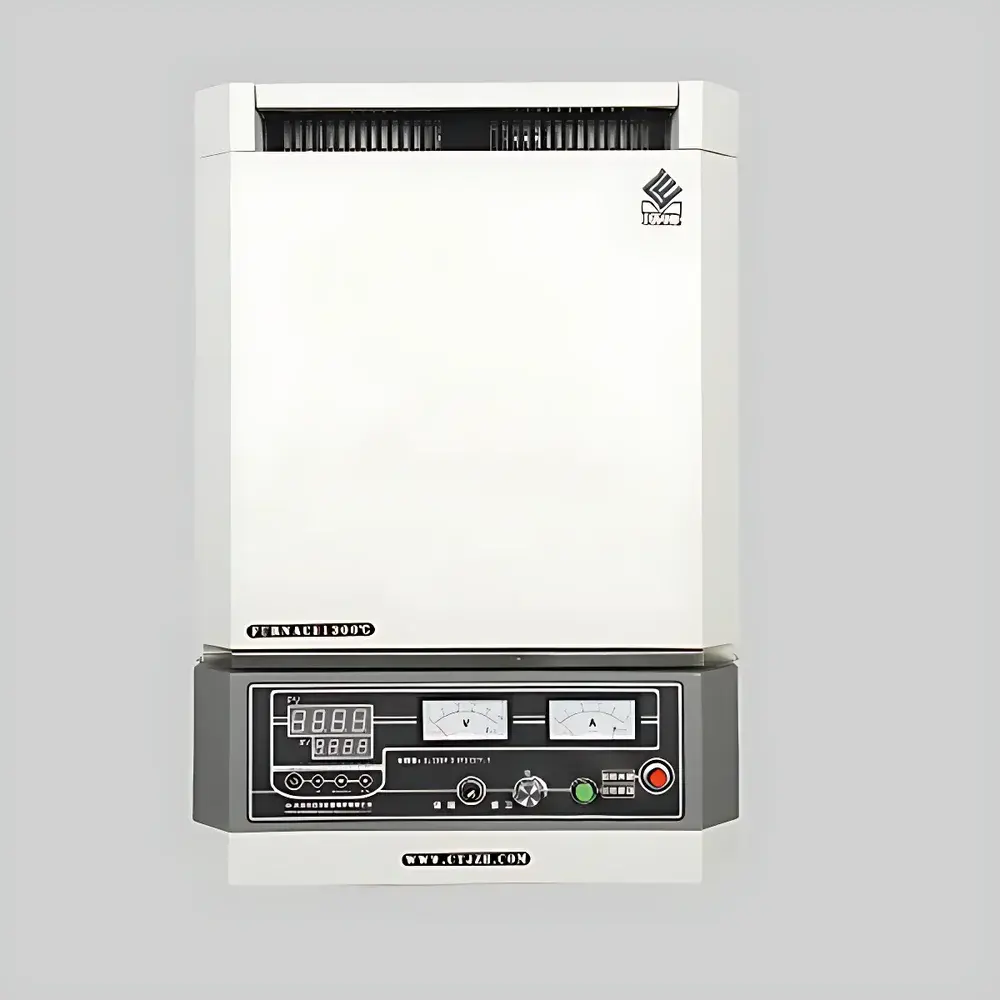
ZHONGHUAN FURNACE ZHX-03173M Desktop High-Temperature Muffle Furnace (1750 °C Max)
| Brand | ZHONGHUAN FURNACE |
|---|---|
| Origin | Tianjin, China |
| Manufacturer Type | Authorized Distributor |
| Product Category | Domestic |
| Model | ZHX-03173M |
| Instrument Type | Box-Type Muffle Furnace |
| Maximum Temperature | 1700 °C |
| Temperature Control Accuracy | ±1 °C |
| Rated Power | 5 kW |
| Heating Element | Silicon-Molybdenum (MoSi₂) Rods |
| Internal Chamber Dimensions | 150 × 140 × 140 mm |
| Chamber Volume | 3 L |
| Rated Voltage | 220 V AC, Single-Phase |
| Typical Ramp Rate | ≤10 °C/min below 1200 °C |
| External Dimensions | 667 × 629 × 1023 mm |
| Net Weight | 140 kg |
Overview
The ZHONGHUAN FURNACE ZHX-03173M is a precision-engineered desktop muffle furnace designed for laboratory-scale high-temperature thermal processing up to 1700 °C. It employs silicon-molybdenum (MoSi₂) heating elements — selected for their excellent oxidation resistance, mechanical stability, and consistent emissivity in air-atmosphere environments — enabling reliable operation at temperatures approaching the upper limits of conventional refractory-based box furnaces. The furnace chamber is fully insulated with multi-layered ceramic fiber modules, engineered to minimize radial heat loss while maintaining structural integrity under repeated thermal cycling. A proprietary air-gap thermal barrier system, integrated into the outer casing, actively manages surface temperature rise; an embedded thermal sensor triggers a forced-air cooling fan when external casing temperature exceeds 50 °C, ensuring safe operator interaction and compliance with IEC 61000-3-2 harmonic current emission guidelines for laboratory equipment.
Key Features
- Intelligent dual-mode temperature control system supporting both PID regulation and fuzzy logic algorithms, with auto-tuning capability for optimal transient response across wide setpoint ranges.
- Three-tier programmable controller options: basic fixed-setpoint (non-programmable), domestic 30-segment ramp-soak profile controller, or imported 40-segment high-resolution program controller with real-time deviation compensation.
- Comprehensive safety architecture including door-interlocked power cutoff, independent over-temperature cut-off (with audible/visual alarm), and residual-current device (RCD)-based earth-leakage protection meeting IEC 61008 standards.
- Current-limiting and soft-start circuitry protects MoSi₂ elements from thermal shock during cold starts or mid-process sample insertion, extending element service life beyond 1,200 operational hours under nominal load conditions.
- RS-485 communication interface compliant with Modbus RTU protocol, enabling integration into centralized lab management systems for remote monitoring, data logging, and audit-trail generation per FDA 21 CFR Part 11 requirements.
- Optional full-color capacitive touchscreen HMI with multiview display modes: digital setpoint/readback, dynamic bar-graph status visualization, real-time temperature curve overlay, historical trend replay (72-hr buffer), and configurable alarm/event log export (CSV/Excel).
Sample Compatibility & Compliance
The ZHX-03173M accommodates crucibles and sample holders fabricated from alumina (Al₂O₃), zirconia (ZrO₂), silicon carbide (SiC), or high-purity graphite — compatible with ASTM C71, ISO 2477, and USP thermal stability testing protocols. Its sealed muffle design ensures minimal atmospheric contamination during annealing, sintering, ashing, or calcination procedures. The furnace meets CE marking requirements for electromagnetic compatibility (EN 61326-1) and low-voltage safety (EN 61010-1). All electrical insulation materials comply with UL 94 V-0 flame-retardancy classification. Calibration traceability is supported via NIST-traceable thermocouple inputs (Type S or B) and optional factory calibration certificate (ISO/IEC 17025 accredited).
Software & Data Management
The optional PC-based control suite supports concurrent management of up to 200 units via daisy-chained RS-485 network topology. Software features include GMP-compliant electronic signatures, time-stamped audit trails with user-level access control (admin/operator/guest), automated report generation (PDF/CSV), and configurable alarm escalation (email/SNMP trap). Data integrity safeguards include write-once archival mode, cyclic redundancy checksum validation for all logged records, and automatic backup to external NAS or cloud storage endpoints. All firmware updates are digitally signed and verified prior to installation to prevent unauthorized modification.
Applications
This furnace is routinely deployed in materials science laboratories for ceramic sintering (e.g., BaTiO₃, YSZ), metallurgical phase transformation studies (Fe–C, Ni–Cr alloys), catalyst thermal activation (Pt/Al₂O₃, V₂O₅/TiO₂), ash content determination per AOAC 923.03, and pre-firing of analytical substrates used in XRD and SEM sample preparation. Its compact footprint and precise thermal uniformity (±5 °C across working zone at 1600 °C, per ASTM E220) make it suitable for QC labs requiring repeatable high-temperature conditioning of reference standards, calibration artifacts, and certified reference materials (CRMs).
FAQ
What type of thermocouple is recommended for use with this furnace?
Type S (Platinum–10% Rhodium / Platinum) thermocouples are recommended for continuous operation up to 1600 °C; Type B (Platinum–30% Rhodium / Platinum–6% Rhodium) is advised for extended dwell periods above 1600 °C.
Can the furnace be operated in inert or reducing atmospheres?
No — the MoSi₂ heating elements and standard ceramic fiber insulation are rated exclusively for oxidizing (air) atmospheres. For inert or reducing gas applications, consult the manufacturer for custom-configured models with alternative heating elements and atmosphere-sealed chambers.
Is the 1700 °C rating sustainable for long-term operation?
The furnace is rated for intermittent operation at 1700 °C (≤2 hr per cycle); continuous operation above 1600 °C is not recommended to preserve element longevity and insulation integrity.
Does the system support GLP-compliant data archiving?
Yes — when equipped with the optional software package and configured with password-protected user roles, electronic signatures, and immutable audit logs, the system satisfies core GLP data integrity requirements as defined in OECD Principles of Good Laboratory Practice.
What maintenance intervals are specified for the MoSi₂ heating elements?
Visual inspection every 200 operating hours; resistance measurement every 500 hours; replacement recommended upon ≥15% increase in cold resistance or visible surface pitting/cracking.
Related Products



