
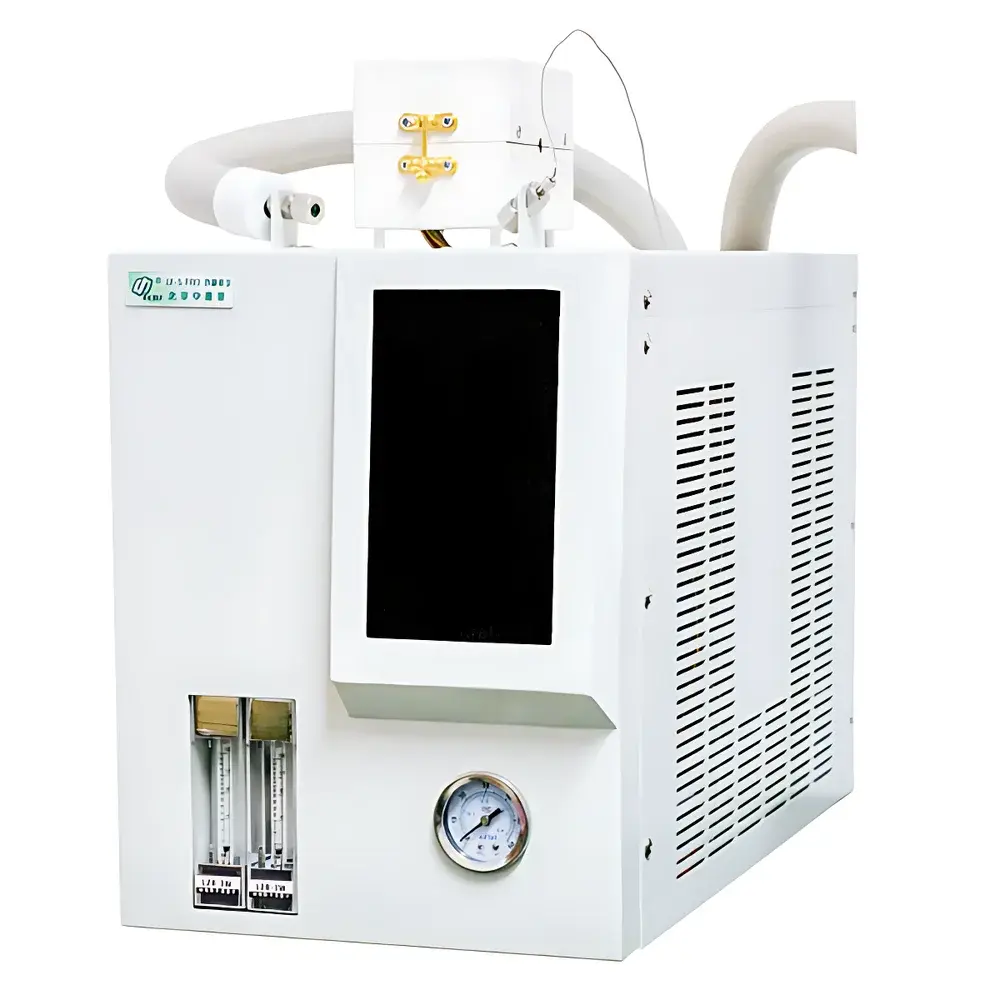
Zhonghuipu JX-5 PRO Dual-Stage (Cryogenic Trap) Thermal Desorber
| Brand | Zhonghuipu |
|---|---|
| Origin | Beijing, China |
| Manufacturer Type | Manufacturer |
| Product Category | Domestic |
| Model | JX-5 PRO |
| Instrument Type | Dual-Stage Thermal Desorber / Thermal Desorption Unit |
| Automation Level | Semi-Automatic |
| Primary Desorption Temp Range | 40–400 °C |
| Secondary Desorption Temp Range | −35 to 450 °C |
| Valve Inlet Temp Range | 40–240 °C, Accuracy: ±1 °C |
| Transfer Line Temp Range | 40–240 °C, Accuracy: ±1 °C |
| Cryogenic Trap Temp Range | −35 to −5 °C |
| Temperature Control Accuracy | ±1 °C |
| Sample Position Count | 1 |
| Secondary Desorption Ramp Rate | >70 °C/s |
| Sample Tube Dimensions | Ø ≤6.5 mm, L ≥120 mm |
| Desorption Time | 0–60 min |
| Injection Time | 0–10 min |
| Simulated Sampling Time | 0–60 min |
| Simulated Sampling Flow Rate | 16–160 mL/min |
| RSD | ≤2.5% (benzene in 0.05 μg methanol) |
| Power Consumption | 500 W |
Overview
The Zhonghuipu JX-5 PRO Dual-Stage (Cryogenic Trap) Thermal Desorber is an engineered solution for trace-level volatile organic compound (VOC) and semi-volatile organic compound (SVOC) analysis in environmental, occupational health, and indoor air quality laboratories. It operates on the principle of two-stage thermal desorption: first, analytes are thermally released from sorbent tubes under controlled inert gas flow (primary desorption); second, the evolved vapors are cryogenically focused into a narrow band within a thermally isolated trap (−35 °C to −5 °C), followed by rapid flash-heating (>70 °C/s) to transfer a sharp, solvent-free analyte plug directly into the GC or GC-MS inlet. This architecture minimizes band broadening, maximizes sensitivity (sub-pg detection limits achievable with optimized GC-MS systems), and ensures high reproducibility across repeated analyses.
Key Features
- Semi-automatic operation with integrated 7-inch capacitive touchscreen interface—supports method setup, real-time monitoring, and execution of three core workflows: simulated sampling, thermal desorption, and sorbent tube conditioning/activation.
- High-efficiency Peltier-based cryogenic trapping system capable of reaching −35 °C (ambient-dependent), eliminating the need for liquid nitrogen or external chillers and reducing operational cost and logistical complexity.
- Motor-driven, high-precision 6-port switching valve housed in a fully heated oven (up to 240 °C), constructed from passivated 316 stainless steel with PTFE seals—ensuring zero dead volume, minimal carryover, and compatibility with aggressive VOCs and polar compounds.
- Fully heated sample pathway: primary desorption furnace (40–400 °C), transfer line (40–240 °C), and valve manifold—all independently controlled with ±1 °C accuracy to prevent condensation and adsorption losses.
- Optimized pneumatic and geometric design: custom-calibrated tapered ferrules and reduced-diameter connectors minimize interfacial dead volume between sorbent tube and transfer line, enhancing quantitative recovery—particularly critical for low-boiling compounds (e.g., benzene, formaldehyde precursors).
- Comprehensive thermal profiling: secondary desorption ramp rate exceeds 70 °C/s, achieving final temperatures up to 450 °C; resulting peak widths <3 seconds at base, supporting high-resolution chromatographic separation and improved signal-to-noise ratios.
Sample Compatibility & Compliance
The JX-5 PRO accommodates standard 1/4″ OD (≤6.5 mm) sorbent tubes up to 120 mm in length—including multi-bed configurations (e.g., Tenax TA, Carbopack B/C, Carboxen 1000) used in EPA TO-17, ISO 16017-1, and HJ-series methodologies. Its performance meets or exceeds requirements specified in multiple regulatory frameworks: GB 50325-2020 (indoor benzene and TVOC determination), GB/T 18883-2022 (indoor air quality), HJ 583-2010 (ambient air BTEX), HJ 644-2013 (ambient air VOCs via TD-GC-MS), and HJ 734-2014 (stack emission VOCs). While not pre-certified for FDA 21 CFR Part 11, its deterministic thermal control, audit-ready parameter logging, and method recall functionality support GLP/GMP-aligned validation protocols when deployed in regulated QC environments.
Software & Data Management
The embedded touchscreen firmware stores up to 100 user-defined methods with full parameter logging (temperature setpoints, timing sequences, flow profiles, and system status flags). All method executions generate timestamped run logs exportable via USB to CSV format for traceability. No proprietary PC software is required; however, optional ASCII output mode enables integration with third-party LIMS or chromatography data systems (CDS) via RS-232 or Ethernet (with adapter). System diagnostics—including heater health, thermocouple integrity, and valve actuation feedback—are continuously monitored and displayed in real time to support preventive maintenance planning.
Applications
- Indoor air quality assessment per GB 50325-2020 and GB/T 18883-2022—quantification of benzene, toluene, ethylbenzene, xylenes (BTEX), and C6–C16 aliphatic/aromatic VOCs.
- Ambient air monitoring for regulatory compliance (HJ 583-2010, HJ 644-2013), including ozone precursor speciation and odorant profiling.
- Stack and fugitive emission testing (HJ 734-2014) in petrochemical, pharmaceutical, and coating manufacturing facilities.
- Material emission testing (e.g., carpets, adhesives, furniture composites) using micro-chamber or small-scale chamber sampling followed by TD-GC-MS analysis.
- Sorbent tube reconditioning and blank verification—integrated tube activation mode supports automated bake-out at up to 350 °C under continuous purge flow.
FAQ
Is the JX-5 PRO compatible with all major GC and GC-MS systems?
Yes—it features standard 1/4″ VCR and Swagelok-compatible fittings and outputs a carrier-gas-coupled analytical plug suitable for direct connection to Agilent, Thermo Fisher, Shimadzu, and PerkinElmer inlets. Optional interface kits are available for split/splitless, PTV, and cold-on-column injection modes.
What is the minimum detectable mass for benzene using this system?
When coupled with a modern GC-MS operating in SIM mode and using certified reference standards, typical method detection limits (MDLs) fall between 0.005–0.02 µg per tube (equivalent to ~0.1–0.4 µg/m³ in 10-L air samples), depending on sorbent choice, desorption efficiency, and instrument sensitivity.
Does the system support unattended overnight operation?
No—the JX-5 PRO is single-position and semi-automatic; it does not include autosampler capability or multi-tube carousel. Each run requires manual tube loading and method initiation. For high-throughput labs, sequential batch processing is possible but requires operator intervention between runs.
Can the cryogenic trap temperature be stabilized at −40 °C?
The specified range is −35 °C to −5 °C. Achieving −40 °C is not guaranteed and depends on ambient laboratory temperature and ventilation conditions; sustained operation below −35 °C may compromise thermal stability and long-term Peltier module life.
Are calibration certificates and IQ/OQ documentation available?
Factory calibration reports (temperature uniformity, timing accuracy, flow verification) are provided with shipment. Custom IQ/OQ protocol development and on-site qualification support can be arranged through Zhonghuipu’s international service partners upon request.





