
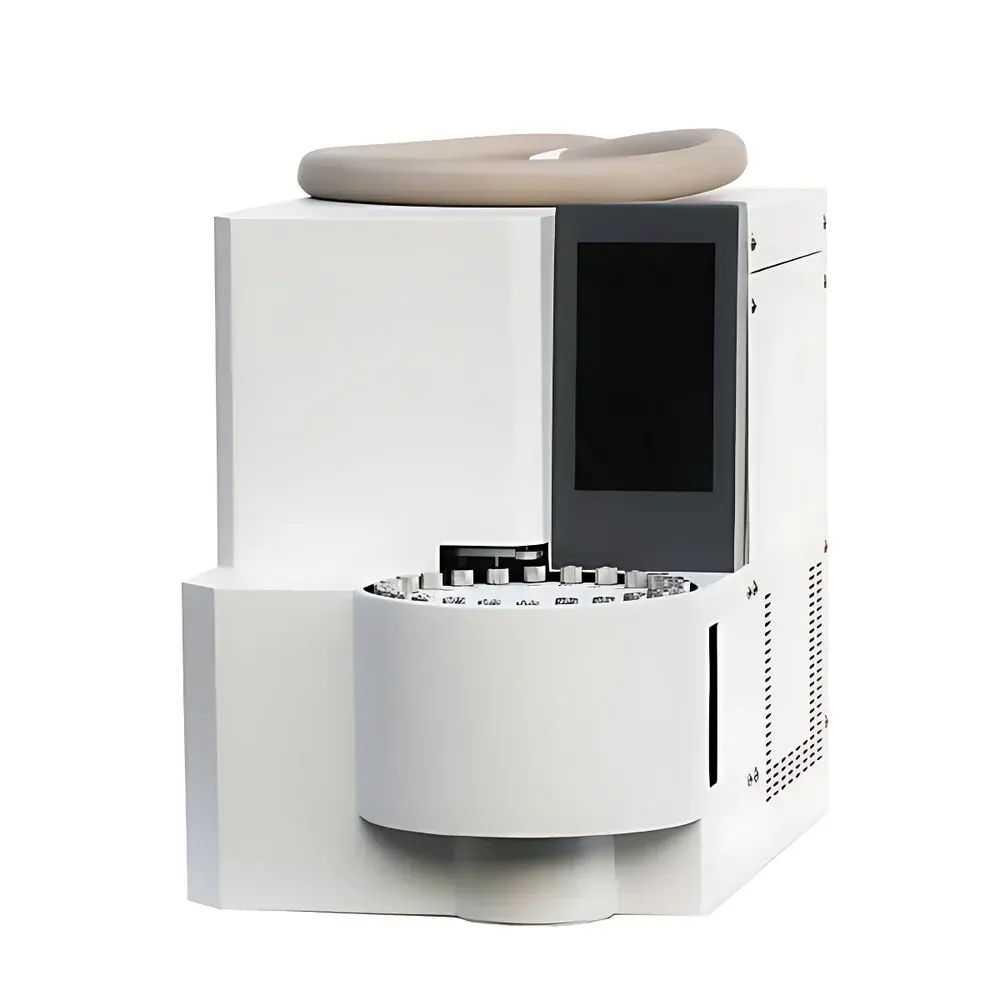
Zhonghuipu JX-7 PRO Fully Automated Two-Stage Thermal Desorber
| Brand | Zhonghuipu |
|---|---|
| Origin | Beijing, China |
| Manufacturer Type | Direct Manufacturer |
| Instrument Type | Two-Stage (Cryo-Focused) Thermal Desorber |
| Automation Level | Fully Automated |
| Primary Desorption Temperature Range | 40–400 °C |
| Secondary Desorption (Cryo-Trap) Temperature Range | −35 °C to 450 °C |
| Valve & Transfer Line Temperature Range | 40–240 °C, Accuracy: ±1 °C |
| Cryo-Trap Temperature Range | −35 °C to Ambient |
| Temperature Control Accuracy | ±1 °C |
| Sample Positions | 24 |
| Cryo-Cooling Method | Semiconductor-Based |
| Maximum Heating Rate (Secondary Desorption) | >70 °C/s |
| Sample Tube Dimensions | 1/4″ OD × 3.5″ L |
| Enrichment Time | 0–60 min |
| Injection Time | 0–10 min |
| Simulated Sampling Duration | 0–60 min |
| Simulated Sampling Flow Rate | 0–200 mL/min |
| RSD | ≤2.5% (for benzene at 0.05 μg in methanol) |
| Peak Power Consumption | 500 W |
| Gas Path Materials | Passivated 316 stainless steel (RESTEK Siltek®/Sulfinert® treated), PTFE seals, heated throughout |
| Needle Design | Stainless steel tapered needle with side port |
| GC Synchronization | Yes — supports ready-signal handshake and concurrent instrument start |
Overview
The Zhonghuipu JX-7 PRO is a fully automated two-stage thermal desorption system engineered for high-fidelity volatile organic compound (VOC) analysis in environmental and indoor air monitoring applications. It implements cryogenic focusing—where analytes are first thermally desorbed from sorbent tubes (primary desorption), then refocused onto a cooled trap (−35 °C minimum), and finally rapidly injected into a gas chromatograph (GC) or GC-MS via high-speed secondary desorption (>70 °C/s). This architecture ensures sharp, narrow analyte bands, superior sensitivity, and minimal breakthrough or carryover—critical for compliance with low-level regulatory thresholds defined in standards such as GB/T 18883–2022, GB 50325–2020, HJ 583–2010, HJ 644–2013, and HJ 734–2014.
Key Features
- Fully automated 24-position sample carousel with intuitive 7-inch capacitive touchscreen interface—enabling method setup, real-time status monitoring, and diagnostics without external PC dependency.
- Semiconductor-based cryo-cooling eliminates the need for liquid nitrogen or mechanical compressors, reducing operational cost, footprint, and maintenance complexity while maintaining stable trap temperatures down to −35 °C (ambient-dependent).
- Motor-driven mechanical actuation replaces pneumatic or solenoid-based motion systems—ensuring precise, repeatable positioning of valves, traps, and transfer lines without compressed gas supply.
- Entire gas path—from sample tube to GC inlet—is constructed from RESTEK Siltek®/Sulfinert®-passivated 316 stainless steel tubing, heated continuously to prevent condensation and adsorption losses; all seals use high-purity PTFE rated for sustained operation up to 240 °C.
- Stainless steel tapered injection needle with side-port geometry minimizes septum wear and extends consumable life—validated across >500 injections per septum under routine operation.
- Integrated simulated sampling function allows calibration and system verification using standard gas mixtures, with programmable flow (0–200 mL/min) and duration (0–60 min) to replicate field collection conditions.
- Real-time fault detection logic monitors motor torque, valve position, temperature deviation, and pressure integrity—automatically halting operation and alerting users upon anomaly detection to protect hardware and data integrity.
Sample Compatibility & Compliance
The JX-7 PRO accepts standard 1/4″ OD × 3.5″ sorbent tubes (e.g., Tenax TA, Carbopack B/C, Carboxen 1000) and is compatible with all major GC and GC-MS platforms—including Agilent, Thermo Fisher, Shimadzu, and PerkinElmer—via TTL or Ethernet-based synchronization protocols. Its temperature control accuracy (±1 °C across all zones), reproducibility (RSD ≤2.5% at trace benzene levels), and leak-tight design meet the instrumental performance requirements outlined in ISO 16000-6, ASTM D6196, and US EPA TO-17. The system supports GLP-compliant workflows through audit-trail-capable method logging and user-accessible calibration records—though native 21 CFR Part 11 compliance requires integration with validated third-party LIMS or chromatography data systems.
Software & Data Management
Onboard firmware provides complete method definition for enrichment, cryo-trapping, secondary desorption, and GC trigger timing—all adjustable via the touch interface. Methods include configurable hold times, ramp rates, and flow profiles. Raw instrument logs (temperature setpoints, valve actuation timestamps, error codes) are stored internally and exportable via USB. For laboratory-scale deployment, the JX-7 PRO supports RS-232 or Ethernet communication to external chromatography data systems (CDS), enabling synchronized run initiation, status polling, and event-driven reporting. All parameters adhere to IUPAC-recommended nomenclature and SI units, facilitating cross-platform method transfer and regulatory documentation.
Applications
- Indoor air quality assessment per GB/T 18883–2022 and GB 50325–2020, including formaldehyde, benzene, toluene, ethylbenzene, xylenes (BTEX), and C2–C12 aliphatics.
- Ambient air VOC monitoring per HJ 644–2013 and HJ 734–2014, with validated performance for carbonyls, halogenated hydrocarbons, and oxygenated VOCs.
- Workplace exposure evaluation in industrial hygiene labs requiring OSHA or ACGIH TLV-aligned sampling and quantification.
- Method development and validation studies where cryo-focusing efficiency, thermal stability, and inter-laboratory reproducibility are critical performance criteria.
- Reference material analysis and proficiency testing programs requiring trace-level precision and long-term instrument stability.
FAQ
Does the JX-7 PRO require liquid nitrogen or external cooling gases?
No—it uses solid-state semiconductor cooling for the cryo-trap, eliminating dependency on cryogens or compressed air.
Can it be integrated with legacy GC systems lacking digital I/O?
Yes—TTL-level trigger signals and analog-ready status outputs allow compatibility with older GC models via simple relay interfaces.
What maintenance intervals are recommended for the gas path and seals?
PTFE seals should be inspected every 500 runs; passivated stainless-steel tubing requires no routine replacement but benefits from annual leak-checking using helium mass spectrometry.
Is remote monitoring or networked operation supported?
The unit includes an Ethernet port for IP-based status polling and firmware updates; however, full remote control requires integration with a local SCADA or lab automation platform.
How is calibration verified across temperature zones?
Each heating zone (primary furnace, valve, transfer line, trap) is factory-calibrated against NIST-traceable RTD sensors; users may perform periodic verification using certified reference thermocouples per ISO/IEC 17025 guidelines.




