
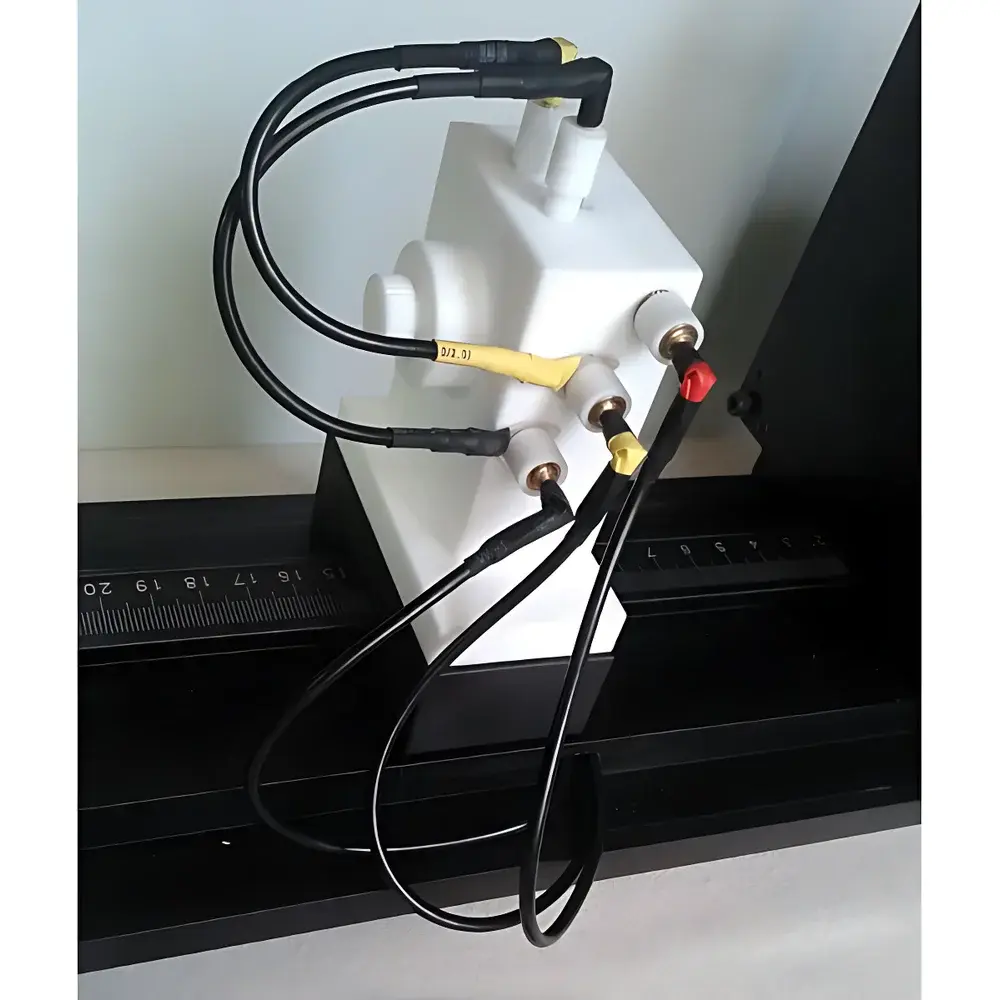
Zhongjiaojinyuan PECK205 Multi-Functional Photoelectrochemical Cell
| Brand | Zhongjiaojinyuan |
|---|---|
| Origin | Beijing, China |
| Manufacturer Type | Direct Manufacturer |
| Region Classification | Domestic (China) |
| Model | PECK205 |
| Pricing | Upon Request |
Overview
The Zhongjiaojinyuan PECK205 Multi-Functional Photoelectrochemical Cell is a rigorously engineered three-electrode electrochemical measurement platform designed for controlled illumination experiments in photoelectrocatalysis, solar fuel synthesis, semiconductor electrochemistry, and interfacial charge-transfer kinetics. It operates on the fundamental principle of photoelectrochemical (PEC) spectroscopy—where incident photons generate electron–hole pairs at a light-absorbing working electrode (e.g., FTO/ITO-coated conductive glass or metal oxides), and the resulting photocurrents are quantified under potentiostatic or galvanostatic control using a compatible electrochemical workstation. The cell’s modular, all-polytetrafluoroethylene (PTFE) construction ensures chemical inertness against aggressive electrolytes (e.g., aqueous KOH, H₂SO₄, LiPF₆-based organic electrolytes, and iodide/triiodide redox mediators), while its integrated quartz optical window enables collimated or diffuse illumination across UV–vis–NIR spectral ranges (200–2500 nm) with minimal optical distortion or absorption loss.
Key Features
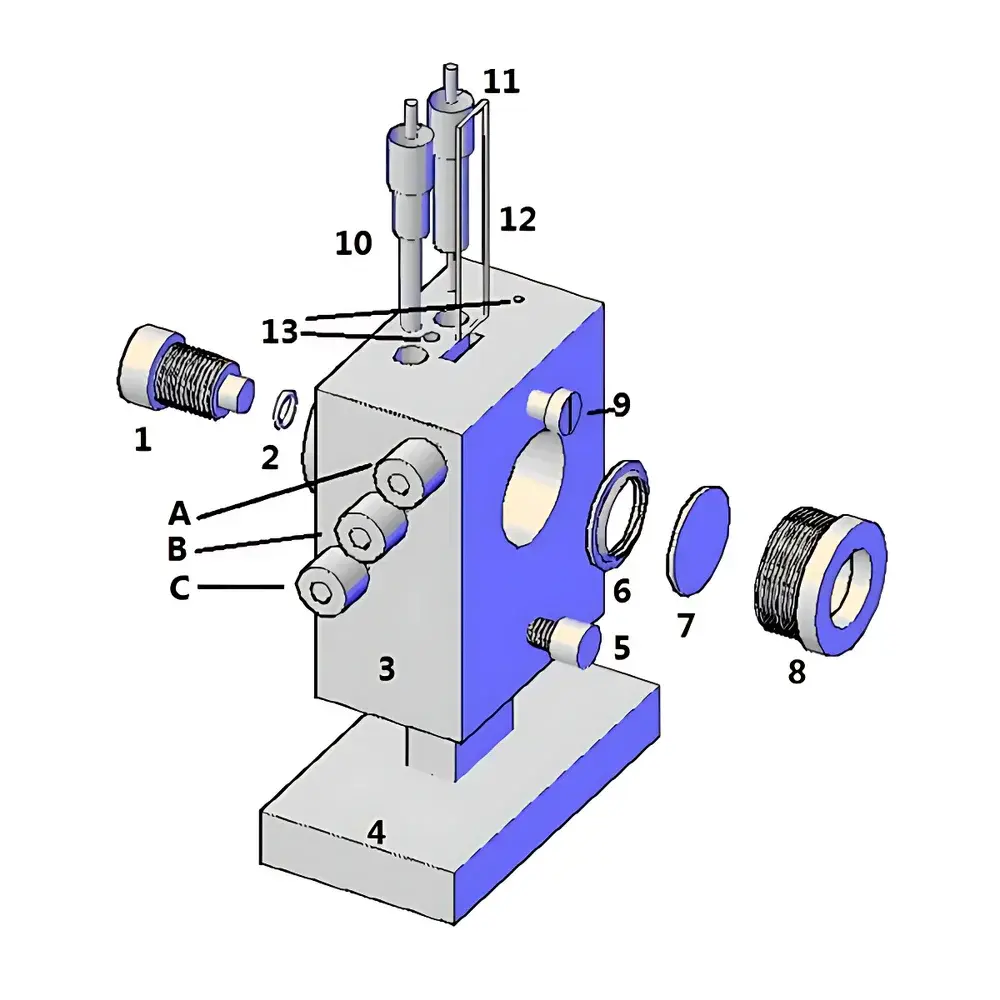
- Modular PTFE cell body (Item 3) and base (Item 4) with precision-machined alignment grooves for repeatable electrode positioning and mechanical stability during long-term chronoamperometric or impedance measurements.
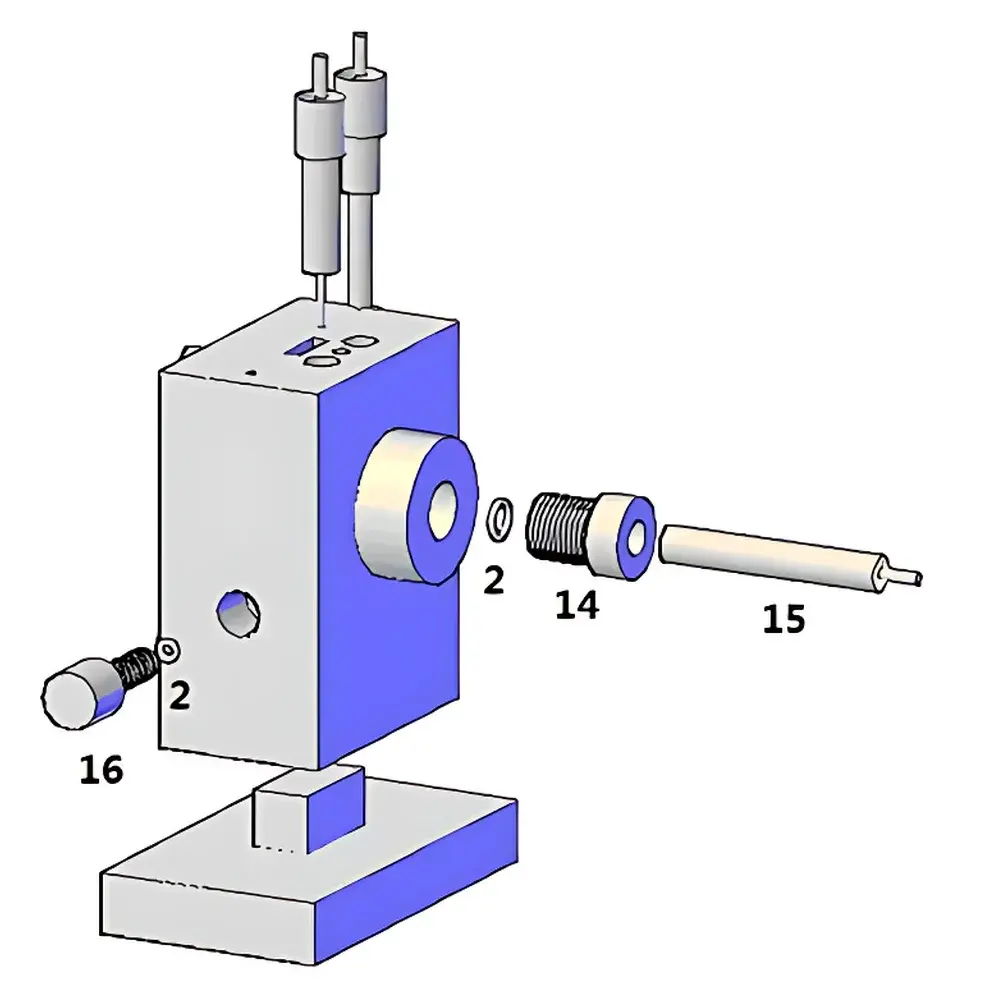
- Dual-seal architecture: Includes two distinct O-ring sizes—one for the working electrode port (larger cross-section, high compression resilience) and one for the drain port (smaller diameter, optimized for low-leakage sealing under vacuum or inert gas purging).
- Optically transparent quartz window (Item 7, 10 mm clear aperture, thickness 2.0 ± 0.1 mm) mounted via a dedicated PTFE gasket (Item 6, convex side outward) and stainless-steel retaining screw (Item 8), ensuring hermeticity and <0.1% transmission loss at 300 nm.
- Adjustable working electrode holder: Accommodates both planar conductive substrates (e.g., 10 × 45 × 1 mm FTO/ITO glass, secured via Item 9) and rod-type electrodes (e.g., Pt wire, GC disc), with independent depth adjustment via threaded PTFE cap (Item 14) and captive O-ring.
- Three-terminal electrical interface (Terminals A, B, C): Terminal A is hardwired to the conductive glass clamping mechanism; Terminals B and C support interchangeable placement of reference (e.g., Ag/AgCl, SCE) and counter electrodes (e.g., Pt mesh, graphite rod), enabling flexible cell configuration per ASTM E1936 and ISO 17282 protocols.
- Integrated liquid handling system: Dual-port design with top-fill inlet (Item 13) and bottom drain (Item 16), facilitating full electrolyte exchange, degassing under N₂/Ar, and removal of gas evolution products (e.g., O₂, H₂) without disassembly.
Sample Compatibility & Compliance
The PECK205 supports heterogeneous photoelectrodes including metal oxide semiconductors (TiO₂, BiVO₄, Fe₂O₃), chalcogenides (CdS, CuInGaSe₂), perovskites (MAPbI₃), and molecular catalyst-modified interfaces. Its geometry conforms to standard three-electrode PEC cell dimensions referenced in IUPAC Technical Report on Photoelectrochemical Measurements (2021). All wetted components comply with USP Class VI biocompatibility requirements for polymeric materials and meet RoHS Directive 2011/65/EU restrictions on hazardous substances. When operated with certified reference electrodes and calibrated workstations, data generated satisfies GLP documentation requirements for traceability, including electrode potential reporting relative to RHE (reversible hydrogen electrode) with temperature compensation.
Software & Data Management
The PECK205 is fully agnostic to third-party electrochemical instrumentation. It integrates seamlessly with commercial potentiostats (e.g., BioLogic SP-300, Gamry Interface 5000E, PalmSens EmStat Go) supporting cyclic voltammetry, linear sweep voltammetry, chronoamperometry, electrochemical impedance spectroscopy (EIS), and chopped-light intensity-modulated photocurrent spectroscopy (IMPS). Raw current–time and current–potential datasets are exported in ASCII or .mpt format, compatible with MATLAB, Python (via Pymatgen or ECpy libraries), and OriginLab for kinetic modeling (e.g., Butler–Volmer analysis, surface state density extraction). Audit trails—including seal integrity checks, illumination calibration logs, and electrode positioning records—can be maintained in accordance with FDA 21 CFR Part 11 when paired with compliant laboratory information management systems (LIMS).
Applications
- Quantitative assessment of photoconversion efficiency (ABPE, IPCE) in water-splitting photoanodes under AM 1.5G illumination.
- In situ monitoring of photocorrosion onset potentials for sulfide-based photocathodes in polysulfide electrolytes.
- Time-resolved photocurrent decay analysis to extract minority carrier diffusion lengths in nanostructured hematite films.
- Electrochemical quartz crystal microbalance (EQCM)-coupled PEC studies of mass change during photoinduced intercalation in WO₃.
- High-throughput screening of co-catalyst deposition effects on NiOₓ-modified BiVO₄ using standardized illumination–bias protocols per IEA Task 16 guidelines.
FAQ
What is the maximum operating temperature and pressure rating of the PECK205 cell?
The PTFE body and seals are rated for continuous operation up to 120 °C and 0.5 bar overpressure. For elevated-temperature studies (>80 °C), use only quartz window assemblies and avoid silicone-based greases.
Can the PECK205 be used under inert atmosphere or vacuum conditions?
Yes—the dual O-ring sealing system and threaded quartz retention allow stable operation under N₂/Ar glovebox environments or static vacuum down to 10⁻² mbar, provided the drain port is sealed with Item 16 before evacuation.
Is the quartz window replaceable, and what is its specified transmission range?
The 10-mm-diameter fused silica window (Item 7) is field-replaceable and certified for ≥85% transmittance from 190 nm to 2.5 µm, with AR coating optional upon request.
How is electrical contact resistance minimized at the conductive glass interface?
Item 9 applies uniform axial load (0.8–1.2 N) via spring-loaded brass contact, achieving contact resistance <0.3 Ω as verified by four-point probe validation per ASTM F1529.
Does the PECK205 support rotating disk electrode (RDE) configurations?
No—it is a stationary-cell design optimized for planar illumination geometry. For RDE-PEC coupling, Zhongjiaojinyuan offers the separate PECK-RDE series with motorized shaft feedthroughs and magnetic shielding.



