
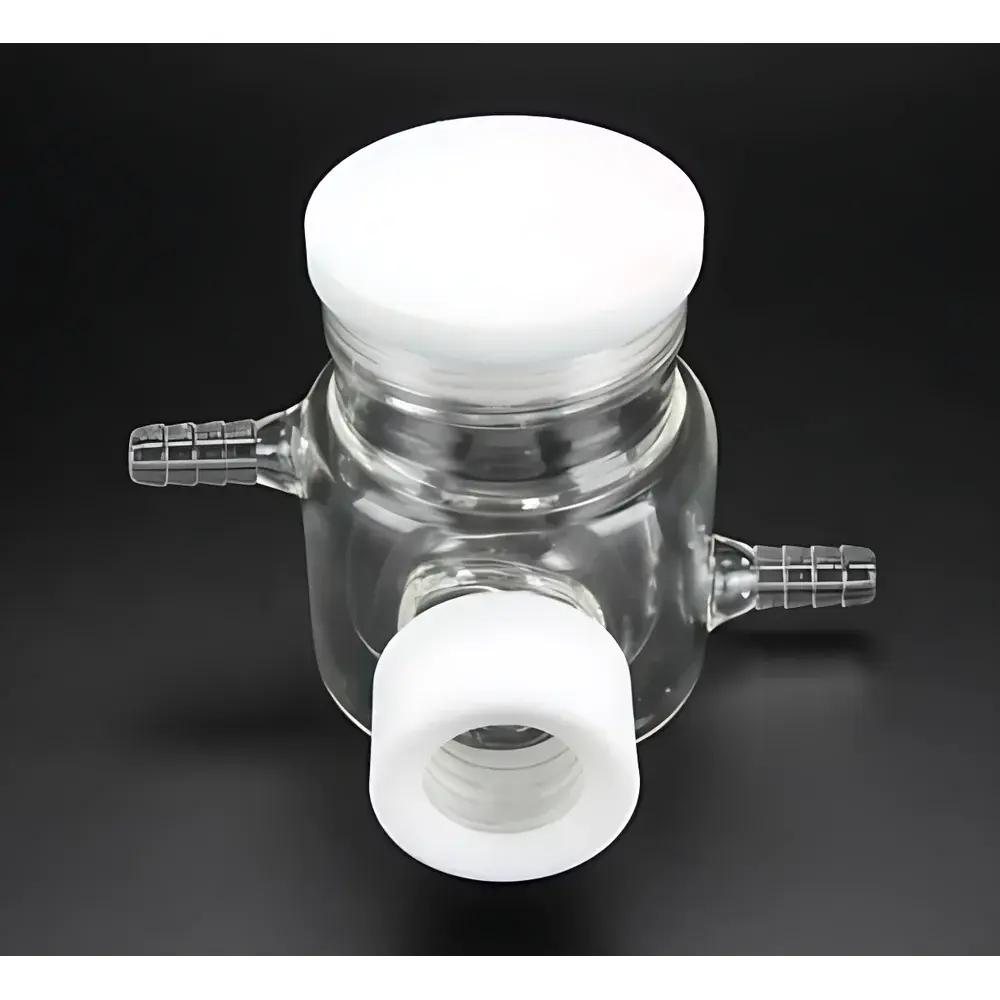
Zhongjiaojinyuan PECK45S Temperature-Controlled Sealed Photoelectrochemical Cell
| Brand | Zhongjiaojinyuan |
|---|---|
| Origin | Beijing, China |
| Manufacturer Type | Direct Manufacturer |
| Product Category | Domestic |
| Model | PECK45S |
| Component Type | Optical Component |
| Cell Volume | 100 mL |
| Optical Window | Fused Silica, Ø24 mm |
| Construction | Borosilicate Glass Body, PTFE Lid, Water-Jacketed Temperature Control |
| Electrode Configuration | Threaded Electrode Holder (Working: Pt Clip |
| Counter | Pt Wire |
| Reference | Ag/AgCl) |
| Customization Options | Electrode Port Size/Quantity, Volume (50/200 mL), Compatible with LX/HX Series Circulating Chillers |
Overview
The Zhongjiaojinyuan PECK45S is a precision-engineered, temperature-controlled sealed photoelectrochemical (PEC) cell designed for quantitative light-driven electrochemical investigations under rigorously controlled thermal conditions. Built upon the fundamental principles of photoelectrochemistry—where incident photons generate electron–hole pairs at semiconductor/electrolyte interfaces—the PECK45S enables reproducible measurement of photocurrent density, incident photon-to-current efficiency (IPCE), and open-circuit photovoltage under isothermal operation. Its double-walled borosilicate glass body incorporates an integrated water-jacketed cavity, allowing precise thermal regulation via external recirculating chillers (e.g., LX or HX series). The fused silica optical window (Ø24 mm, UV-VIS transparent from 190–2500 nm) ensures minimal spectral distortion and high transmission for calibrated illumination across standard solar simulators and monochromated light sources. The sealed architecture prevents electrolyte evaporation and atmospheric contamination (e.g., O₂ ingress), critical for long-duration stability tests and oxygen-sensitive systems such as dye-sensitized solar cells (DSSCs) or metal–organic framework (MOF)-based photoanodes.
Key Features
- Thermally stabilized design: Water-jacketed cell body enables ±0.2 °C temperature control when paired with a certified recirculating chiller—essential for kinetic studies and Arrhenius analysis.
- Optically optimized window: High-purity fused silica disc (Ø24 mm, thickness 3 mm) with AR coating optional; transmittance >92% across 200–800 nm range.
- Chemically inert construction: PTFE lid and borosilicate glass body resist corrosion from acidic, alkaline, and halide-containing electrolytes (e.g., 0.5 M H₂SO₄, 1 M KOH, LiI/I₂-based redox mediators).
- Modular electrode integration: Three standardized threaded ports accommodate interchangeable working, counter, and reference electrodes; port diameter and count customizable per experimental configuration.
- Quick-access assembly: Tool-free optical window mounting with O-ring compression seal facilitates rapid cell cleaning, electrode exchange, and optical alignment without disassembly of electrical connections.
- Scalable volume options: Standard 100 mL internal volume; available as custom variants at 50 mL (high surface-area-to-volume ratio for fast transient measurements) or 200 mL (enhanced thermal mass for extended potentiostatic holds).
Sample Compatibility & Compliance
The PECK45S supports a broad range of photoactive materials and electrolyte systems, including colloidal quantum dots (CdSe, PbS), perovskite thin films (MAPbI₃), BiVO₄ photoanodes, and molecular photosensitizers (e.g., Ru(bpy)₃²⁺). Its sealed geometry complies with ASTM E2649–21 guidelines for photoelectrochemical testing in controlled atmospheres and meets structural prerequisites for GLP-compliant electrochemical data acquisition workflows. When used with traceable temperature sensors and calibrated light sources, the cell supports adherence to ISO/IEC 17025 requirements for measurement uncertainty reporting in accredited laboratories.
Software & Data Management
While the PECK45S is a passive optical–electrochemical interface (no embedded electronics), it is fully compatible with industry-standard potentiostats (e.g., BioLogic SP-300, Gamry Interface 5000E) and spectroelectrochemical platforms. All electrode connections utilize BNC and banana-jack interfaces conforming to IEC 61000-4-3 EMC standards. Experimental metadata—including temperature setpoint, flow rate (if coupled with electrolyte circulation), illumination intensity (measured via NIST-traceable photodiode), and timestamped current–voltage sweeps—can be logged synchronously using software supporting IEEE 1451.2 transducer definitions. Audit trails for calibration events and maintenance logs are exportable in CSV/JSON format for FDA 21 CFR Part 11–aligned documentation.
Applications
- Quantitative photocatalytic water splitting kinetics under controlled thermal boundary conditions
- Stability assessment of emerging photoelectrodes (e.g., Fe₂O₃ nanorods, Ta₃N₅ heterojunctions) over 100+ hour chronoamperometric runs
- Spectral response characterization (IPCE/APCE) of tandem photoabsorbers in neutral and buffered electrolytes
- In situ electrochemical impedance spectroscopy (EIS) during illumination to resolve charge-transfer resistance and Helmholtz capacitance under steady-state photoexcitation
- Photoelectrochemical CO₂ reduction studies requiring O₂ exclusion and precise thermal management to suppress competing HER pathways
FAQ
Is the fused silica window replaceable without specialized tools?
Yes—the Ø24 mm window is secured by a spring-loaded PTFE retainer ring; removal and reinstallation require only finger-tightening and take less than 60 seconds.
Can the PECK45S be used under positive pressure or vacuum?
It is rated for ambient-pressure operation only; pressure differentials exceeding ±10 kPa may compromise the O-ring seal integrity and are not recommended.
What is the maximum operating temperature supported by the water jacket?
The glass body and PTFE lid maintain structural integrity up to 60 °C coolant inlet temperature; prolonged exposure above 50 °C may accelerate aging of the silicone O-ring.
Are electrode leads shielded against electromagnetic interference?
The standard configuration uses unshielded leads; for low-noise microampere-level photocurrent measurements, users should integrate twisted-pair or coaxial cables with grounded Faraday shielding at the potentiostat input stage.
Does Zhongjiaojinyuan provide calibration certificates for optical transmission or thermal uniformity?
Calibration reports for window transmittance (per ISO 9050) and thermal gradient mapping (via IR thermography at 25/40/60 °C setpoints) are available upon request as optional add-on services.




