
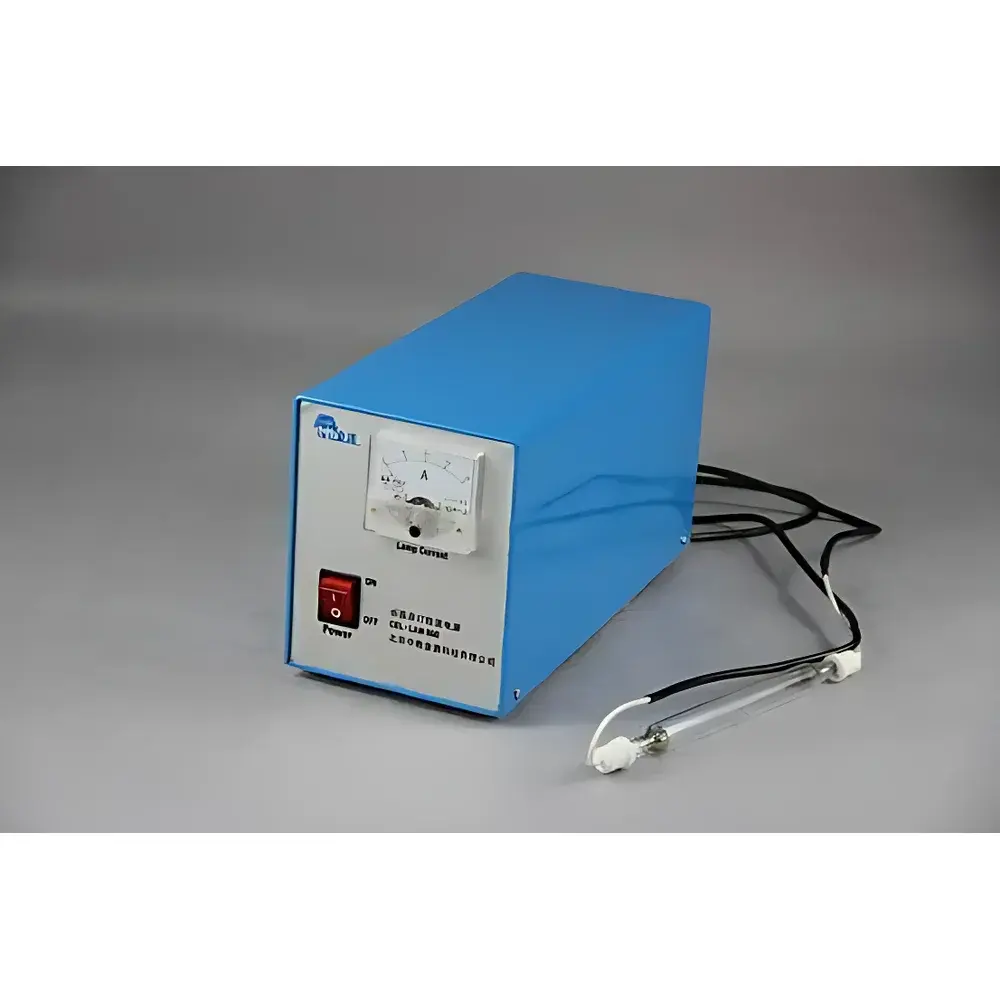
Zhongjiaojinyuan ZJ-GH Series Tubular High-Pressure Mercury Lamp
| Brand | Zhongjiaojinyuan |
|---|---|
| Origin | Beijing, China |
| Manufacturer Type | Direct Manufacturer |
| Region of Origin | Domestic (China) |
| Model Options | 350W, 500W, 1000W |
| Pricing | Available Upon Request |
Overview
The Zhongjiaojinyuan ZJ-GH Series Tubular High-Pressure Mercury Lamp is a robust, air-cooled ultraviolet (UV) light source engineered for laboratory-scale photochemical reaction systems, UV curing validation, photostability testing (per ICH Q1B), and spectral calibration applications. Operating on the principle of high-intensity arc discharge within a fused quartz envelope doped with mercury vapor under elevated pressure (typically 2–10 MPa), the lamp emits a characteristic polychromatic UV–visible spectrum with strong line emissions at 254 nm, 313 nm, 365 nm, 405 nm, and 436 nm—enabling targeted excitation across photochemical, polymerization, and fluorescence-based workflows. Unlike low-pressure mercury lamps, the ZJ-GH series delivers significantly higher radiance per unit area and enhanced spectral stability during steady-state operation, making it suitable for reproducible irradiance-controlled experiments in controlled-environment chambers and custom optical setups.
Key Features
- Three standardized power configurations (350W, 500W, 1000W) to match varying irradiance requirements and thermal management capabilities of host systems.
- Fused quartz tubular envelope with optimized wall thickness and dopant profile to maximize UV transmission (>85% at 254 nm) while resisting solarization under prolonged operation.
- Integrated ceramic base and precision-aligned tungsten electrodes designed for stable arc ignition and extended operational lifetime (rated ≥1,200 hours at rated power).
- Air-cooled design compatible with standard forced-air heat dissipation modules; no external water chiller required—reducing system complexity and footprint.
- Compliant with IEC 62471 (Photobiological Safety) for Risk Group 3 classification when used with appropriate shielding and interlocks.
- Electrical interface conforming to IEC 60061-1 lamp caps (G12 or R7s base variants available per model), facilitating drop-in replacement in legacy UV irradiation rigs.
Sample Compatibility & Compliance
The ZJ-GH lamp is routinely deployed in ASTM D4329 (fluorescent UV exposure of plastics), ISO 4892-3 (plastics—exposure to UV radiation), and USP (container–closure integrity testing using UV irradiation). Its spectral output supports both qualitative band-selective excitation and semi-quantitative irradiance mapping when paired with NIST-traceable UV radiometers (e.g., calibrated silicon photodiodes with Schott UG11 filters). The lamp does not contain regulated substances under RoHS Directive 2011/65/EU Annex II exemptions for mercury-containing discharge lamps (Exemption 1a). All units undergo factory burn-in and spectral verification prior to shipment, with full test reports provided upon request.
Software & Data Management
While the ZJ-GH lamp operates as a standalone hardware component without embedded firmware or digital control, it is fully compatible with third-party irradiance monitoring and process logging platforms—including LabVIEW-based DAQ systems, Arduino-compatible UV intensity loggers (with calibrated SiC or GaP sensors), and industrial PLC-controlled exposure timers. For GLP/GMP-regulated environments, integration with validated data acquisition software (e.g., NI DIAdem or MATLAB Production Server) enables audit-ready timestamped irradiance logs, lamp-on duration tracking, and preventive maintenance alerts based on cumulative operating hours. Optional analog 0–10 V feedback interface (available on custom orders) permits closed-loop intensity stabilization via external PID controllers.
Applications
- Photochemical synthesis of metal–organic frameworks (MOFs) and photocatalytic degradation studies (e.g., TiO₂-mediated oxidation of organic pollutants).
- Accelerated weathering and photostability assessment of pharmaceutical dosage forms per ICH Q5C guidelines.
- UV crosslinking of acrylate-based resins in microfluidic device fabrication and 3D-printed biomaterial scaffolds.
- Calibration reference source for UV–Vis spectrophotometers and fluorometers requiring discrete-line emission standards.
- Activation of photoinitiators in dental composites and industrial coatings during R&D and QC batch release testing.
FAQ
What is the typical warm-up time to reach spectral stability?
Approximately 8–12 minutes after ignition, depending on ambient temperature and airflow; spectral line intensities stabilize within ±3% after this period.
Can the lamp be dimmed or operated below rated power?
No—continuous operation below nominal voltage/current risks arc instability, electrode sputtering, and reduced lifetime; use external neutral density filters or mechanical shutters for irradiance reduction.
Is ozone generation a concern during operation?
Yes—significant ozone is produced below 220 nm; operation requires adequate ventilation or catalytic ozone destruct systems in enclosed enclosures.
How often should the lamp be replaced for critical applications?
Replace after 1,200 hours of cumulative operation or if spectral output at 365 nm declines by >15% relative to baseline calibration (measured with a calibrated spectroradiometer).
Does Zhongjiaojinyuan provide spectral emission data sheets?
Yes—each lamp ships with a factory-measured relative spectral power distribution (SPD) curve (200–700 nm, 1 nm resolution) and peak intensity values for major mercury lines.



