
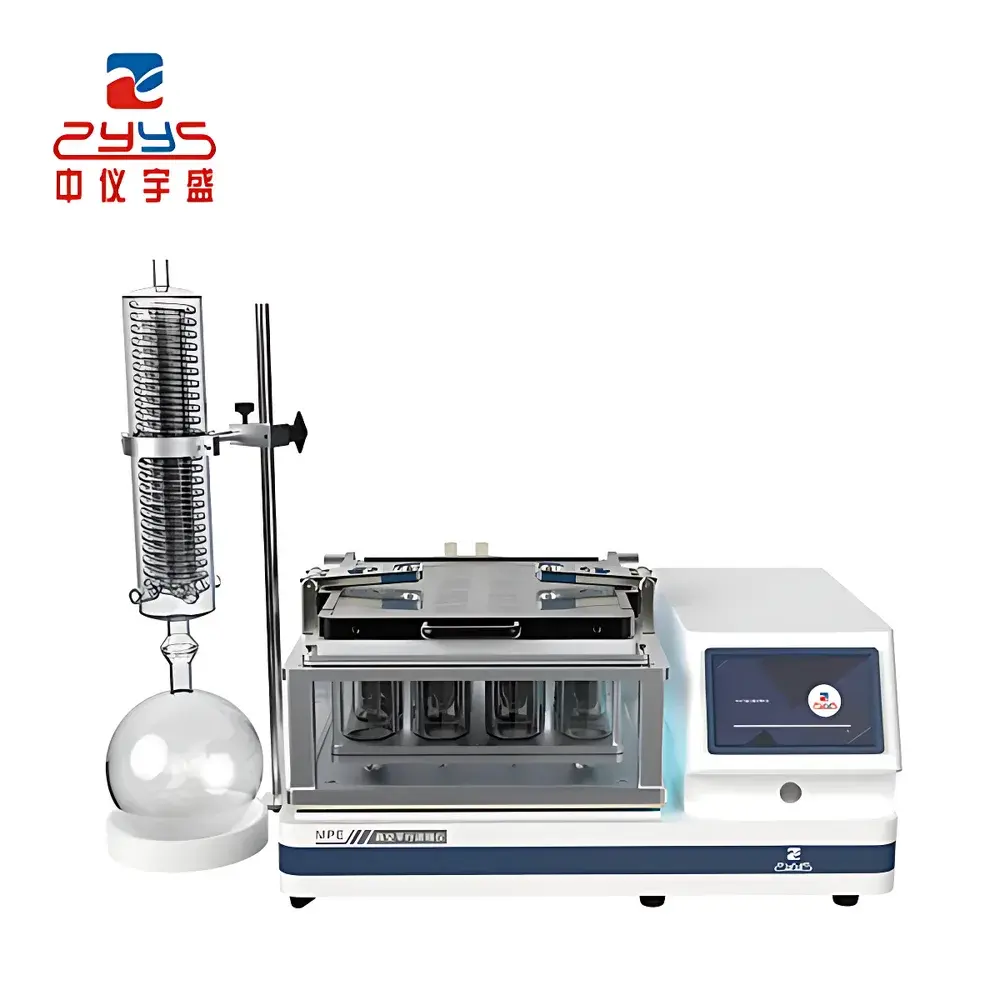
Zhongyi Yusheng MPE Vacuum Parallel Evaporator
| Brand | Zhongyi Yusheng |
|---|---|
| Origin | Beijing, China |
| Manufacturer Type | Direct Manufacturer |
| Instrument Type | Vacuum Parallel Evaporator |
| Model | MPE |
| Sample Capacity | 1–16 positions (customizable up to 25/36/49) |
| Sample Tube Standard | 260 mL (customizable) |
| Heating Source | Water Bath |
| Vacuum System | Integrated Diaphragm Pump |
| Cooling | Integrated Condenser with Recycled Solvent Recovery |
| Compliance | GB 23200.8–2016, GB 23200.9–2016, GB/T 20752–2006, HJ 743–2015, HJ 784–2016, HJ 1290–2023 |
Overview
The Zhongyi Yusheng MPE Vacuum Parallel Evaporator is an engineered solution for high-throughput, solvent-based sample concentration in analytical laboratories. It operates on the principle of vacuum-assisted evaporation—reducing ambient pressure within a sealed chamber to lower the boiling point of organic solvents, thereby accelerating solvent removal while minimizing thermal degradation of analytes. Integrated water bath heating, programmable orbital shaking, and active vacuum control enable uniform and reproducible concentration across multiple samples simultaneously. Designed for compatibility with GC-MS, LC-MS/MS, and HPLC sample preparation workflows, the MPE system supports method-compliant residue analysis in food safety, environmental monitoring (soil, water, sediment), forensic toxicology, and agricultural chemistry applications. Its closed-loop condensation system captures and recycles volatile solvents—including hexane, acetone, ethyl acetate, and dichloromethane—ensuring operator safety and regulatory compliance with indoor air quality and hazardous waste handling guidelines.
Key Features
- Parallel processing of 1–16 samples (expandable to 25/36/49 positions via optional racks); all positions receive identical vacuum, temperature, and agitation profiles for inter-sample comparability.
- Standardized 260 mL borosilicate glass sample tubes with PTFE-lined caps; tube holders are modular and tool-free, enabling rapid interchange between tube diameters (e.g., 12 mm, 16 mm, 20 mm).
- Integrated vacuum generation and regulation using a corrosion-resistant diaphragm pump; real-time pressure feedback maintains setpoint stability within ±0.5 kPa during extended runs.
- Intelligent water bath control with dry-run protection: ultrasonic level sensing triggers audible/visual alerts and automatically halts heating if water volume falls below operational threshold.
- Hinged, counterbalanced lid with position-hold mechanism allows hands-free access at any angle (0°–90°); dual-point latch system ensures leak-tight sealing without tools or torque calibration.
- Full-parameter digital interface displays and permits dynamic adjustment of water bath temperature (range: ambient +5°C to 95°C), oscillation speed (0–600 rpm), and vacuum setpoint (1–100 kPa abs) during operation.
- Built-in evaporation database includes pre-validated protocols for >20 common solvents per ICH Q5C and USP guidance; users may store, name, and recall custom methods with timestamped versioning.
- Optically transparent acrylic chamber walls (four-sided) permit unobstructed visual monitoring of meniscus recession and endpoint detection without interrupting vacuum integrity.
- One-touch preheat mode synchronizes warming of water bath, condenser coil, and vapor transfer lines to minimize condensation lag and improve solvent recovery efficiency (>92% typical for low-boiling solvents).
Sample Compatibility & Compliance
The MPE system accommodates liquid and semi-solid matrices including aqueous extracts, acetonitrile homogenates, ethyl acetate eluates, and methanol-based tissue digests. It is validated for use in multi-residue pesticide analysis per Chinese national standards GB 23200.8–2016 and GB 23200.9–2016, as well as nitrofuran metabolite quantification in animal tissues (GB/T 20752–2006). Environmental applications include PCBs (HJ 743–2015), PAHs (HJ 784–2016), and toxaphene (HJ 1290–2023) in soil and sediment. All hardware materials comply with ISO 8573-1 Class 3 purity requirements for compressed air–free operation, and the solvent recovery path meets EPA Method 8081B containment specifications. The system architecture supports GLP documentation workflows through audit-trail-enabled parameter logging (ISO/IEC 17025:2017 Annex A.3).
Software & Data Management
The embedded controller logs all operational parameters—including time-stamped vacuum pressure, bath temperature, rotational speed, and run duration—at 1-second intervals. Data export is supported via USB 2.0 to CSV format for integration with LIMS or ELN platforms. While no PC software is bundled, the device conforms to Modbus RTU protocol over RS-485 for third-party SCADA integration. All method files retain digital signatures and modification history, satisfying FDA 21 CFR Part 11 requirements for electronic records when deployed with validated IT infrastructure.
Applications
- Pre-concentration of QuEChERS extracts prior to GC-MS analysis of pesticides in fruits and vegetables.
- Volume reduction of SPE eluates containing PAHs from sediment pore water for HPLC-FLD quantification.
- Parallel cleanup of forensic blood/urine samples spiked with controlled substances prior to LC-MS/MS confirmation.
- Concentration of enzymatic hydrolysates from meat and seafood for nitrofuran marker residue screening.
- High-reproducibility solvent exchange (e.g., acetonitrile → toluene) in dioxin congener isolation workflows.
FAQ
Does the MPE require external compressed air or nitrogen gas?
No—the system uses only integrated vacuum and mechanical agitation; no auxiliary gas supply is needed.
Can the instrument be validated for GMP environments?
Yes—when operated with documented IQ/OQ protocols and paired with calibrated traceable sensors (NIST-traceable thermometer, pressure transducer), it meets Annex 15 and EU GMP Chapter 4 requirements.
What maintenance is required for the vacuum pump?
The diaphragm pump requires annual replacement of check valves and diaphragms; no oil changes or lubrication are necessary.
Is remote monitoring possible?
Not natively—but analog 4–20 mA outputs for temperature and pressure are available upon request for PLC integration.
How is endpoint detection handled?
Visual observation through the transparent chamber is the primary endpoint method; users may define volume thresholds based on meniscus height relative to tube graduation marks.



