
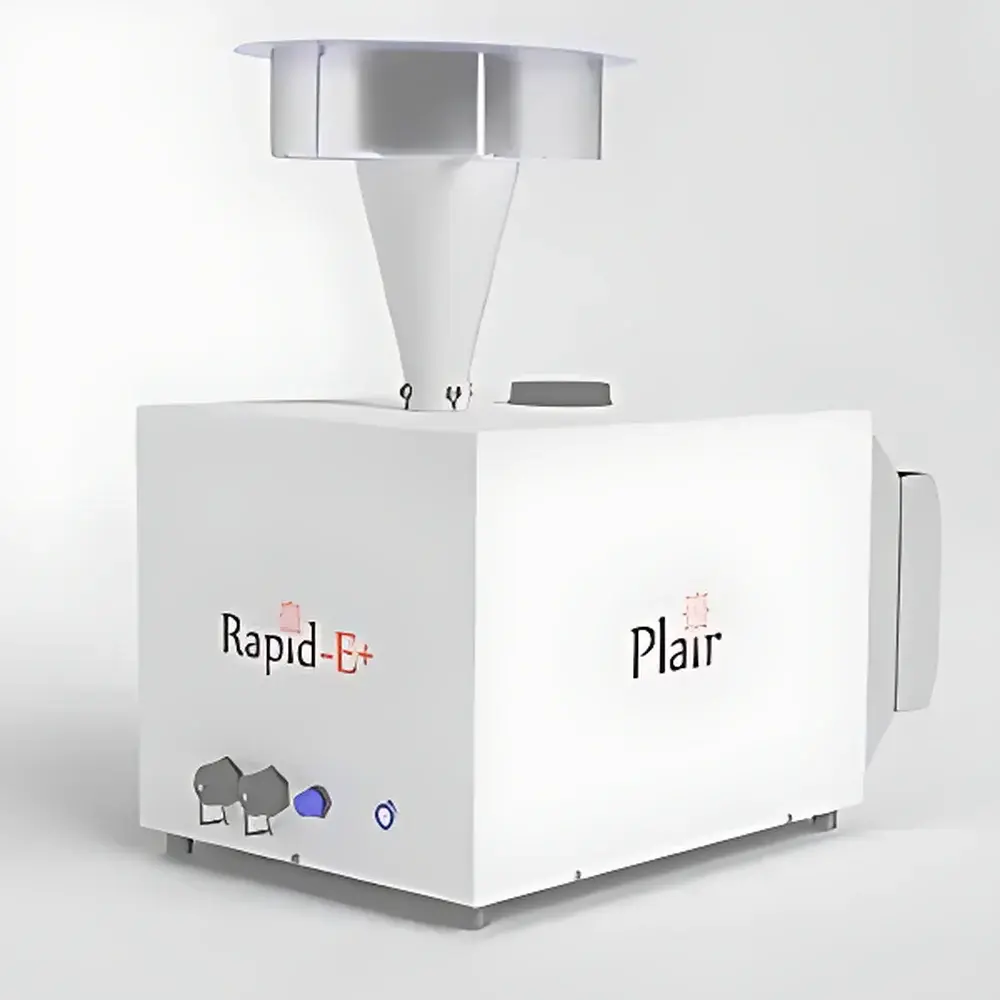
Plair Rapid-E+ Intelligent Real-Time Bioaerosol and Pollen Monitor
| Brand | Plair |
|---|---|
| Origin | Switzerland |
| Model | Rapid-E+ |
| Instrument Type | Bioaerosol Detector |
| Particle Size Range | 0.3–100 µm |
| UV Laser Wavelength | 337 nm |
| Scatter Laser Wavelength | 445 nm |
| Imaging Laser Wavelength | 635 nm |
| Scatter Pixel Configuration | 14+14 (non-polarized + parallel-polarized) |
| Fluorescence Spectral Range | 350–540 nm (12 nm/pixel) |
| Fluorescence Lifetime Channels | 373–387 nm, 412–438 nm, 459–481 nm |
| Fluorescence Decay Resolution | 1 ns |
| Imaging Pixel Configuration | 16 (5 parallel-polarized, 5 perpendicular-polarized, 6 non-polarized) |
| Sampling Flow Rate | 5 L/min |
| Max. Counting Rate | 1,000,000 particles/min (size & count) |
| Power Supply | 90–240 VAC |
| Power Consumption | <200 W |
| Dimensions | 40 × 34 × 73 cm |
| Operating Temperature | −10 to +45 °C |
| Relative Humidity | 0–95 % RH (non-condensing) |
| Weight | 25 kg |
Overview
The Plair Rapid-E+ Intelligent Real-Time Bioaerosol and Pollen Monitor is an advanced, field-deployable instrument engineered for continuous, label-free, single-particle characterization of airborne biological and non-biological aerosols. It operates on a dual-modal optical principle combining angularly resolved, polarization-sensitive Mie scattering with ultraviolet laser-induced fluorescence (UV-LIF) spectroscopy and time-resolved fluorescence lifetime detection. This integrated approach enables real-time morphological classification (via scatter pattern analysis) and biochemical fingerprinting (via multi-channel spectral and temporal fluorescence response), delivering high-fidelity identification of pollen grains, fungal spores, bacterial cells, viral aggregates, and inert particulates across a broad size range (0.3–100 µm). Unlike bulk or ensemble measurement techniques, the Rapid-E+ analyzes each particle individually—capturing its unique optical signature in under 100 microseconds—making it suitable for regulatory-grade environmental surveillance, occupational health monitoring, and clinical aerosol research.
Key Features
- GPU-accelerated onboard intelligence for real-time particle classification and adaptive algorithm training without cloud dependency
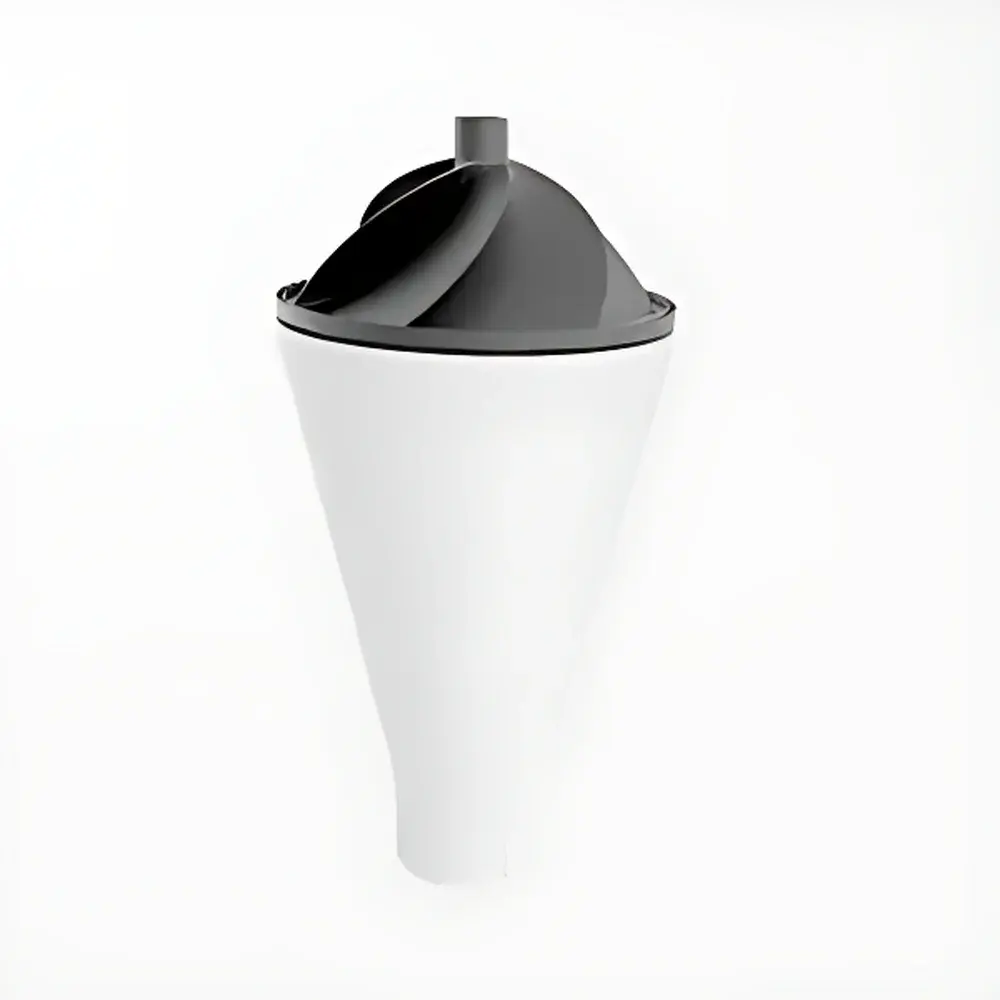
- Patented high-efficiency sampling head validated via CFD simulation at HEPIA (Geneva), demonstrating >92% aspiration efficiency for 10–100 µm particles at 2 m/s crossflow velocity
- Triple-laser optical architecture: 445 nm for polarized Mie scattering imaging, 337 nm UV for multi-band fluorescence excitation, and 635 nm for high-contrast 2D morphology reconstruction
- 16-channel fluorescence spectral acquisition (350–540 nm, 12 nm resolution) coupled with nanosecond-resolution lifetime decay profiling across three dedicated emission bands
- Full optical fingerprint recording per particle—including scatter asymmetry, depolarization ratio, fluorescence quantum yield, spectral centroid shift, and decay kinetics—enabling species-level discrimination with ≤1% false-positive rate in controlled validation studies
- Remote operation via encrypted HTTPS API and optional LTE/4G module; supports scheduled calibration, firmware updates, and diagnostic telemetry over secure TLS 1.2 connections
Sample Compatibility & Compliance
The Rapid-E+ is designed for unattended, long-term deployment in diverse ambient environments—from urban rooftops and hospital HVAC intakes to agricultural fields and cleanroom vestibules. Its robust thermal management and condensation-resistant optical path ensure stable performance across −10 to +45 °C and 0–95% RH (non-condensing). The instrument complies with IEC 61326-1 (EMC for laboratory equipment), IEC 61000-6-3 (emission limits), and meets mechanical safety requirements per IEC 61010-1. Data integrity protocols align with GLP and GMP principles: all raw scatter/fluorescence waveforms, timestamps, and classification metadata are stored locally with SHA-256 checksums and optional write-once SD card archiving. Audit trails—including operator login history, parameter changes, and calibration events—are retained for ≥18 months and exportable in CSV/JSON format for FDA 21 CFR Part 11–compliant review workflows.
Software & Data Management
The Rapid-E+ ships with Plair’s proprietary OptiTrack Suite, a Linux-based embedded application providing real-time visualization, configurable alerting (email/SMS/webhook), and granular data export. Users define custom classification thresholds using supervised machine learning models trained on reference libraries (e.g., Poaceae vs. Betulaceae pollen, Aspergillus vs. Cladosporium spores) or unsupervised clustering for exploratory aerosol profiling. All processed data—including particle counts per taxonomic group, size distribution histograms, and time-series concentration heatmaps—are accessible via RESTful API for integration into enterprise LIMS, SCADA systems, or public air quality dashboards. Raw binary files (HDF5 format) preserve full waveform fidelity for retrospective reanalysis or third-party algorithm development. Optional cloud synchronization enables federated learning across multi-site deployments while maintaining local data sovereignty.
Applications
- Real-time pollen forecasting and allergen exposure mapping for public health agencies and clinical immunology departments
- Continuous bioaerosol monitoring in pharmaceutical manufacturing cleanrooms per ISO 14644-1 Class 5–8 requirements
- Field validation of HVAC filtration efficiency against viable microbial aerosols (ASTM D6329, ISO 21501-4)
- Long-term atmospheric biology studies tracking seasonal spore dynamics, desert dust bioload, or wildfire-associated pathogen transport
- Occupational hygiene assessment in agriculture, composting facilities, and wastewater treatment plants
- Research on virus-laden droplet nuclei stability under varying RH/T conditions, supporting WHO and ECDC indoor transmission modeling
FAQ
How does the Rapid-E+ differentiate between viable and non-viable biological particles?
It relies on the correlation between UV-induced fluorescence intensity, spectral shape (e.g., NADH vs. tryptophan signatures), and nanosecond-scale decay kinetics—parameters empirically linked to metabolic activity and membrane integrity in peer-reviewed validation studies.
Can the instrument be calibrated traceably to national standards?
Yes—Plair provides NIST-traceable polystyrene latex (PSL) and fluorescent microsphere reference materials for scatter and fluorescence channel alignment; annual factory recalibration includes Mie scattering model verification against ISO 21501-4 compliant standards.
Is remote firmware update supported without physical access?
Yes—over-the-air (OTA) updates are delivered via signed packages authenticated with ECDSA-256; rollback capability and dual-boot partitioning ensure operational continuity during upgrade cycles.
What maintenance intervals are recommended for field operation?
Optical window cleaning every 30 days in high-dust environments; full system verification (scatter/fluorescence gain, flow rate, timing jitter) every 6 months; no consumables required beyond standard HEPA filter replacement (optional accessory).
Does the Rapid-E+ meet EU CE marking requirements for environmental monitoring instruments?
Yes—it carries CE marking under Directive 2014/30/EU (EMC) and 2014/35/EU (LVD), with technical documentation available upon request for Notified Body review.







