
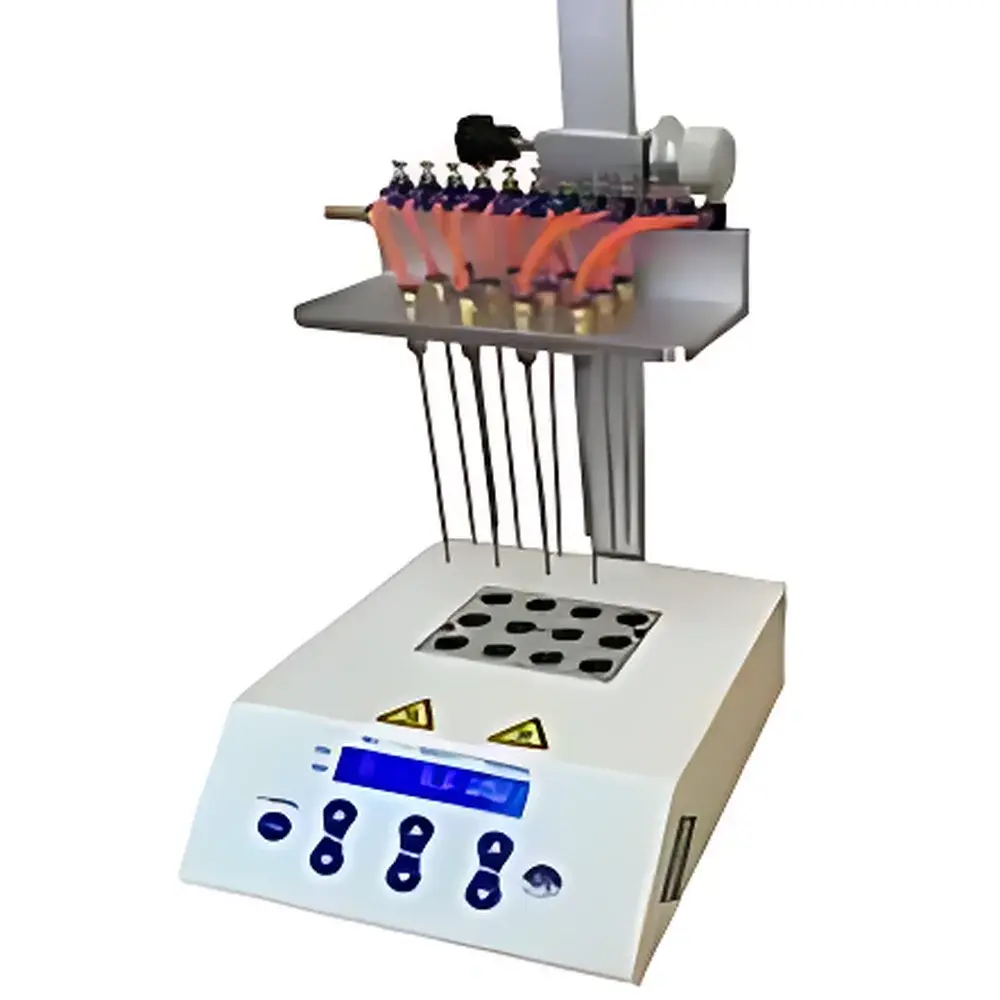
ZiQi DC-12A 12-Position Dry Block Nitrogen Evaporator
| Brand | ZiQi |
|---|---|
| Origin | Shanghai, China |
| Manufacturer Type | Direct Manufacturer |
| Model | DC-12A (12-Position) |
| Heating Method | Dry Block Heating |
| Temperature Range | Ambient +5°C to 150°C |
| Temperature Stability | ±0.5°C at 100°C |
| Temperature Uniformity | ±0.1°C (setpoint fluctuation) |
| Sample Capacity | 12 positions |
| Tube Diameter Compatibility | 0.2–19 mm (standard module: 16 mm |
| Nitrogen Flow Rate | 0–10 L/min |
| Max Operating Pressure | ≤0.1 MPa |
| Heating Power | 200 W |
| Dimensions (W×D×H) | 230 × 200 × 500 mm |
| Weight | ~4.2 kg |
| Programmable Profiles | 5 user-defined temperature/time ramps |
| Display | LED with real-time temperature and countdown timer |
| Safety | Over-temperature cutoff, internal thermal sensor with active cooling fan, ventilated cabinet-compatible design |
Overview
The ZiQi DC-12A is a precision-engineered 12-position dry block nitrogen evaporator designed for reproducible, oxygen-free solvent removal in analytical laboratories. It operates on the principle of gentle inert gas displacement—nitrogen is delivered via individually adjustable stainless steel needles positioned just above the liquid surface of each sample tube. Simultaneously, a high-thermal-conductivity aluminum heating block maintains precise, uniform temperature control across all 12 positions. Unlike water bath evaporators, the dry block architecture eliminates cross-contamination risk from bath fluid carryover, enables rapid thermal response (<30 min to reach 150°C from 40°C), and supports operation under low-humidity or elevated-temperature conditions where water baths are impractical. The system is optimized for applications requiring strict analyte integrity—such as residual solvent removal prior to GC-MS or LC-MS analysis, hormone quantification in clinical matrices, and high-throughput drug metabolite isolation—where oxidation-sensitive compounds demand inert atmosphere handling.
Key Features
- Aluminum dry block heater with exceptional thermal conductivity and spatial uniformity (±0.1°C setpoint fluctuation), ensuring consistent evaporation kinetics across all 12 channels.
- Individually controllable nitrogen flow per position via 12 independent on/off valves—minimizing gas consumption and enabling selective processing of subsets of samples.
- Vertically adjustable gas manifold with 150 mm standard needle length; compatible with interchangeable modules for tubes ranging from 0.2 mL microcentrifuge tubes to 19 mm OD test tubes.
- Programmable temperature profiling: 5 user-stored protocols support multi-stage ramp/soak sequences—e.g., initial low-temperature solvent removal followed by final high-temperature trace residue drying.
- Integrated safety architecture: dual thermal protection—including primary PID-controlled cutoff at 150°C and secondary internal ambient-sensing circuit that activates a rear-mounted cooling fan when chassis temperature exceeds safe thresholds.
- LED interface with simultaneous display of setpoint temperature, actual block temperature, and countdown timer (up to 99 h 59 min); intuitive navigation without software dependency.
- Ventilation-ready design: fully enclosed chassis with front-accessible gas inlet and rear exhaust allows safe integration into fume hoods during volatile or toxic solvent evaporation.
Sample Compatibility & Compliance
The DC-12A accommodates standardized tube formats including 0.2 mL, 0.5 mL, 1.5 mL, and 2.0 mL microcentrifuge tubes, as well as round-bottom culture tubes (7–19 mm OD). Custom aluminum modules are available for non-standard diameters or specialized vessel geometries. All contact surfaces are electropolished anodized aluminum—chemically inert toward common organic solvents (acetonitrile, methanol, ethyl acetate, hexane) and compatible with aqueous buffers. While not certified to ISO/IEC 17025 or FDA 21 CFR Part 11 out-of-the-box, the instrument’s deterministic thermal behavior, programmable repeatability, and audit-ready parameter logging (via optional RS232/USB interface) support GLP-compliant workflows. Its design aligns with ASTM D5292 (solvent evaporation for petroleum product analysis) and USP residual solvent testing prerequisites—particularly where nitrogen blanketing is specified to prevent oxidative degradation.
Software & Data Management
The DC-12A operates as a standalone instrument with embedded firmware controlling all thermal and pneumatic functions. For laboratories requiring electronic record retention, an optional serial (RS232) or USB interface enables connection to LIMS or custom data acquisition platforms. Real-time temperature and elapsed time can be streamed at 1-second intervals; protocol execution logs—including start time, target temperatures, soak durations, and fault events—are timestamped and exportable as CSV. No proprietary software installation is required; communication follows standard ASCII command sets compatible with Python, LabVIEW, or MATLAB automation scripts. Firmware updates are performed via USB memory stick—ensuring long-term maintainability without vendor lock-in.
Applications
- Preparative concentration of biological extracts (plasma, urine, tissue homogenates) prior to LC-MS/MS quantitation of endogenous steroids or xenobiotics.
- Routine cleanup in environmental labs: EPA Method 525.3 (pesticide residues in drinking water) and Method 8082 (PCBs in soil/sediment) require nitrogen-assisted evaporation to avoid thermal decomposition.
- Pharmaceutical QC: residual solvent removal from API intermediates per ICH Q3C guidelines—especially low-boiling solvents (e.g., dichloromethane, acetone) where precise endpoint control prevents analyte loss.
- Forensic toxicology: parallel concentration of 12 post-mortem blood samples for benzodiazepine screening, maintaining recovery consistency across replicates.
- Academic research: high-throughput library preparation for metabolomics, where >100 samples/day must undergo identical evaporation kinetics to preserve multivariate statistical validity.
FAQ
Is the DC-12A suitable for use with chlorinated solvents such as chloroform or carbon tetrachloride?
Yes—provided operation occurs inside a certified fume hood. The aluminum block and stainless steel gas needles resist corrosion from halogenated solvents; however, prolonged exposure to acidic vapors may degrade surface finish over time.
Can I replace the standard 16 mm module with a 10 mm module without tools?
Yes—the modular block design allows tool-free swapping. Each module features alignment pins and recessed mounting grooves for secure, repeatable positioning.
Does the instrument meet CE or UL safety certification requirements?
The DC-12A complies with IEC 61010-1:2010 for laboratory electrical equipment. CE marking is applied for EU market distribution; UL listing is available upon request for North American installations.
What maintenance is required to ensure long-term temperature accuracy?
Annual verification using a NIST-traceable calibrated thermometer inserted into a reference well is recommended. No routine calibration of internal sensors is needed—the PID controller maintains stability within specification for ≥5 years under normal lab conditions.
Is remote monitoring or network integration supported?
Not natively—but the optional RS232/USB interface enables integration with building management systems (BMS) or centralized lab monitoring platforms via Modbus RTU or simple ASCII polling.



