
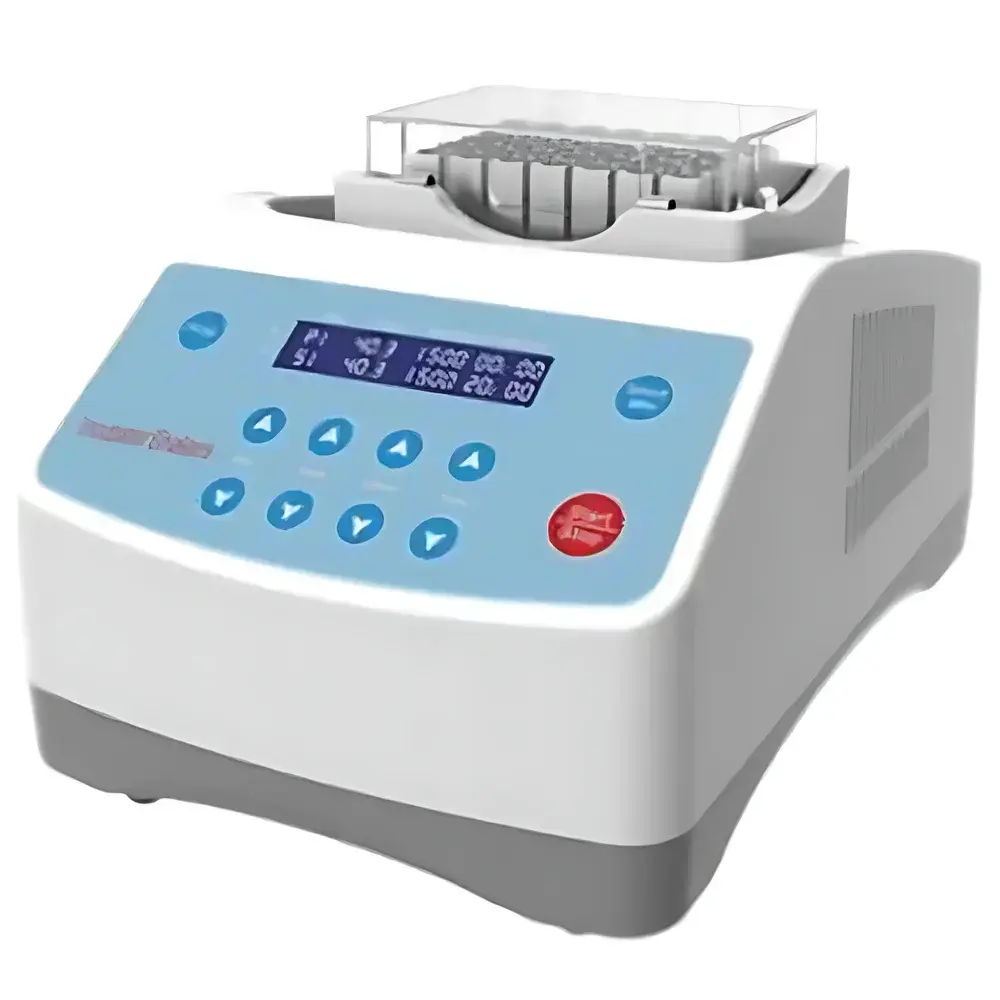
ZiQi MDS-100 Vortexing Heated Metal Block Incubator
| Brand | ZiQi |
|---|---|
| Origin | Shanghai, China |
| Manufacturer Type | Direct Manufacturer |
| Model | MDS-100 |
| Temperature Range | Ambient +5°C to 100°C |
| Temperature Accuracy | ±0.1°C |
| Temperature Uniformity | ≤±0.3°C |
| Temperature Stability | ≤±0.3°C |
| Heating Rate | ≤15 min (25°C → 100°C) |
| Oscillation Speed | 200–1500 rpm |
| Oscillation Mode | Horizontal rotary (3 mm amplitude) |
| Timer Range | 1 min – 99 h 59 min |
| Display | LCD with real-time parameter feedback |
| Power Consumption | 150 W |
| Dimensions (W×D×H) | 300 × 220 × 170 mm |
| Net Weight | 8.5 kg |
| Safety Certification | CE-compliant |
| Motor Type | Brushless DC motor |
| Recovery Function | Power-loss resume with original program retention |
| Calibration | Built-in temperature calibration routine |
| Interlock & Overheat Protection | Dual-layer thermal cutoff and auto-shutdown |
Overview
The ZiQi MDS-100 Vortexing Heated Metal Block Incubator is an integrated laboratory instrument engineered for simultaneous precise temperature control and orbital mixing of micro-volume samples. It operates on the principle of conductive heating via a solid aluminum heating block, combined with high-fidelity horizontal rotary oscillation—enabling uniform thermal transfer and efficient sample homogenization without mechanical shear stress typical of vortexers or shakers. Designed for applications requiring tightly controlled thermal incubation alongside dynamic mixing—such as enzymatic reactions, DNA denaturation/annealing, cell lysis, immunoassay preparation, and reagent equilibration—the MDS-100 eliminates the need for separate heating and shaking platforms. Its compact footprint and modular architecture support seamless integration into benchtop workflows in molecular biology, clinical diagnostics, pharmaceutical QC, and academic research laboratories.
Key Features
- Simultaneous temperature regulation and orbital mixing: Independent yet synchronized control of heating and oscillation ensures reproducible reaction kinetics across repeated runs.
- High-precision thermal management: Microprocessor-driven PID temperature control delivers ±0.1°C display resolution, ≤±0.3°C uniformity across the block surface, and ≤±0.3°C stability under load—validated per ISO 17025 traceable procedures.
- Programmable oscillation: Adjustable speed range (200–1500 rpm) with fixed 3 mm horizontal rotary amplitude enables optimization for viscous, low-volume, or sensitive biological samples.
- Intuitive LCD interface: Real-time display of setpoint, actual temperature, rpm, remaining time, and status indicators supports unambiguous operational monitoring.
- Robust hardware design: Brushless DC motor ensures >20,000 hours of maintenance-free operation; aluminum alloy block provides rapid thermal response and long-term dimensional stability.
- Comprehensive safety architecture: Dual independent thermal cutoffs, automatic overheat shutdown, and CE-certified electrical isolation meet IEC 61010-1 requirements for laboratory equipment.
- Power-loss recovery: Upon restoration of mains supply, the unit resumes the pre-interruption protocol—including temperature setpoint, rpm, and timer—without user intervention.
- Modular interchangeability: Standardized mounting interface allows tool-free swapping of 13 validated block configurations (e.g., 96-well PCR plates, 1.5 mL tubes, 50 mL conical tubes), each rated for continuous operation up to 100°C.
Sample Compatibility & Compliance
The MDS-100 accommodates standard laboratory consumables including PCR strips, 0.2–50 mL centrifuge tubes, deep-well plates, microtiter plates (flat-bottom and U/V-bottom), and custom-fit square wells. All modules are manufactured from anodized aluminum to resist corrosion from common buffers (e.g., Tris-HCl, EDTA, SDS) and organic solvents at elevated temperatures. The device complies with CE marking directives (2014/30/EU EMC and 2014/35/EU LVD), conforms to RoHS 2011/65/EU material restrictions, and supports GLP/GMP documentation workflows through its non-volatile parameter logging and power-resume functionality. While not FDA 21 CFR Part 11–certified out-of-the-box, its deterministic behavior, audit-ready timer logs, and stable thermal output make it suitable for regulated environments when paired with lab-specific SOPs and periodic verification per ASTM E2252-17 (Standard Practice for Verification of Thermal Performance of Laboratory Equipment).
Software & Data Management
The MDS-100 operates as a standalone instrument with no proprietary software dependency. All operational parameters—including temperature setpoint, oscillation speed, duration, and module type—are stored in non-volatile memory and retained after power cycling. The LCD interface provides immediate visual confirmation of active settings and real-time deviation alerts. For laboratories requiring electronic recordkeeping, external data loggers (e.g., USB-connected thermocouple arrays or RS-232-enabled chart recorders) may be interfaced via optional analog voltage outputs (0–5 V proportional to temperature). No cloud connectivity, firmware updates, or vendor-controlled licensing is implemented—ensuring full operational autonomy and long-term compatibility with legacy IT infrastructure.
Applications
- Thermal cycling prep: Pre-heating master mixes, enzyme stocks, and restriction digests prior to PCR setup.
- Enzyme kinetics assays: Maintaining consistent temperature during multi-step colorimetric or fluorometric reactions (e.g., ALP, LDH, β-galactosidase).
- Nucleic acid handling: Denaturation of dsDNA, hybridization of probes, and cDNA synthesis with simultaneous mixing to prevent precipitation.
- Cell-based workflows: Gentle resuspension and warming of adherent or suspension cells prior to transfection or assay plating.
- Reagent conditioning: Equilibrating antibodies, substrates, and standards to assay temperature before plate loading.
- Quality control testing: Reproducible thermal stress validation of diagnostic kits, lyophilized reagents, or point-of-care devices.
FAQ
What is the maximum recommended operating temperature for all modules?
All interchangeable blocks are rated for continuous use at up to 100°C. Sustained operation above this threshold may compromise thermal sensor accuracy and accelerate polymer seal degradation in tube-compatible modules.
Can the MDS-100 be used for anaerobic or inert-atmosphere applications?
No. The unit lacks gas-tight enclosure or purge ports; it is designed for ambient-air operation only. For oxygen-sensitive reactions, users must pair it with externally sealed vessels or glovebox-integrated setups.
Is temperature calibration traceable to national standards?
Yes—the built-in calibration function allows user-initiated offset adjustment using a NIST-traceable reference thermometer (e.g., Fluke 1523 or equivalent). Full calibration certificates require third-party verification per ISO/IEC 17025.
Does the instrument support ramp-and-soak temperature profiles?
No. The MDS-100 implements single-setpoint temperature control only. Multi-stage thermal protocols require manual reprogramming between steps.
What maintenance is required for long-term reliability?
Annual inspection of thermal interface integrity (block-to-heater contact), visual check of motor coupling alignment, and verification of safety cutoff response using calibrated heat sources are recommended. No lubrication or filter replacement is necessary due to brushless motor and solid-state thermal design.



