
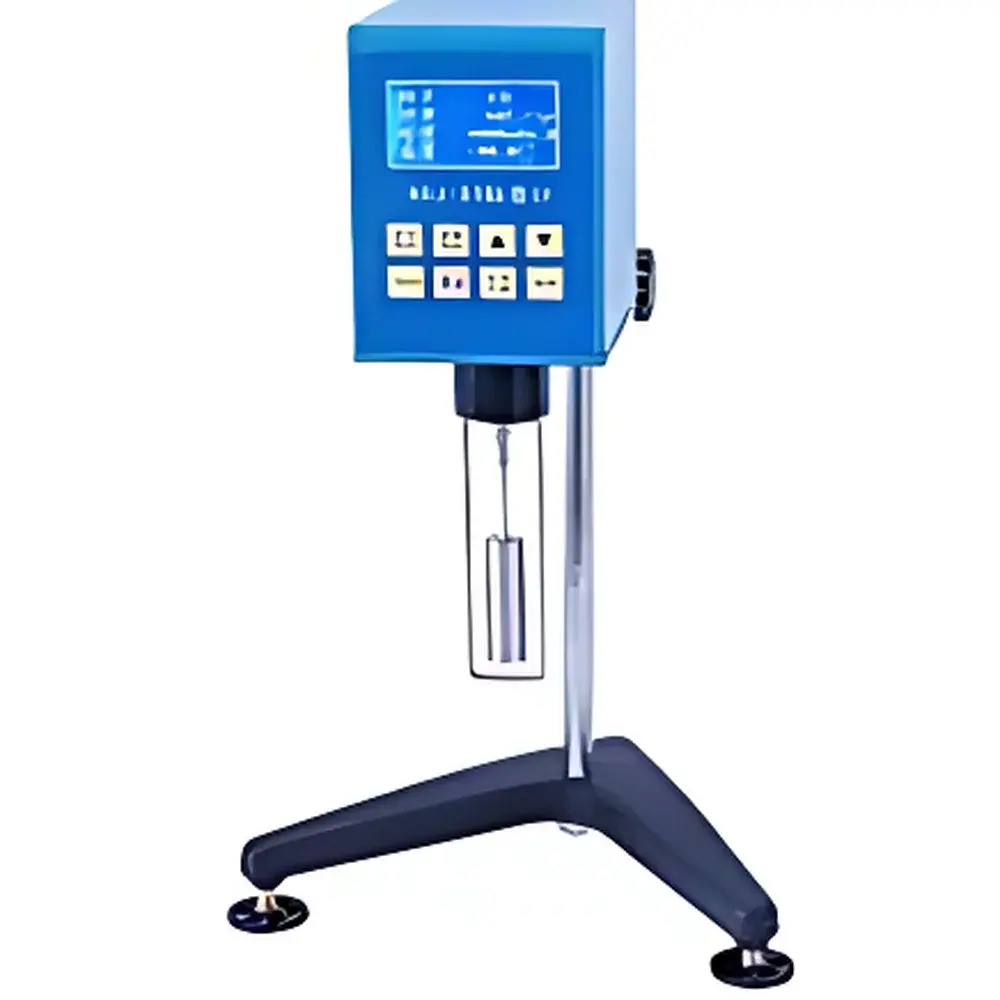
ZiQi NDJ-5S Digital Rotational Viscometer
| Brand | ZiQi |
|---|---|
| Origin | Shanghai, China |
| Manufacturer Type | Direct Manufacturer |
| Instrument Type | Benchtop Rotational Viscometer |
| Operating Environment | Ambient Temperature |
| Viscosity Range | 10–100,000 mPa·s |
| Speed Settings | 6, 12, 30, 60 rpm |
| Standard Spindles | LV#1–#4 (SP#0 optional) |
| Accuracy | ±1.0% FS |
| Repeatability | ±0.5% |
| Power Supply | AC 100–240 V, 50/60 Hz |
| Dimensions | 275 × 230 × 475 mm |
Overview
The ZiQi NDJ-5S Digital Rotational Viscometer is a benchtop instrument engineered for precision viscosity measurement of Newtonian and mildly non-Newtonian fluids under ambient laboratory conditions. Based on the Couette principle, it employs a coaxial cylinder geometry where torque generated by fluid resistance to spindle rotation is transduced into a digital viscosity reading. Designed for routine quality control, incoming material inspection, and formulation development in chemical, pharmaceutical, food, and adhesive manufacturing, the NDJ-5S delivers stable, reproducible measurements across a wide dynamic range—10 to 100,000 mPa·s—without mechanical gear reduction. Its direct-drive stepper motor ensures exact rotational speed delivery at four discrete setpoints (6, 12, 30, and 60 rpm), eliminating backlash, slippage, or speed drift associated with geared transmission systems.
Key Features
- Direct-coupled stepper motor drive: No gears, belts, or clutches—ensures accurate, repeatable rotational speed control and long-term mechanical stability.
- Backlit blue LCD display: Presents real-time viscosity (mPa·s), rotational speed (rpm), spindle identifier, and full-scale capacity for the selected speed/spindle combination.
- Dynamic range indicator: Automatically calculates and displays the maximum measurable viscosity at the current speed and spindle configuration—supporting rapid method selection and preventing over-range operation.
- Continuous viscosity tracking: Captures transient changes during mixing, curing, or temperature-dependent flow behavior without sampling delay.
- Acoustic over-range alert: Audible tone activates when torque exceeds the calibrated limit for the active spindle/speed pair—preventing sensor overload and data corruption.
- Full-scale linear calibration: Factory-applied two-point calibration traceable to NIST-traceable reference oils; supports user verification using certified standard fluids per ASTM D2196 or ISO 2555.
- Universal power input: Integrated switching-mode AC adapter (100–240 V, 50/60 Hz) provides EMI-hardened operation suitable for shared lab power circuits.
Sample Compatibility & Compliance
The NDJ-5S accommodates low-to-medium viscosity liquids—including solvents, polymer solutions, emulsions, syrups, coatings, and suspensions—using standard LV spindles #1 through #4. Optional SP#0 spindle extends low-end sensitivity for ultra-dilute systems. All spindles are stainless steel (AISI 304) and chemically resistant to common organic solvents and aqueous media. The instrument complies with general safety requirements of IEC 61010-1 for electrical equipment used in laboratory environments. While not certified for GLP/GMP production environments out-of-the-box, its fixed-speed architecture, audit-ready calibration logs (when paired with external documentation), and deterministic output support alignment with internal SOPs referencing ASTM D1200 (for automotive paints), ISO 2555 (for resins), or USP (for topical formulations).
Software & Data Management
The NDJ-5S operates as a standalone instrument with no embedded USB or Bluetooth interface. However, its analog torque signal path and stable digital output architecture allow integration into custom data acquisition workflows via optional RS-232 or analog voltage (0–5 V) output modules (sold separately). When connected to a PC-based DAQ system, users can generate time-stamped viscosity profiles, calculate shear rate approximations using spindle geometry constants, and export CSV-formatted datasets for statistical process control (SPC) analysis. For regulated environments requiring electronic record integrity, manual entry into validated LIMS or ELN platforms—paired with operator-signed calibration certificates and daily verification logs—fulfills FDA 21 CFR Part 11 documentation expectations at the procedural level.
Applications
- QC release testing of industrial lubricants, hydraulic fluids, and transformer oils per ASTM D445.
- Batch consistency verification of water-based adhesives, latex dispersions, and ink vehicles.
- Stability assessment of pharmaceutical suspensions and ointment bases during accelerated aging studies.
- Routine monitoring of food-grade syrups, dressings, and dairy concentrates in pilot-scale processing.
- Educational use in undergraduate rheology labs for introducing fundamental concepts of shear stress, shear rate, and apparent viscosity.
FAQ
Is the NDJ-5S suitable for measuring non-Newtonian fluids?
Yes—it reports apparent viscosity at each selected speed/spindle combination. For qualitative shear-thinning or thixotropic evaluation, users must manually conduct multi-speed sweeps and compare values; it does not compute flow curves or yield stress automatically.
Can I validate calibration in-house?
Yes—using NIST-traceable viscosity standards (e.g., Cannon, Brookfield, or SRS certified oils) and following the two-point verification procedure outlined in the operator manual.
Does the instrument meet ISO/IEC 17025 requirements?
The NDJ-5S itself is not accredited, but its measurement capability—when operated within specified environmental conditions, with documented calibration, and trained personnel—can support compliance with ISO/IEC 17025 clause 6.4 (Equipment) and 6.5 (Measurement Traceability) in accredited laboratories.
What spindle geometry does it use?
LV spindles follow the classical cylindrical bob-in-cup design per ASTM D1200; spindle dimensions and rotational constants are provided in the technical appendix for shear rate estimation.
Is temperature control integrated?
No—temperature management requires external circulation baths or Peltier plates; viscosity measurements should be conducted at stabilized sample temperature per ISO 3219.



