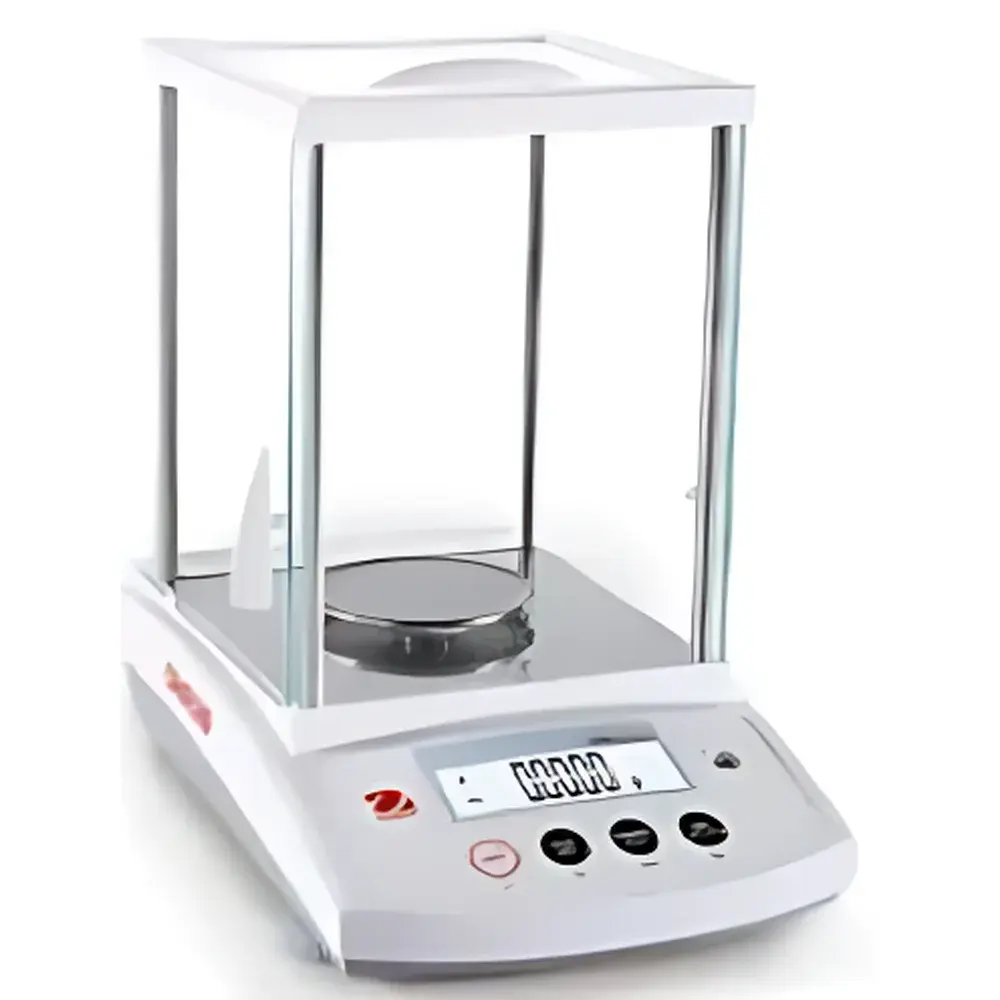
OHAUS PR224ZH/E Analytical Balance
| Brand | OHAUS |
|---|---|
| Origin | USA |
| Model | PR224ZH/E |
| Maximum Capacity | 220 g |
| Readability | 0.1 mg |
| Repeatability | 0.1 mg |
| Calibration | External |
| Weighing Modes | Standard, Piece Counting, Percentage |
| Display | Backlit LCD |
| Interface | RS232 |
| Operating Temperature | 10–30 °C |
| Operating Humidity | ≤80% RH (at ≤30 °C), linearly decreasing to 50% RH at 40 °C |
| Pan Size | 90 mm diameter |
| Dimensions (W × D × H) | 201 × 317 × 333 mm |
| Net Weight | 4.5 kg |
| Compliance | ISO/IEC 17025, USP <41>, GLP/GMP-ready |
Overview
The OHAUS PR224ZH/E Analytical Balance is a high-precision, externally calibrated laboratory balance engineered for routine analytical weighing tasks in regulated and non-regulated environments. Designed as a direct successor to the legacy CP series, the PR platform integrates robust mechanical architecture with intuitive operational logic—making it suitable for quality control laboratories, academic teaching labs, pharmaceutical R&D, and industrial QC settings where traceable, reproducible mass measurement is required at the 0.1 mg readability level. Its measurement principle relies on electromagnetic force compensation (EMFC) technology, delivering stable, drift-compensated results under standard ambient conditions (10–30 °C, ≤80% RH). The balance meets foundational metrological requirements outlined in USP for repeatability and minimum weight determination, and supports compliance workflows aligned with ISO/IEC 17025 accreditation and GLP/GMP documentation practices.
Key Features
- Sturdy, space-efficient chassis with compact footprint (201 × 317 mm base) and elevated weighing chamber—maximizing usable benchtop area while maintaining full accessibility to the 90 mm stainless steel weighing pan.
- Corrosion-resistant stainless steel pan and ABS thermoplastic housing; removable pan design facilitates cleaning and maintenance; integrated draft shield with top-sliding glass doors ensures environmental isolation during sensitive measurements.
- Backlit monochrome LCD display with high-contrast characters and context-sensitive iconography—enabling immediate visual feedback without operator training.
- Four tactile mechanical keys provide direct access to core functions: tare, print, mode selection, and menu navigation—eliminating reliance on soft-touch interfaces prone to wear or calibration drift.
- Configurable environmental parameters—including auto-zero tracking, adjustable display brightness, programmable auto-dimming, and user-defined stability threshold—allow optimization for varying lab conditions and operator preferences.
- Full software lock capability, customizable user ID and sample ID fields, overload/underload alerts, and real-time stability indication support audit-ready operation in regulated environments.
Sample Compatibility & Compliance
The PR224ZH/E accommodates solid, granular, and low-viscosity liquid samples within its 220 g maximum capacity and 90 mm pan diameter. Its external calibration architecture permits traceable verification using certified Class E2 or Class F1 weights per OIML R111 guidelines. The balance supports USP minimum weight validation protocols: typical minimum weight is 200 mg (K = 2, U = 0.10%), with optimal minimum weight at 82 mg under identical uncertainty criteria. It is compatible with ISO 9001, ISO/IEC 17025, and FDA 21 CFR Part 11–compliant data integrity frameworks when paired with validated third-party data capture software. No internal calibration motor or automatic self-test is included—ensuring mechanical simplicity and long-term stability of the EMFC sensor system.
Software & Data Management
Data output is delivered via standard RS232 serial interface (no USB or Ethernet option available on this model), supporting ASCII-based transmission to PCs, printers, or LIMS systems. Output format is fully configurable: users may select units (g, mg, oz, lb, ct, dwt, ozt, N), define decimal places, enable auto-print triggers, and assign custom identifiers to each weighing record. While the device lacks built-in electronic signature or audit trail functionality, its deterministic output stream and menu-lock capability allow integration into validated data acquisition workflows. When used with compliant terminal software (e.g., OHAUS Acquire or third-party GxP-compliant tools), the PR224ZH/E supports full ALCOA+ principles—ensuring data Attributable, Legible, Contemporaneous, Original, Accurate, Complete, Consistent, Enduring, and Available.
Applications
- Pharmaceutical formulation: active ingredient dispensing, excipient ratio verification, and reference standard preparation per USP and EP monographs.
- Chemical synthesis: stoichiometric reagent weighing, yield calculation, and reaction mixture quantification.
- Materials science: powder density determination, coating mass uniformity testing, and catalyst loading accuracy assessment.
- Food & beverage QA: nutritional labeling compliance checks, batch consistency evaluation, and moisture content pre/post-drying mass differentials.
- Academic instruction: fundamental metrology labs, uncertainty propagation exercises, and gravimetric titration setup.
FAQ
Is the PR224ZH/E compliant with FDA 21 CFR Part 11?
The balance itself does not include electronic signature or audit trail features. However, it generates deterministic, time-stamped ASCII output via RS232 and supports configuration locking—enabling compliance when integrated with validated external software and procedural controls.
What calibration weights are required for external calibration?
A certified 200 g Class E2 or Class F1 weight is recommended for full-span verification. For intermediate checks, a 100 g or 50 g certified weight may be used in accordance with internal SOPs.
Does the balance support internal calibration?
No—the PR224ZH/E is an externally calibrated model. Internal calibration variants (e.g., PR224ZH) are available but differ in hardware configuration and regulatory documentation.
Can the draft shield be removed for large-sample weighing?
Yes—the glass draft shield is fully detachable, and the top-sliding door mechanism allows unobstructed vertical access. The balance retains full metrological performance without the shield when environmental turbulence is controlled.
What is the warm-up time before first use?
OHAUS recommends a minimum 30-minute stabilization period after power-on under constant ambient temperature to ensure thermal equilibrium of the EMFC transducer and minimize drift during initial measurements.