
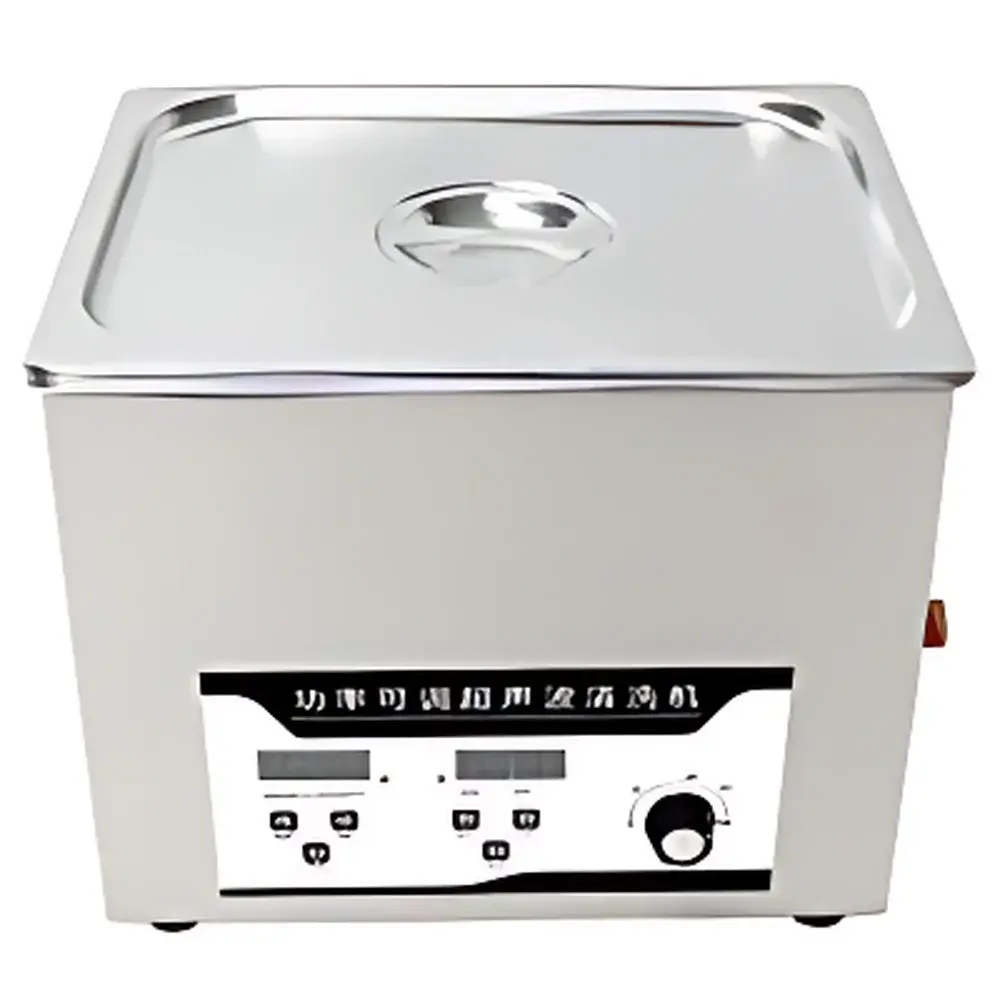
ZiQi ZQ-30DHL 6L Benchtop Digital Ultrasonic Cleaner with Adjustable Power and Heating
| Brand | ZiQi |
|---|---|
| Origin | Shanghai, China |
| Manufacturer Type | Direct Manufacturer |
| Product Category | Domestic |
| Model | ZQ-30DHL (6L Capacity) |
| Instrument Type | General-Purpose |
| Tank Volume | 6 L |
| Ultrasonic Frequency | 40 kHz |
| Ultrasonic Power Range | 70–180 W (Continuously Adjustable) |
| Temperature Control Range | Ambient to 80 °C (Digitally Adjustable) |
| Timer Range | 1–30 min (Digitally Adjustable) |
| Sound-Dampening Lid | Included |
| Drainage | Manual Valve |
Overview
The ZiQi ZQ-30DHL is a benchtop digital ultrasonic cleaner engineered for precision cleaning, degassing, and sample preparation in research laboratories, quality control environments, and industrial R&D settings. It operates on the principle of piezoelectric transduction, generating high-frequency mechanical vibrations at 40 kHz within the cleaning bath. These vibrations produce controlled cavitation—microscopic bubble formation and implosion—in the liquid medium, delivering consistent energy transfer to surfaces and interstitial regions of immersed components. The unit integrates heating and digitally adjustable ultrasonic power, enabling process optimization across diverse applications including solvent-based cleaning of optical components, degassing of HPLC mobile phases, cell lysis in life sciences, and removal of particulate contaminants from precision machined parts. Its 6 L stainless steel tank provides sufficient volume for batch processing of medium-sized parts or multiple small samples while maintaining thermal and acoustic uniformity.
Key Features
- Digitally controlled ultrasonic power output (70–180 W), continuously adjustable via front-panel interface for reproducible energy delivery across cleaning protocols.
- Precise temperature regulation from ambient to 80 °C, with real-time digital display and PID-based heating control to ensure thermal stability during extended cycles.
- Programmable timer (1–30 minutes), with automatic shutdown and audible end-cycle alert for unattended operation compliance with laboratory safety standards.
- Seamless, one-piece drawn stainless steel tank construction eliminates weld seams—reducing corrosion risk, enhancing durability, and facilitating validation of cleaning residue limits (CRL).
- Integrated sound-dampening lid reduces airborne noise to ≤55 dB(A) at 1 m distance, supporting ISO 14040-compliant acoustic management in shared lab spaces.
- Front-panel LED display shows simultaneous real-time values for power level, set temperature, current bath temperature, and remaining time—enabling full operational traceability.
- Manual drain valve located at the tank base allows controlled, spill-free fluid disposal; compatible with standard laboratory floor drain connections.
Sample Compatibility & Compliance
The ZQ-30DHL accommodates a broad range of sample types—including glassware, metal tools, ceramic substrates, printed circuit boards, and biological tissue carriers—without requiring specialized fixtures. Its non-aggressive, non-contact cleaning mechanism preserves surface integrity of delicate optics, microfluidic devices, and coated sensors. The unit meets general electrical safety requirements per IEC 61010-1 and complies with RoHS Directive 2011/65/EU for hazardous substance restrictions. While not certified for medical device reprocessing under ISO 17664 or EN 285, it supports GLP-aligned cleaning validation when used with documented SOPs, calibrated thermometers, and verified ultrasonic intensity mapping (e.g., using aluminum foil erosion test per ASTM E1739). Optional stainless steel mesh baskets (sold separately) facilitate handling of small or fragile items while maintaining cavitation efficiency.
Software & Data Management
The ZQ-30DHL operates as a standalone instrument with no embedded software or network connectivity. All operational parameters are configured and monitored via its integrated digital control panel. For audit readiness in regulated environments (e.g., pharmaceutical QC labs), users may record settings manually in logbooks or integrate the unit into broader electronic lab notebook (ELN) workflows using external data capture tools. Though not 21 CFR Part 11 compliant out-of-the-box, the device supports ALCOA+ principles through consistent parameter logging, operator identification, and timestamped cycle records. Firmware updates are not applicable; hardware revisions follow documented change control procedures issued by ZiQi Manufacturing.
Applications
- Cleaning of analytical instrumentation components (HPLC injectors, GC liners, spectrometer cuvettes) prior to calibration or analysis.
- Degassing of aqueous and organic solvents to eliminate dissolved oxygen that interferes with electrochemical measurements or UV-Vis absorbance baselines.
- Cell disruption and homogenization in preparative biochemistry, particularly for bacterial lysis prior to protein extraction.
- Removal of polishing compounds, flux residues, and oxide films from semiconductor wafers and MEMS devices during fabrication QA.
- Extraction of active compounds from botanical matrices in natural product research, leveraging enhanced mass transfer under controlled thermal-ultrasonic conditions.
- Preparation of colloidal suspensions and nanoparticle dispersions where uniform deagglomeration is critical to downstream characterization (e.g., DLS, TEM).
FAQ
What is the maximum recommended operating temperature for aqueous solutions?
The unit is rated for continuous operation up to 80 °C; however, prolonged use above 60 °C with water-based solutions may accelerate tank oxidation. Use deionized water or low-conductivity solvents for optimal longevity.
Can this unit be used with flammable solvents?
No. The ZQ-30DHL lacks explosion-proof certification and is intended only for aqueous or non-flammable, low-volatility solvents (e.g., isopropanol below flash point, ethanol <10% v/v). Always consult SDS before solvent selection.
Is the ultrasonic power output calibrated or traceable to national standards?
Power is factory-set and stable within ±5% of nominal value; however, the unit does not include NIST-traceable calibration certificates. Users requiring metrological verification should perform periodic intensity mapping using standardized methods such as the calorimetric or chemical dosimetry approach.
Does the drain valve support connection to a fixed waste line?
Yes—the 1/4″ BSP male threaded outlet accepts standard laboratory tubing or quick-connect fittings compatible with PVC or silicone drain lines.
How often should the tank be descaled?
In hard water areas, descaling every 2–4 weeks with a citric acid solution (5% w/v, 40 °C, 15 min soak) is recommended to maintain heating efficiency and prevent nucleation site inhibition on the transducer surface.



