
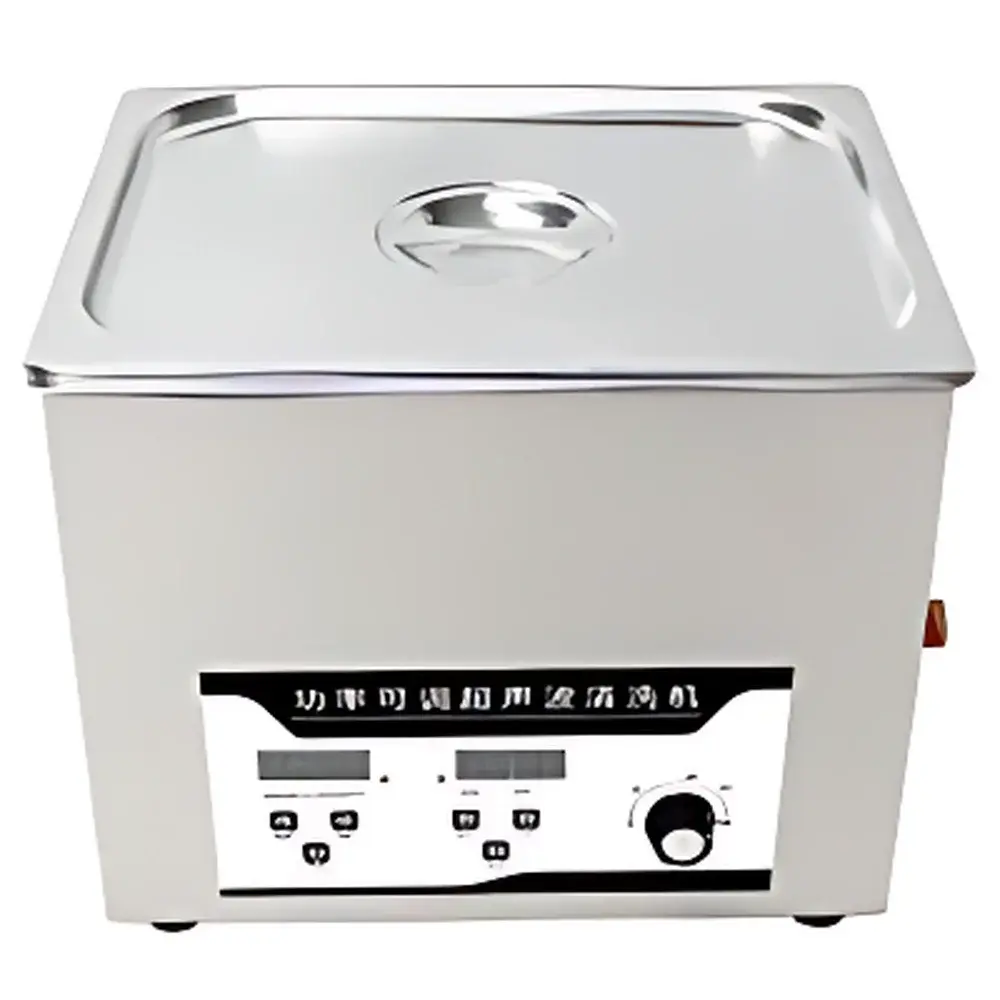
ZiQi ZQ-80DHL 22L Benchtop Digital Ultrasonic Cleaner with Adjustable Power and Heating
| Brand | ZiQi |
|---|---|
| Origin | Shanghai, China |
| Manufacturer Type | Direct Manufacturer |
| Product Category | Domestic |
| Model | ZQ-80DHL 22L |
| Capacity | 22 L |
| Ultrasonic Frequency | 40 kHz |
| Ultrasonic Power Range | 200–480 W (continuously adjustable) |
| Temperature Control Range | Ambient to 80 °C (digitally settable) |
| Timer Range | 1–30 min (digitally settable) |
| Sound-Dampening Lid | Included |
| Drainage | Manual valve |
| Heating Power | 800 W |
| Tank Dimensions (L×W×H) | 500 × 300 × 150 mm |
| Overall Dimensions (L×W×H) | 550 × 330 × 270 mm |
| Net Weight | 13.0 kg |
Overview
The ZiQi ZQ-80DHL is a benchtop digital ultrasonic cleaner engineered for precision cleaning, degassing, emulsification, homogenization, extraction, and cell disruption in laboratory, R&D, and quality control environments. It operates on the principle of high-frequency acoustic cavitation—generated by piezoelectric transducers bonded to the stainless-steel tank bottom—at a fixed frequency of 40 kHz. This frequency delivers optimal balance between cavitation intensity and penetration depth, making it suitable for both delicate components and robust industrial parts. The unit integrates digitally controlled heating (ambient to 80 °C), continuous ultrasonic power adjustment (200–480 W), and programmable timing (1–30 minutes), enabling reproducible, protocol-driven cleaning cycles essential for GLP-compliant workflows and method validation.
Key Features
- Seamless, weld-free stainless-steel tank formed via deep-drawing—eliminates crevices where contaminants or moisture may accumulate, enhancing corrosion resistance and long-term structural integrity.
- Digitally calibrated temperature control with ±1 °C stability across the 0–80 °C range; integrated PT100 sensor ensures accurate thermal feedback and uniform bath heating.
- Continuously variable ultrasonic power output (200–480 W) allows optimization for diverse sample types—from sensitive optical lenses to heavily soiled metal assemblies—without manual hardware modification.
- High-contrast LED display with intuitive membrane keypad enables simultaneous monitoring and setting of time, temperature, and power parameters; all values shown in real-time during operation.
- Included sound-dampening lid reduces airborne noise to ≤55 dB(A) at 1 m distance, meeting occupational safety guidelines for sustained lab use.
- Manual drain valve positioned at the tank base facilitates rapid, residue-free solution exchange—critical when switching between solvents or performing multi-step cleaning protocols.
Sample Compatibility & Compliance
The ZQ-80DHL accommodates a broad spectrum of sample geometries and materials, including glassware (vials, cuvettes, chromatography columns), metallic components (surgical instruments, precision fixtures), ceramic substrates, and polymer-based devices. Its 22 L capacity supports batch processing of large or multiple items without compromising ultrasonic field uniformity. The unit complies with IEC 61000-6-3 (EMC emission standards) and IEC 61000-6-2 (immunity). While not certified for medical device reprocessing per ISO 15883 or EN 285, its operational parameters align with common laboratory cleaning validation requirements referenced in ASTM D4292 (ultrasonic cleaning efficacy testing) and USP <1051> (Cleaning and Sterilization of Laboratory Equipment). Optional stainless-steel baskets (not included) are available for standardized part placement and improved acoustic coupling.
Software & Data Management
The ZQ-80DHL operates as a standalone instrument with no embedded software or network interface. All settings are retained in non-volatile memory after power cycling, ensuring repeatable parameter recall. Though lacking FDA 21 CFR Part 11-compliant audit trails or electronic signature capability, its digital interface supports documented manual entry into laboratory notebooks or LIMS systems. Users may record cycle logs—including date/time stamp, setpoints, and operator ID—using external documentation practices consistent with ISO/IEC 17025 clause 7.7 (control of records) and internal QA procedures for equipment qualification (IQ/OQ).
Applications
- Removal of particulate, organic, and inorganic residues from analytical instrumentation components (e.g., HPLC injectors, GC liners, mass spectrometer ion sources).
- Preparation of homogeneous suspensions for particle size analysis or rheological testing.
- Accelerated solvent extraction of botanical matrices or environmental samples prior to chromatographic analysis.
- Cell lysis and subcellular fractionation in molecular biology workflows requiring controlled, non-thermal disruption.
- De-gassing of viscous solutions (e.g., adhesives, resins, casting media) to eliminate microbubbles prior to curing or molding.
- Surface activation and contaminant removal from substrates prior to coating, plating, or bonding operations.
FAQ
What is the recommended cleaning solution for general laboratory use?
Aqueous alkaline detergents (e.g., Alconox® or Liquinox®) are preferred for most applications. Avoid halogenated solvents unless confirmed compatible with the tank’s 304 stainless-steel construction and sealed electronics.
Can this unit be used for sterilization?
No. Ultrasonic cleaning removes bioburden but does not achieve sterility. It is a pre-sterilization step only; terminal sterilization requires autoclaving, dry heat, or ethylene oxide per ISO 11135/11137.
Is the heating function independent of ultrasonic activation?
Yes. Temperature can be set and maintained without ultrasonic energy—enabling gentle warming of temperature-sensitive solutions prior to sonication.
How often should the transducer performance be verified?
We recommend quarterly verification using an aluminum foil test (ASTM E1759-18) or calibrated hydrophone measurement to confirm consistent cavitation distribution across the tank volume.
Does the unit include overtemperature or dry-run protection?
Yes. An independent thermal cutoff switch disables heating if the tank temperature exceeds 85 °C or if liquid level falls below the minimum fill line, preventing damage to transducers and heater elements.



