
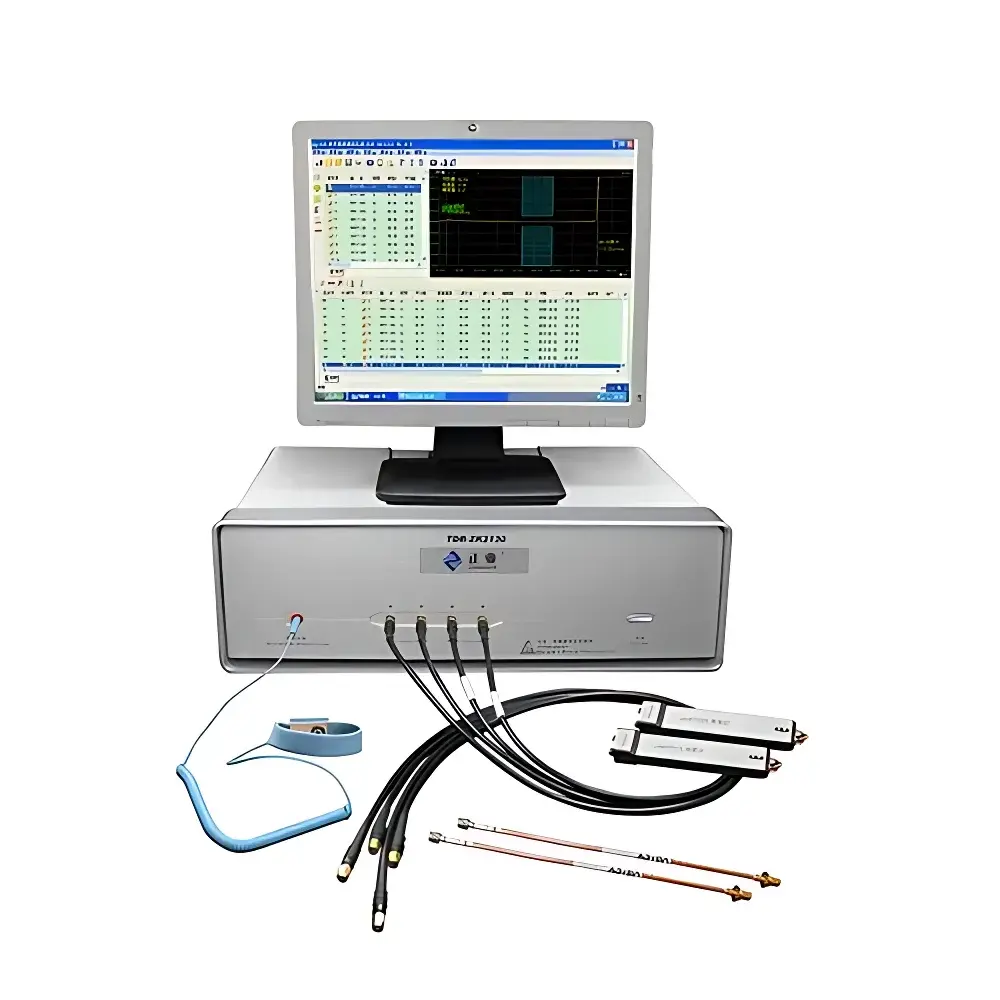
ZK2130 TDR Characteristic Impedance Analyzer for High-Frequency PCBs
| Brand | Zhengye |
|---|---|
| Origin | Guangdong, China |
| Manufacturer Type | OEM/ODM Producer |
| Model | ZK2130 |
| Measurement Range | 20–150 Ω |
| Measurement Length | 0.05–2 m |
| Bandwidth | 3 GHz |
| Accuracy | ±1% at 50 Ω |
| Test Speed | ≤1 s per point |
| Compliance | Designed for IPC-TM-650 2.5.1 and IEC 61189-2 compliant impedance verification |
Overview
The ZK2130 TDR Characteristic Impedance Analyzer is an engineered time-domain reflectometry (TDR) system specifically developed for high-frequency printed circuit board (PCB) manufacturing and quality assurance environments. It operates on the fundamental principle of launching a fast-rising step signal into a transmission line and analyzing the reflected waveform to determine characteristic impedance (Z₀), discontinuity location, and signal integrity anomalies. With a 3 GHz bandwidth and sub-nanosecond edge rise time, the ZK2130 resolves impedance variations with spatial resolution better than 5 cm along trace lengths ranging from 5 cm to 2 meters. Its architecture supports both single-ended and differential pair measurements, making it suitable for evaluating microstrip, stripline, and coplanar waveguide structures in multilayer PCBs, flex-rigid boards, and high-speed interconnects used in 5G infrastructure, automotive ADAS modules, and server backplanes.
Key Features
- High-fidelity TDR core: Integrated 3 GHz bandwidth front-end with <100 ps rise time step generator and synchronized high-resolution sampling (≥50 GS/s equivalent)
- Precision probe interface: Calibrated coaxial launch fixtures and spring-loaded contact probes ensure repeatable DUT connection with minimal loading effect
- Multi-point calibration suite: Supports open-short-load (OSL) and thru-reflect-line (TRL) calibration methods; user-accessible calibration coefficients enable traceable metrology
- Automated workflow engine: One-click multi-location testing across predefined net lists; configurable pass/fail thresholds based on IPC-2152 and IPC-TM-650 2.5.1 standards
- Real-time waveform analytics: Embedded oscilloscope-style display with cursor-based impedance profiling, derivative analysis for discontinuity detection, and delta-Z mapping
- Robust mechanical design: Industrial-grade chassis with EMI-shielded enclosure, fan-cooled thermal management, and vibration-damped base for production-floor deployment
Sample Compatibility & Compliance
The ZK2130 accommodates standard PCB test coupons (IPC-2141A compliant), bare boards with embedded test traces, and terminated cable assemblies (RG-174, SMA-pigtailed coax). It interfaces directly with industry-standard test fixtures including edge-launch, via-in-pad, and differential probe stations. All measurement algorithms adhere to IPC-TM-650 Method 2.5.1 (“Characteristic Impedance of Printed Board Traces Using Time Domain Reflectometry”) and are compatible with ISO/IEC 17025-accredited laboratory workflows. Data export formats include CSV, XML, and PDF reports containing full metadata—timestamp, operator ID, calibration date, fixture ID, and environmental conditions (optional external sensor integration). The system supports audit-ready documentation for GLP/GMP environments when paired with optional 21 CFR Part 11-compliant software modules.
Software & Data Management
The embedded ZK-ControlSuite v3.2 firmware provides intuitive GUI navigation with dual-view mode: real-time waveform + impedance profile overlay. Measurement data is stored locally in SQLite databases with automatic versioning and SHA-256 hash logging. Export functions support SPC-compatible statistical process control files (X-bar/R charts, Cpk/Ppk calculation), as well as direct integration with MES platforms via RESTful API or OPC UA protocol. All report templates comply with IPC-2221 and IPC-2222 documentation requirements, including trace geometry annotations, layer stack-up references, and material property callouts. Calibration history is maintained with digital signatures and timestamped entries accessible only by authorized users.
Applications
- PCB fabrication line QA/QC: In-process impedance verification of inner/outer layer traces pre-lamination and post-etch
- Design validation: Correlation between SI simulation (e.g., HFSS, CST) and physical measurement for high-speed SerDes channels (PCIe 5.0+, USB4, MIPI D-PHY)
- Fabrication process monitoring: Trend analysis of etch uniformity, plating thickness variation, and dielectric constant drift across panel zones
- Cable and connector characterization: Verification of impedance continuity in RF coaxial assemblies, LVDS harnesses, and automotive FAKRA/ZF connectors
- Failure analysis lab use: Locating opens, shorts, solder mask voids, and via stub resonances contributing to return loss degradation
FAQ
What standards does the ZK2130 comply with for PCB impedance testing?
It implements IPC-TM-650 2.5.1 and supports traceable calibration per ISO/IEC 17025 requirements when used with certified reference standards.
Can the ZK2130 measure differential impedance without external baluns?
Yes—the instrument includes integrated differential TDR mode with phase-matched internal signal paths and common-mode rejection optimization.
Is remote operation supported for factory automation integration?
Yes, via Ethernet TCP/IP interface with SCPI command set and Modbus TCP option for PLC synchronization.
How often must the system be recalibrated?
Annual calibration is recommended; however, daily verification using supplied short/open/load standards is advised prior to critical measurements.
Does the software support multi-language UI and report generation?
English and Chinese language packs are included; report templates are fully editable and support localized regulatory footers.



