
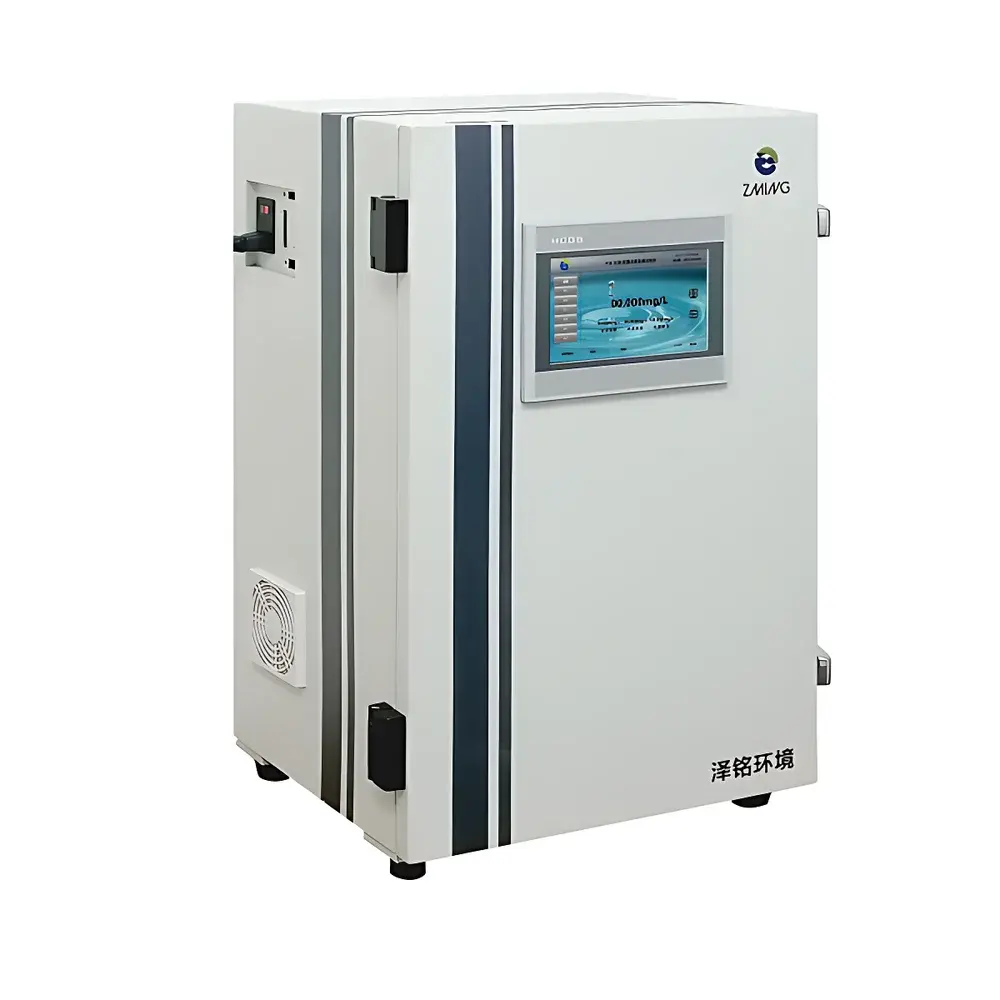
Zming Environmental HQ-3100 Online Ammonia Nitrogen Analyzer
| Brand | Zming Environmental Technology Co., Ltd. |
|---|---|
| Origin | Jiangsu, China |
| Model | HQ-3100 |
| Instrument Type | Online Analyzer |
| Measurement Principle | Colorimetric Method (Nesslerization or Salicylate-based) |
| Measurement Range | 0–2 mg/L and 0–10 mg/L (switchable), extendable up to 500 mg/L |
| Cycle Time | 40 minutes per analysis |
| Optical Design | Dual-beam photometry |
| Sample Handling | Capacitive volumetric dosing |
| Turbidity & Color Compensation | Automatic real-time correction |
| Reagent Shelf Life | Up to 3 months under standard storage conditions |
Overview
The Zming Environmental HQ-3100 Online Ammonia Nitrogen Analyzer is an industrial-grade, fully automated water quality monitoring system engineered for continuous, unattended quantification of ammonia nitrogen (NH₃-N) in natural and anthropogenic aqueous matrices. It operates on a validated colorimetric principle—typically Nesslerization or salicylate reaction—where ammonia nitrogen reacts with reagents to form a stable chromophore, the absorbance of which is measured at a defined wavelength (e.g., 420 nm or 655 nm) using dual-beam photometry. This architecture ensures high optical stability by actively referencing the light source intensity against a reference beam, thereby mitigating drift caused by lamp aging, voltage fluctuation, or ambient electromagnetic interference. Designed for deployment in fixed-site environmental monitoring networks, the HQ-3100 delivers regulatory-grade data integrity for compliance reporting under national surface water quality standards (e.g., China’s GB 3838-2002) and supports long-term trend analysis in dynamic aquatic systems.
Key Features
- Dual-beam optical path design minimizes signal drift and enhances measurement reproducibility across extended operational cycles.
- Capacitive volumetric dispensing system ensures precise, pulse-free delivery of sample and reagents—critical for maintaining stoichiometric accuracy and inter-run repeatability (RSD < 3% at 1 mg/L NH₃-N).
- Integrated turbidity and true-color compensation algorithm dynamically corrects for spectral interference from suspended solids and dissolved organic matter, enabling reliable operation in raw river water (up to 500 NTU) and wastewater effluents without pre-filtration.
- Stabilized reagent formulation—optimized for thermal and hydrolytic resistance—maintains analytical performance over a 90-day shelf life when stored at 4–25°C, reducing maintenance frequency and logistical overhead in remote installations.
- Modular hardware architecture supports hot-swappable reagent cartridges and self-diagnostic routines for pump wear, valve actuation, and photometer baseline validation—facilitating GLP-aligned operational verification.
Sample Compatibility & Compliance
The HQ-3100 is validated for direct analysis of untreated surface water, groundwater, drinking water distribution system samples, municipal and industrial wastewater effluents, and aquaculture recirculation streams. It accommodates inlet pressures from 0.1 to 0.6 MPa and tolerates particulate loadings ≤ 100 µm without clogging, provided optional 80-µm pre-filtration is deployed in high-sediment environments. The analyzer meets IEC 61326-1 (EMC for laboratory and industrial use) and IP65-rated enclosure specifications for outdoor cabinet integration. While not certified to ISO/IEC 17025 as a standalone testing laboratory, its measurement traceability aligns with ISO 14911 (water quality — determination of ammonium — spectrometric method) and supports data audit trails compliant with local environmental monitoring protocols requiring instrument calibration logs, reagent lot tracking, and measurement metadata (timestamp, temperature, pressure, fault flags).
Software & Data Management
The embedded firmware provides configurable measurement scheduling (e.g., hourly, bi-hourly, or event-triggered via Modbus RTU/TCP), automatic zero/span verification every 24 hours, and onboard storage of ≥ 30 days of minute-resolution process data. Communication interfaces include RS-485 (Modbus RTU), Ethernet (TCP/IP), and optional 4–20 mA analog output for SCADA integration. Remote access is enabled via secure HTTP(S) web interface supporting role-based user permissions (operator, technician, administrator). All measurement events—including calibration actions, reagent depletion alerts, and error codes—are time-stamped and logged with immutable records, satisfying basic requirements for electronic record retention under China’s HJ 212-2017 data transmission standard. Audit trail export is supported in CSV format with SHA-256 hash integrity verification.
Applications
- Real-time surveillance of ammonia nitrogen concentrations at national surface water quality monitoring stations (e.g., Yangtze River Basin, Pearl River Delta).
- Compliance monitoring of discharge permits for textile, pharmaceutical, and food processing facilities subject to NH₃-N effluent limits.
- Early-warning detection in urban river restoration projects, particularly where nitrification inhibition or seasonal algal bloom dynamics are linked to ammonia loading.
- Performance verification of tertiary treatment units (e.g., MBR, BAF, or constructed wetlands) by tracking influent-effluent NH₃-N gradients across multiple sampling points.
- Supporting nutrient budget modeling in inter-basin water transfer corridors—such as the South-to-North Water Diversion Project—by delivering spatially resolved, time-synchronized datasets across cascade monitoring sections.
FAQ
What is the minimum detectable concentration (MDC) for ammonia nitrogen using the HQ-3100?
The system achieves an MDC of ≤ 0.02 mg/L under standard operating conditions (0–2 mg/L range), determined per ISO 11885 Annex A using blank standard deviation and calibration slope.
Does the HQ-3100 require daily manual intervention?
No—once commissioned and loaded with reagents, it operates autonomously for up to 90 days; routine tasks (e.g., tubing replacement, optical window cleaning) are scheduled at 30-day intervals.
Can the analyzer be integrated into an existing PLC-based SCADA system?
Yes—native Modbus RTU/TCP support enables seamless read/write communication for setpoint adjustment, alarm acknowledgment, and diagnostic status polling.
Is the colorimetric chemistry compliant with international standard methods?
The core reaction pathway conforms to the principles of ISO 14911 and ASTM D1426-15 (Standard Test Methods for Nitrogen in Water), with method-specific validation documentation available upon request.
How is calibration performed and how often is it required?
Calibration uses certified NH₄Cl standard solutions traceable to NIM (National Institute of Metrology, China); initial 3-point calibration is recommended at commissioning, followed by automated span verification every 24 hours and full recalibration every 7 days or after reagent change.







