
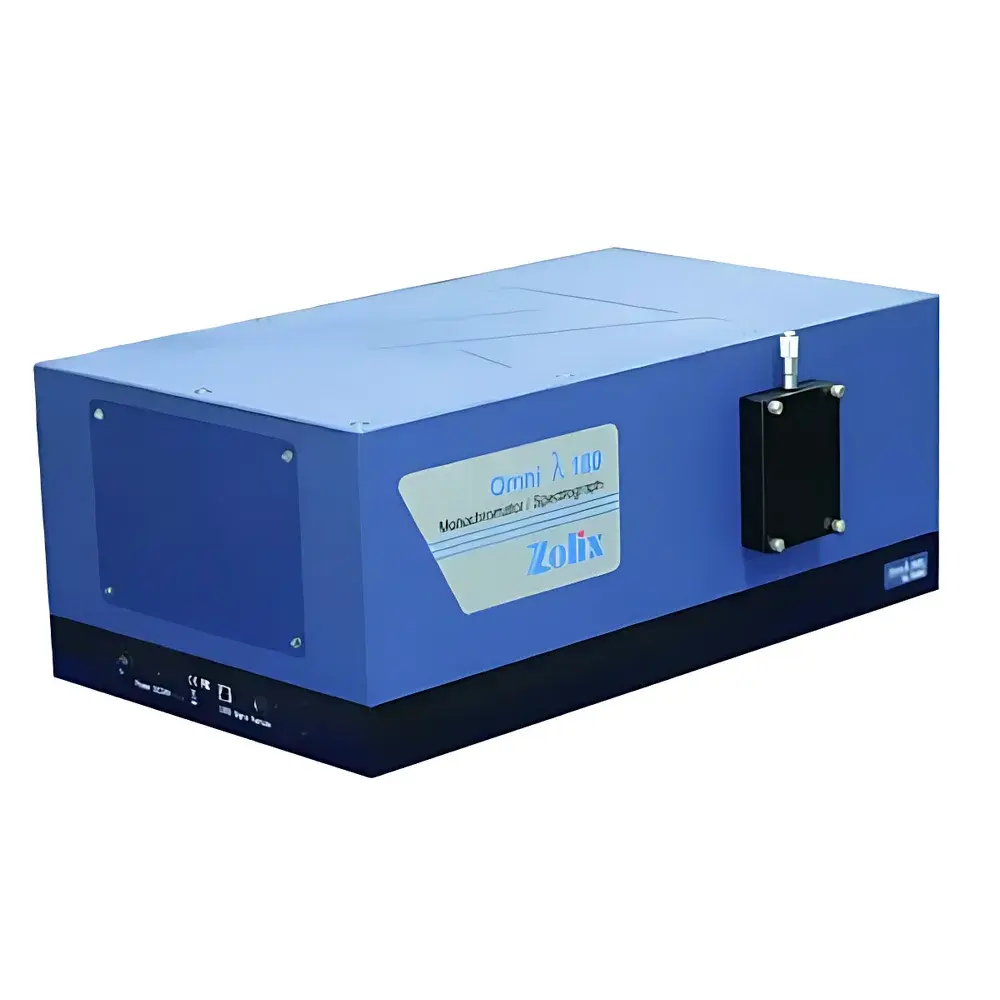
ZOLIX Omni-λ180D Dual-Stage Monochromator
| Brand | ZOLIX |
|---|---|
| Origin | Beijing, China |
| Manufacturer Type | Original Equipment Manufacturer (OEM) |
| Product Type | Domestic |
| Model | Omni-λ180D |
| Price Range | USD 1,400 – 7,000 |
| Application Systems | Transmission & Reflection Spectroscopy |
| Grating Configuration | Dual-grating turret |
| Spectral Resolution | 0.25 nm (at 1200 g/mm grating) |
| Dispersion | 3.7 nm/mm (linear dispersion, at 1200 g/mm grating) |
| Wavelength Range | 190–1100 nm (dependent on grating selection) |
| F-number | F/3.9 |
| Wavelength Accuracy | ±0.2 nm |
| Wavelength Repeatability | ±0.1 nm |
| Stray Light Level | <1×10⁻⁹ |
Overview
The ZOLIX Omni-λ180D is a dual-stage monochromator engineered for high-fidelity spectral isolation in demanding optical measurement environments. Operating on the principle of subtractive dispersion—where two serially aligned Czerny-Turner monochromators are optically matched to cancel out non-dispersed stray light paths—the Omni-λ180D achieves exceptional spectral purity. This architecture ensures that only photons following the nominal optical path undergo constructive recombination at the exit slit, while off-axis and scattered radiation is suppressed through destructive interference across both stages. With a focal length of 180 mm and an f/3.9 aperture, the instrument balances throughput efficiency with spatial resolution, making it particularly suitable for low-signal applications such as Raman spectroscopy, detector spectral responsivity calibration, and tunable monochromatic source construction.
Key Features
- Subtractive dispersion design optimized for ultra-low stray light (<1×10⁻⁹), critical for weak-signal detection in UV–VIS–NIR regimes
- Dual-grating turret enabling rapid, software-controlled switching between gratings (e.g., 300, 600, 1200, or 2400 g/mm) to support broad spectral coverage from 190 nm to 1100 nm
- Integrated USB 2.0 interface for full remote control—including wavelength scanning, grating selection, and entrance/exit slit width adjustment (0.01–3 mm range)
- Monolithic mechanical housing minimizing alignment drift and enhancing transport stability; no field realignment required after relocation
- High wavelength repeatability (±0.1 nm) and accuracy (±0.2 nm) validated against NIST-traceable spectral line sources
- Optimized optical train with fused silica substrates and enhanced aluminum coatings for >85% average reflectance across 190–900 nm
Sample Compatibility & Compliance
The Omni-λ180D is compatible with standard optical bench configurations and integrates seamlessly into OEM systems requiring calibrated monochromatic output. It supports fiber-coupled, free-space, and collimated input geometries, and is routinely deployed in setups involving halogen-deuterium white-light sources, motorized filter wheels, and lock-in-amplified photodetectors. From a regulatory standpoint, its deterministic wavelength positioning and audit-ready parameter logging (via ZOLIX’s proprietary software suite) align with GLP-compliant workflows. While not certified per se, its performance metrics meet typical requirements referenced in ASTM E275, ISO 13406-2 (for detector calibration traceability), and IEC 61000-4-3 (EMC immunity for lab instrumentation). All firmware and motion control logic comply with IEC 61508 functional safety principles for industrial-grade optical controllers.
Software & Data Management
Control is executed via ZOLIX’s cross-platform SpectraMaster™ software (Windows/macOS/Linux), which provides scripting interfaces (Python API, LabVIEW VIs) for integration into automated test benches. The software logs all operational parameters—including grating ID, slit positions, motor encoder counts, and timestamped wavelength commands—with optional export to HDF5 or CSV formats. Audit trails include user authentication, session start/end timestamps, and change history for calibration coefficients. For regulated environments, optional 21 CFR Part 11 compliance packages are available, featuring electronic signatures, role-based access control, and immutable log archiving. Firmware updates preserve backward compatibility and include built-in self-diagnostic routines for encoder synchronization and grating homing verification.
Applications
- Tunable monochromatic light sources: Paired with broadband lamps, the Omni-λ180D delivers spectrally pure output for LED/LD characterization, thin-film transmittance mapping, and photochemical reaction studies
- Raman spectroscopy: Functions as a high-rejection bandpass filter to isolate Stokes/anti-Stokes signals, especially effective below 200 cm⁻¹ where laser line rejection demands sub-10⁻⁹ stray light suppression
- Detector calibration: Enables NIST-traceable spectral responsivity measurements across UV (190–250 nm), visible (380–780 nm), and NIR (780–1100 nm) bands with minimized uncertainty contributions from out-of-band irradiance
- Fluorescence excitation profiling: Provides narrowband excitation (FWHM ≤ 0.3 nm) for lifetime-resolved and quantum yield measurements without secondary excitation artifacts
- Optical component testing: Used in metrology labs for measuring coating reflectance/transmittance uniformity, grating efficiency maps, and polarization-dependent loss (PDL)
FAQ
What gratings are supported by the Omni-λ180D?
Standard configurations include 300, 600, 1200, and 2400 grooves/mm blazed gratings optimized for UV, VIS, or NIR regions. Custom ruled or holographic gratings can be installed upon request.
Can the Omni-λ180D be integrated into vacuum or purged environments?
Yes—the base housing is sealed and compatible with dry nitrogen purging; optional UHV-compatible versions (CF flanged, stainless steel body) are available for synchrotron or plasma diagnostics use.
Is external triggering supported for synchronized data acquisition?
Yes—TTL-compatible trigger I/O ports allow hardware synchronization with CCD/CMOS detectors, choppers, or pulsed lasers at rates up to 10 kHz.
How is wavelength calibration performed and maintained?
Factory calibration uses Hg/Ar/Ne spectral lines; users may perform recalibration using any known emission source. Calibration coefficients are stored per grating and persist across power cycles.
Does the system support motorized entrance and exit slits?
Yes—both slits are independently motorized with 0.01 mm resolution and programmable presets for rapid method switching.






