
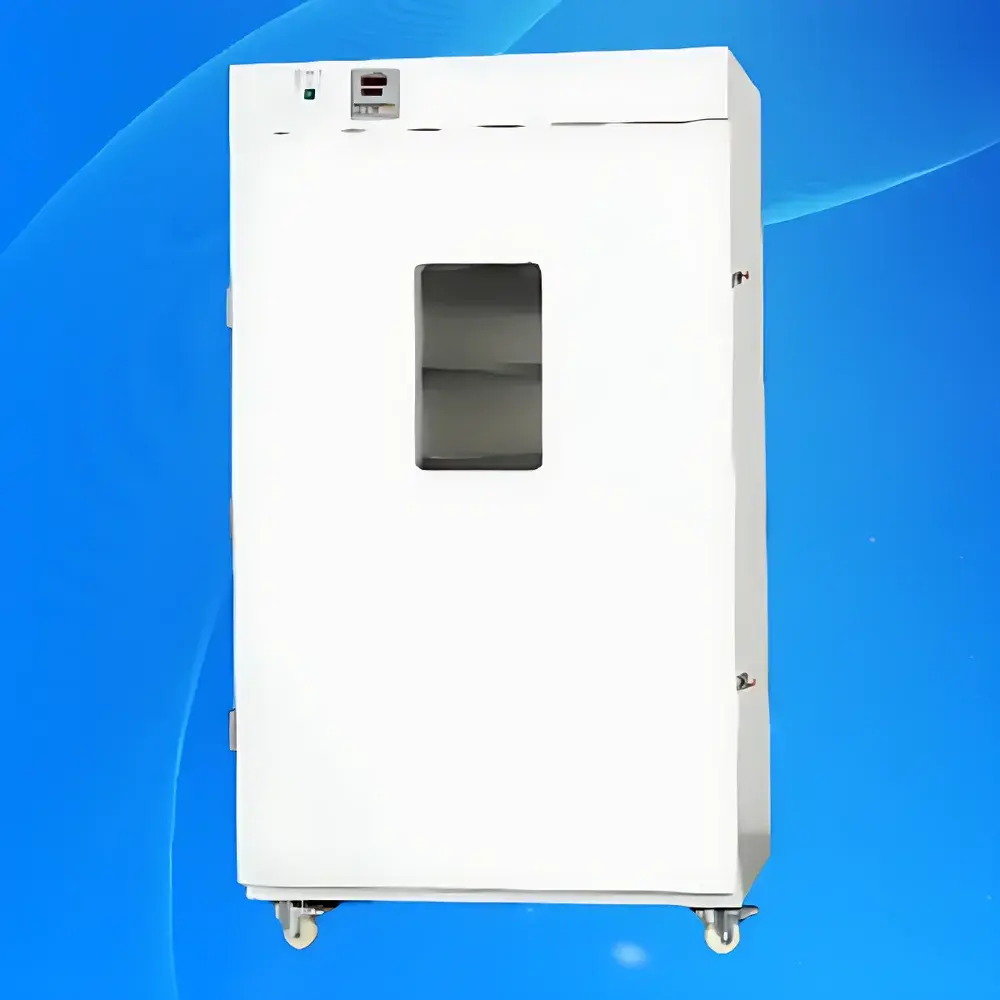
Zuofei DHG-9426A Forced-Air Constant-Temperature Drying Oven
| Brand | Zuofei |
|---|---|
| Origin | Shanghai, China |
| Manufacturer Type | Direct Manufacturer |
| Product Category | Domestic |
| Model | DHG-9426A |
| Instrument Type | High-Temperature Forced-Air Oven |
| Temperature Range | RT+10 °C to 300 °C |
| Temperature Fluctuation | ±1.0 °C |
| External Dimensions (W×D×H) | 81×68×177 cm |
| Internal Dimensions (W×D×H) | 60×55×130 cm |
| Temperature Resolution | 0.1 °C |
| Operating Ambient Temperature | +5 °C to +40 °C |
| Interior Material | Mirror-Finish Stainless Steel |
| Heating Method | Rear-Mounted Stainless Steel Electric Heating Elements |
| Temperature Uniformity | ±3% (at 100 °C test point) |
Overview
The Zuofei DHG-9426A is a precision-engineered forced-air constant-temperature drying oven designed for demanding laboratory and industrial applications requiring reliable thermal processing across a wide operational range (RT+10 °C to 300 °C). Built upon a robust architectural foundation, the unit employs a rear-mounted stainless steel heating system coupled with a high-efficiency axial fan and optimized airflow ducting to ensure consistent convective heat transfer throughout the chamber. Its mirror-finish stainless steel interior resists corrosion, facilitates cleaning, and maintains long-term dimensional stability under repeated thermal cycling. The oven operates on standard 220 V/50 Hz power and delivers 3500 W of heating capacity—sufficient for rapid warm-up, stable dwell conditions, and uniform thermal distribution in a 225 L working volume. Unlike natural-convection ovens, the DHG-9426A’s forced-air design actively circulates heated air, minimizing thermal stratification and enabling reproducible drying, baking, sterilization, and thermal aging protocols in accordance with ISO 17025-compliant laboratory practices.
Key Features
- Microprocessor-based P.I.D. temperature controller with dual-line digital display, offering precise setpoint control and real-time deviation monitoring
- Programmable timer (1–9999 minutes) with auto-shutdown functionality and power-loss recovery to preserve process integrity after interruption
- Over-temperature deviation protection with audible alarm—prevents uncontrolled thermal excursions during operation
- High-transparency double-layer tempered glass observation window for non-intrusive visual monitoring of samples
- Triple-sealed door using high-temperature silicone gasket material rated for continuous service up to 300 °C
- Modular rear-heating configuration with stainless steel sheathed heating elements ensuring mechanical durability and electrical safety
- Optional configurable upgrades including independent over-temperature cut-off circuitry, RS485 communication interface, and multi-segment programmable touch-screen controller
Sample Compatibility & Compliance
The DHG-9426A accommodates a broad spectrum of sample types—including glassware, metal components, polymer specimens, pharmaceutical excipients, and biological substrates—without compromising thermal fidelity or chamber integrity. Its 60×55×130 cm internal cavity supports up to six adjustable stainless steel shelving levels (standard configuration includes three), permitting flexible load arrangements while maintaining airflow continuity. All materials in contact with the chamber interior conform to RoHS Directive 2011/65/EU restrictions on hazardous substances. While not certified to UL or CSA standards out-of-the-box, the unit meets general safety requirements outlined in IEC 61010-1:2010 for electrical equipment used in laboratory environments. Optional configurations support integration into GLP/GMP workflows via audit-trail-capable data logging (when paired with RS485-enabled controllers) and are compatible with FDA 21 CFR Part 11–compliant software platforms when external validation is performed.
Software & Data Management
The base model features embedded firmware supporting local parameter setting and real-time temperature tracking. For advanced data governance, optional accessories include an RS485 serial interface enabling connection to external PCs running compliant SCADA or LIMS systems. When equipped with the optional multi-segment programmable controller, users gain access to full thermal profile programming—including ramp rates, hold durations, soak temperatures, and automatic start/stop scheduling—with built-in temperature curve visualization and CSV-exportable log files. All recorded datasets retain timestamped metadata, supporting traceability requirements in regulated environments. The controller firmware implements cyclic redundancy check (CRC) validation on stored parameters and enforces write-protection for critical calibration constants.
Applications
- Drying moisture-sensitive powders, granules, and filter cakes in QC/QA laboratories per USP & Ph. Eur. general chapters on loss on drying (LOD)
- Baking ceramic precursors and sintering aids prior to high-temperature firing cycles
- Thermal conditioning of electronic assemblies and PCB substrates before environmental stress screening
- Accelerated aging studies of elastomers and thermoplastics per ASTM D573 and ISO 188
- Melting point determination of waxes and low-melting-point polymers using standardized isothermal holds
- Pre-sterilization drying of surgical instruments and glassware in hospital central supply departments
- Residual solvent removal from coated films and thin-film photovoltaic layers
FAQ
What is the maximum operating temperature of the DHG-9426A?
The unit is rated for continuous operation at temperatures up to 300 °C, with full thermal stability and uniformity performance validated at this upper limit.
Does the oven meet international electromagnetic compatibility (EMC) standards?
It complies with EN 61326-1:2013 for EMC in laboratory environments; CE marking is available upon request with full technical documentation package.
Can the temperature uniformity be improved beyond ±3% at 100 °C?
Yes—optional auxiliary heating elements can be installed to achieve ≤±2 °C uniformity at 150 °C, as verified by calibrated PT100 sensor mapping per ISO 17025 procedures.
Is remote monitoring supported without additional hardware?
No—the base unit lacks network connectivity; RS485 interface or Ethernet gateway modules must be added for remote supervision and alarm notification.
What maintenance intervals are recommended for optimal performance?
Fan lubrication and gasket inspection should occur every 6 months; heating element resistance verification and PID calibration are advised annually or after 2000 operational hours.



